
Why is it important to understand the earth system?
Earth and Atmospheric Sciences
Weathering and erosion are two distinct geological processes that work together to reshape the Earth’s surface.1 A simple way to remember the difference is: weathering breaks it, and erosion takes it.2
1. Weathering: The “Breaker”
Weathering is the process of breaking down rocks, soil, and minerals into smaller pieces without moving them.3 It happens “in place” (in situ) due to contact with the atmosphere, water, and biological organisms.
There are three main types of weathering:4
- Physical (Mechanical) Weathering: The rock is physically broken into smaller fragments without changing its chemical composition.5
- Example: Frost wedging, where water enters a crack, freezes, expands, and splits the rock.6
- Chemical Weathering: The internal structure of a mineral is altered by the removal and/or addition of elements.7
- Example: Oxidation (rusting) or Acid Rain dissolving limestone.8
- Biological Weathering: Living things contribute to the breakdown.9
- Example: Tree roots growing into a crevice and prying the rock apart.10
2. Erosion: The “Mover”
Erosion is the process by which those weathered particles are picked up and transported to a new location.11 Unlike weathering, erosion always involves movement.12
The primary agents of erosion include:
- Water: The most powerful agent. Rainfall, rivers, and ocean waves carry away sediment.13
- Wind: Blows loose sand and dust from one place to another, often polishing rocks in the process.14
- Ice (Glaciers): Massive sheets of ice act like giant sandpaper, grinding and carrying away everything from tiny pebbles to massive boulders.
- Gravity: Causes rocks and soil to move downhill (e.g., landslides or “creep”).
Summary Comparison
| Feature | Weathering | Erosion |
| Action | Breaks down or dissolves rock. | Moves or transports rock. |
| Location | Stays in the same spot. | Moves to a different spot. |
| Key Agents | Temperature, water, acids, plants. | Water, wind, ice, gravity.15 |
Difference between Weathering and Erosion
This video provides a clear, visual explanation of how weathering weakens and breaks rock while erosion acts as the transport system that carries it away.
What are the geologic factors that control weathering?
Weathering is controlled by several key geologic and environmental factors that determine how quickly and effectively rocks break down. According to the video, these factors include:
1. Rock Type and Mineral Composition
Different rocks have unique characteristics that influence how they decay.
- Mineral Stability: Rocks formed under high temperatures and pressures deep in the Earth (like igneous rocks) often become unstable when exposed to the lower temperatures and pressures at the surface.
- Solubility: Certain rocks, like limestone, are highly susceptible to chemical weathering (specifically carbonation) because their primary mineral, calcite, reacts easily with carbonic acid in rainwater.
2. Physical Structure (Surface Area)
- Fragmented Material: Mechanical weathering breaks solid rock into smaller fragments (regolith). This process increases the total surface area available for chemical agents (like water and oxygen) to act upon, accelerating the overall rate of decay.
- Pores and Fractures: Water and ice can enter pores and cracks in the rock. For example, during frost action, water freezes in these spaces, expands by 9%, and exerts enough pressure to break the rock apart.
3. Climate (Temperature and Moisture)
Climate is one of the most significant external factors:
- Moisture: Water is the “universal solvent” and is essential for most chemical weathering processes. Humid climates see much higher rates of carbonation and oxidation.
- Temperature: In cold environments, freeze-thaw cycles drive mechanical weathering through frost action. In warmer environments, chemical reactions generally occur more rapidly.
4. Biological Activity
Living organisms contribute to biological weathering:
- Plants: Tree roots can grow into rock crevices, exerting massive pressure that prying the rock apart.
- Microorganisms: Bacteria, algae, fungi, and lichens can chemically alter minerals. For instance, lichens can leave dark stains that absorb more thermal radiation, further encouraging weathering.
5. Time and Exposure
- Exposure to Agents: Weathering occurs where rock meets the atmosphere, water, and organisms. Processes like unloading (when overlying rock is removed) expose new rock to these surface elements.
- Topography: The slope of the land affects how long weathered material stays in place (the “weathered mantle”) versus being moved by gravity or erosion to expose fresh rock underneath..
What is chemical weathering?
Chemical weathering is the process by which the internal structure of a mineral is altered by the removal and/or addition of elements.1 Unlike physical weathering, which simply breaks rocks into smaller pieces, chemical weathering transforms the original material into a completely different substance.2
This process is most effective in warm, humid climates because water and heat are the primary catalysts for chemical reactions.3
The Big Three Processes
Most chemical weathering occurs through one of these three reactions:
1. Oxidation (The “Ruster”)4
This happens when oxygen reacts with minerals, especially those containing iron.5 The most common result is iron oxide (rust).6
- How it works: Oxygen in the air or water reacts with iron in the rock, turning the rock reddish-brown and making it much softer and more brittle.7
- Result: The rock crumbles easily.8 This is why the soil in places like Georgia or the surface of Mars is red.9
2. Carbonation (The “Dissolver”)10
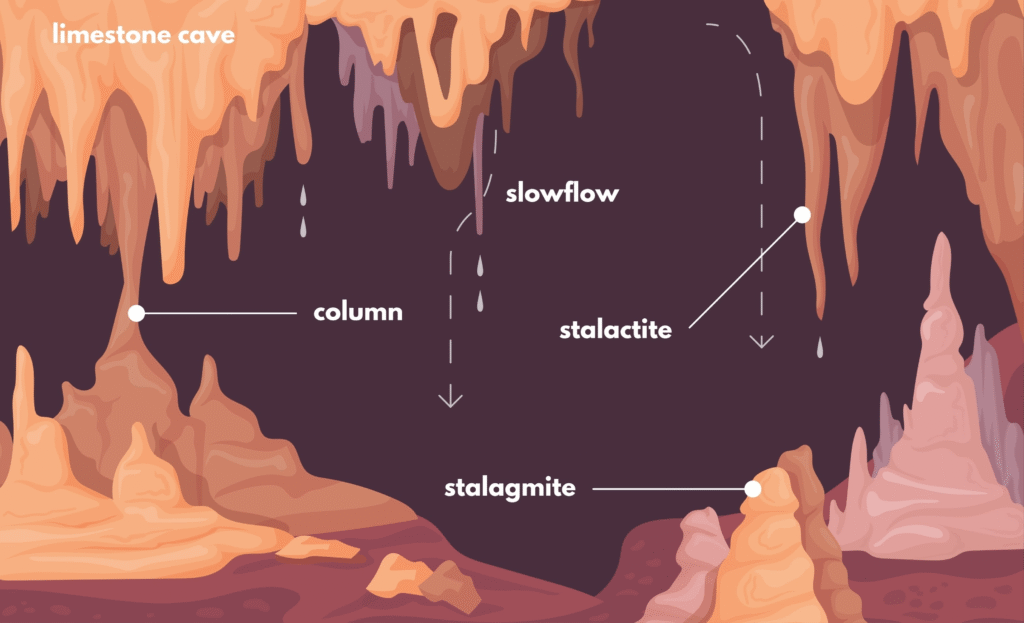
This occurs when carbon dioxide (11CO2) dissolves in rainwater to create a weak carbonic acid (12H2CO3).13
- How it works: As this slightly acidic rain falls or seeps into the ground, it reacts with calcium carbonate in rocks like limestone or marble.14
- Result: Over thousands of years, the acid eats away at the rock, creating massive underground caves, sinkholes, and unique “karst” landscapes.
3. Hydrolysis (The “Transformer”)15
Hydrolysis is the chemical breakdown of a substance when combined with water.16
- How it works: Water molecules directly react with silicate minerals (like feldspar found in granite).17 The hydrogen ions in the water replace other ions in the mineral’s structure.18
- Result: Hard minerals like feldspar are transformed into soft, powdery clay.19 This is why old granite gravestones eventually become blurry and rounded.
Why does it matter?
- Soil Formation: Chemical weathering is the “starting gun” for life; it breaks down hard rock into the fine minerals and clays that make up fertile soil.20
- Carbon Cycling: When rocks undergo carbonation, they actually “trap” carbon dioxide from the atmosphere, helping to regulate the Earth’s climate over millions of years.
- Structural Damage: It is the primary reason why ancient monuments and buildings (like the Parthenon) show signs of “melting” or decay over time.
What is physical weathering?
Physical weathering (also known as mechanical weathering) is the process of breaking rocks into smaller fragments through physical force without changing their chemical makeup. Think of it like smashing a rock with a hammer: the pieces are smaller, but they are still the exact same type of rock.
By breaking large rocks into smaller pieces, physical weathering increases the surface area available for chemical weathering to act upon, which accelerates the overall decay of the landscape.
Primary Types of Physical Weathering
1. Frost Wedging (Freeze-Thaw)
This is the most common form of physical weathering in cold or mountainous climates.
- How it works: Water seeps into cracks in a rock. When it freezes, it expands by approximately 9%. This expansion exerts massive pressure (up to 30,000 psi) against the walls of the crack.
- Result: Repeated freezing and thawing acts like a lever, eventually prying the rock apart.
2. Exfoliation (Unloading)
This typically happens to rocks like granite that form deep underground under intense pressure.
- How it works: As the overlying rock is eroded away, the pressure on the granite is released. The rock expands upward, causing the outer layers to crack and peel off in sheets, much like the layers of an onion.
- Result: This creates rounded, dome-shaped landforms, such as Half Dome in Yosemite National Park.
3. Thermal Expansion
This occurs in environments with extreme temperature swings, like deserts.
- How it works: During the day, the sun heats the outer layer of a rock, causing it to expand. At night, the temperature drops and the rock contracts.
- Result: Because different minerals in the rock expand and contract at different rates, the internal stress eventually causes the rock to fracture and crumble.
4. Biological Activity (Root Wedging)
Living organisms can exert significant physical force on rocks.
- How it works: Seeds fall into small crevices and begin to grow. As a tree’s roots thicken, they act as a wedge, forcing the crack to widen.
- Result: Large boulders can be split entirely in half by a single tree over several decades.
5. Abrasion
This is the “sandpaper” effect of nature.
- How it works: Wind, water, or glaciers carry small particles of rock and sand. As these particles collide with larger rock surfaces, they wear them down.
- Result: River rocks become smooth and rounded, and wind can carve bizarre “mushroom rocks” in desert regions.
Where does it happen most?
Physical weathering is most dominant in cold climates (due to frost wedging) and dry, arid climates (due to thermal expansion and wind abrasion). In contrast, chemical weathering thrives in hot, wet tropical environments.
Would you like to explore how these physical processes contribute to the formation of soil?
Physical and Chemical Weathering
This video provides a clear visual comparison between physical and chemical weathering, illustrating how environmental factors like temperature and pressure physically fracture rock surfaces.
How does the residue of weathering produce soil?
The residue left behind by weathering forms the foundation of soil through a process called pedogenesis. It is essentially the bridge between the rocky interior of the Earth and the living world on its surface.
Soil is not just “dirt”; it is a complex mixture of minerals (about 45%), organic matter (5%), and pore spaces filled with air and water (50%).
1. The Creation of Parent Material
The “residue” you mention is known geologically as regolith—the layer of loose, fragmented rock and mineral material that covers solid bedrock.
- Physical weathering breaks the bedrock into smaller sediments like sand and silt.
- Chemical weathering transforms hard minerals (like feldspar) into soft clay minerals and releases dissolved ions (like calcium and potassium) into the ground.
2. The Integration of Life (Biological Activity)
Weathering products alone are just sediment. To become soil, they must interact with the biosphere:
- Pioneer Species: Lichens and mosses begin growing on weathered fragments, further breaking them down with organic acids.
- Humus Formation: When plants and animals die, their remains are decomposed by bacteria and fungi into humus—a dark, organic-rich substance.
- Mixing: Earthworms, insects, and burrowing animals mix this organic humus with the mineral residue from weathering.
3. The Development of Horizons
Over hundreds to thousands of years, water percolating downward through the weathered residue carries fine clay particles and dissolved nutrients from the surface to deeper layers. This “washing” process (leaching) creates distinct layers called soil horizons:
- O Horizon: The organic layer (leaf litter).
- A Horizon (Topsoil): A mix of mineral residue and humus.
- B Horizon (Subsoil): Where leached minerals and clays accumulate.
- C Horizon: The partially weathered parent material (the pure “residue” of weathering).
Factors that Control This Process
The speed and quality of the soil produced from weathering residue depend on the CLORPT formula:
- CLimate (Temperature and moisture speed up chemical weathering).
- Organisms (Biology adds the necessary organic content).
- Relief (Topography—steep slopes lose soil to erosion too fast).
- Parent Material (What kind of rock the residue came from).
- Time (It can take 500+ years to form just one inch of topsoil).
How does weathering make the raw material of sediment?
Weathering is the “factory” that produces the raw materials for all sedimentary rocks. It transforms solid, immovable bedrock into two distinct types of “pre-sediment”: solid fragments (detritus) and dissolved chemicals (ions).1
1. Creating Solid Fragments (Clastic Sediment)
Mechanical weathering acts like a hammer and chisel, physically prying the rock apart.2
- Fragmentation: Processes like frost wedging or root growth break a single large boulder into thousands of smaller pieces of the same material.
- Size Sorting: These fragments are classified by size into the “ingredients” of future rocks:3
- Gravel: Boulders, cobbles, and pebbles.4
- Sand: Medium-sized grains (mostly quartz).5
- Silt and Clay: The finest particles (mud).6
2. Creating New Minerals (Chemical Residue)
Chemical weathering doesn’t just break the rock; it changes it into something new.7
- Feldspar to Clay: One of the most important reactions in geology is the transformation of feldspar (a common hard mineral in granite) into clay minerals via hydrolysis.8
- Quartz Persistence: Because quartz is chemically very stable, it doesn’t turn into clay. It simply falls out of the rock as individual sand grains. This is why most beaches are made of quartz sand—it is the “survivor” of the weathering process.
3. Creating “Invisible” Sediment (Dissolved Ions)9
Not all sediment is solid. Chemical weathering dissolves parts of the rock into the water supply.10
- The Process: As water reacts with minerals, it carries away atoms in the form of dissolved ions (like calcium, sodium, and potassium).11
- The Result: These ions travel in rivers and eventually reach the ocean.12 This is the raw material for chemical sedimentary rocks like limestone (formed when ions precipitate out) or rock salt (formed when the water evaporates).13
Summary: The “Granite Example”
When a piece of granite (made of quartz, feldspar, and mica) weathers, it produces a specific “kit” of raw materials:
| Original Mineral | Weathering Process | Raw Material Created | Resulting Landscape |
| Quartz | Mechanical | Solid Sand Grains | Sandy Beaches |
| Feldspar | Chemical (Hydrolysis) | Clay Minerals | Muddy River Banks |
| Various | Chemical (Dissolution) | Dissolved Ions (Ca2+, Na+) | Salty Oceans |
Solved Problems
Section 1: The Mechanics of Weathering
1. Q: Why does physical weathering speed up the rate of chemical weathering?
A: Physical weathering breaks rock into smaller fragments, which vastly increases the total surface area exposed to the atmosphere. Since chemical reactions occur on the surface of the rock, more surface area means more “attack sites” for water and acids.
2. Q: In a graveyard with 200-year-old headstones, why is the marble text unreadable while the granite text is still sharp?
A: Mineral composition. Marble is made of calcite, which reacts readily with weak acids in rainwater (carbonation). Granite is composed of quartz and feldspar, which are much more chemically stable and resistant to acid rain.
3. Q: Why is frost wedging more effective in the mountains of Colorado than in the extremely cold Arctic?
A: Frost wedging requires freeze-thaw cycles. Colorado experiences frequent temperature swings above and below freezing. In the high Arctic, the water stays frozen year-round, meaning it doesn’t melt and flow back into cracks to repeat the expansion process.
4. Q: How does “unloading” lead to the formation of exfoliation domes like Half Dome?
A: Granite forms under immense pressure deep underground. When erosion removes the overlying rock, the pressure is released, and the granite expands upward. This expansion causes the rock to fracture in sheets parallel to the surface, which then peel off.
5. Q: What is the role of the “Hydrogen Ion” in the weathering of feldspar?
A: In the process of hydrolysis, hydrogen ions from water replace the potassium or sodium ions in the feldspar’s crystal lattice, fundamentally changing its chemical structure into a soft clay mineral called kaolinite.
Section 2: Soil and Sediment Production
6. Q: Why does tropical weathering produce deep but nutrient-poor soils (Laterites)?
A: High heat and heavy rainfall accelerate chemical weathering, creating very thick layers of soil. However, the heavy rain also causes leaching, where nutrients like potassium and calcium are washed away, leaving behind only insoluble iron and aluminum oxides.
7. Q: If quartz is the most common mineral on beaches, what happened to all the other minerals from the original rock?
A: Most other minerals (like feldspar and mica) are chemically unstable at the Earth’s surface and weather into clay or dissolve into ions. Quartz is chemically inert and hard, so it survives the journey from the mountains to the coast as sand.
8. Q: How does biological activity act as both a physical and chemical weathering agent?
A: Physically, tree roots grow into cracks and pry them apart (root wedging). Chemically, organisms like lichens and bacteria secrete organic acids that dissolve the minerals in the rock they are attached to.
9. Q: Why is the “C-Horizon” of a soil profile considered the link between geology and biology?
A: The C-Horizon consists of partially weathered parent material (regolith). It contains the mineral residue of the bedrock below but is beginning to be influenced by the biological and chemical processes occurring in the soil layers above.
10. Q: What is the relationship between topography and soil thickness?
A: On steep slopes, gravity moves weathered residue downhill (erosion) faster than new soil can form, resulting in thin soil. On flat lowlands, residue accumulates and stays in place, allowing for the development of deep, thick soil profiles.
Section 3: Erosion and Landform Evolution
11. Q: How does the “V-shaped” valley of a river differ from the “U-shaped” valley of a glacier?
A: Rivers erode downward into a narrow channel, and the valley walls “slump” inward due to mass wasting, creating a V-shape. Glaciers are massive and act like a plow, scouring both the bottom and the sides of the valley to create a wide U-shape.
12. Q: Why do ocean waves eventually “straighten” a jagged coastline?
A: Through wave refraction, wave energy is concentrated on protruding rocky headlands and dissipated in recessed bays. This erodes the headlands faster and fills the bays with sediment, eventually creating a straighter coast.
13. Q: What is “saltation” in the context of wind and water erosion?
A: Saltation is a transport mechanism where particles (usually sand) move in a series of leaps or bounces. They are picked up by the wind or current, travel a short distance, and then strike the ground, often knocking other particles into the air.
14. Q: How does a “rain shadow” affect the type of weathering on two sides of a mountain range?
A: The windward side receives high moisture, promoting chemical weathering and lush soil. The leeward side (rain shadow) is arid, where physical weathering (like thermal expansion and wind abrasion) becomes the dominant force.
15. Q: What is the primary difference between a “Rockfall” and “Creep” in terms of erosion?
A: Speed. A rockfall is a rapid, catastrophic movement of material triggered by gravity. Creep is the slowest form of mass wasting, moving soil millimeters per year, often evidenced by tilted fence posts or curved tree trunks.
Section 4: Global Impact
16. Q: How does chemical weathering act as a “thermostat” for the Earth’s climate?
A: The process of carbonation takes $CO_2$ out of the atmosphere and locks it into carbonate minerals. When the Earth gets too hot, weathering speeds up, removing more $CO_2$ and cooling the planet. If it gets too cold, weathering slows down, allowing $CO_2$ to build back up.
17. Q: Why is “Spheroidal Weathering” common in rectangular jointed rocks?
A: Chemical attack is most intense at the corners and edges of a rock because they have more surface area relative to their volume. As the corners wear away faster, the rock naturally rounds into a sphere.
18. Q: How can human agriculture accelerate the rate of erosion?
A: By removing natural vegetation, humans eliminate the root systems that bind soil together. This leaves the “O” and “A” horizons exposed to wind and rain, leading to rapid topsoil loss, as seen in events like the 1930s Dust Bowl.
19. Q: What is “Base Level” in erosion, and why does it matter?
A: Base level is the lowest point to which a river can erode (usually sea level). If the base level drops (e.g., sea level falls), the river will begin to erode downward much more aggressively to reach the new equilibrium.
20. Q: Why does weathering happen faster on a sidewalk than on a natural rock outcrop?
A: Concrete is more porous than many natural rocks, and humans often apply salt in winter. This introduces salt crystal growth, a physical weathering process where crystals grow in pores and exert internal pressure, causing the concrete to pop and crack.
Learn how we bridge these gaps: [The Starline Philosophy: The Modern Polymath]