The relationship between economic geographies, political economies, and worldviews is a triadic cycle of influence. Essentially, where we are and what we produce (Economic Geography) shapes who holds power and how resources are managed (Political Economy), which in turn constructs our shared beliefs about how the world works (Worldviews).
These worldviews then loop back to justify or reform the very systems and landscapes that created them.
1. Economic Geographies: The “Where” and “What”
Economic geography is the foundation. It focuses on the spatial distribution of resources, industries, and labor.1
Proximity and Access: Natural harbors, fertile soil, or proximity to mineral deposits dictate which regions become “cores” (wealthy hubs) and which remain “peripheries” (resource providers).
Infrastructure: The physical layout of cities, trade routes, and internet cables creates a landscape of “winners” and “losers.”
Agglomeration: Firms and people cluster together in cities to reduce costs, creating a geographic concentration of wealth that attracts even more talent and investment.
2. Political Economies: The “Who” and “How”
Political economy is the layer of power and rules applied to that geography. It asks: Who benefits from these resources? How is the surplus wealth distributed?
Institutional Frameworks: Governments create laws (like trade agreements or property rights) that determine how the economic geography is utilized. For example, a country with vast oil reserves (geography) may choose a nationalized model or a free-market model (political economy).
The Power Nexus: Economic power often translates into political influence.2 Wealthy regions (cores) often lobby for policies that maintain their dominance over poorer regions (peripheries).
Interdependence: Political decisions (like Brexit or the creation of the EU) can physically redraw economic geographies by opening or closing borders.
3. Worldviews: The “Why”
Worldviews are the ideological filters—the collective assumptions, theories, and “common sense” that we use to interpret the other two layers.
Normalization: When a specific economic and political system persists for long enough, it becomes “the way things are.” For example, Neoliberalism is a worldview that sees the free market as the most efficient way to organize society.
Geographical Imaginaries: We often hold mental maps of the world (e.g., “The West,” “The Global South,” “The Rust Belt”) that influence our expectations of wealth and poverty.
Ideational Feedback: If people hold a worldview that prioritizes environmental sustainability over profit, they may push for a political economy that transitions the economic geography from fossil fuels to renewables.
The Synthesis: How They Connect
The interaction between these three can be summarized as a continuous feedback loop:
Connection
Description
Example
Geography $\rightarrow$ Economy
Natural resources and location determine what kind of political power can emerge.
The “Hydraulic Hypothesis”: Communities near large rivers had to centralize power to manage irrigation, leading to autocratic states.
Economy $\rightarrow$ Worldview
The way we organize production shapes our morality and logic.
Industrial capitalism led to a worldview that values “efficiency,” “growth,” and “individualism.”
Worldview $\rightarrow$ Geography
Our beliefs lead us to physically alter the earth.
The worldview of “Manifest Destiny” led to the rapid expansion and infrastructure development of the American West.
Summary
Economic Geography provides the stage and the props.
Political Economy writes the script and chooses the lead actors.
Worldviews are the audience’s interpretation—and the critics’ reviews—which determine whether the play continues or a new one begins.
How do we learn in an ideological world?
In an ideological world, learning is rarely a neutral process of absorbing facts.1 Instead, it is a process of socialization and negotiation.
Sociologists and educators often describe this through three distinct lenses: how we are taught to fit in, how the environment teaches us without us knowing, and how we can learn to break free.
1. The “Banking” Model vs. Ideological Apparatuses
French philosopher Louis Althusser argued that schools are the primary Ideological State Apparatus (ISA).2 In this view, we don’t just learn math or history; we learn how to be “good citizens” or “obedient workers.”
The Banking Model: Paulo Freire described traditional education as “banking,” where teachers “deposit” authorized knowledge into passive students.3 This prevents students from questioning the power structures that the knowledge supports.
The Hidden Curriculum: This refers to the unwritten lessons we learn in school, such as:
Hierarchy: Learning to obey authority figures (teachers/bosses).4
Punctuality: Internalizing the “clock-time” necessary for industrial or corporate labor.
Competition: Learning that individual success depends on outperforming peers (meritocracy).
2. Situated Learning: Communities of Practice
We also learn ideologies through immersion. According to theorists Jean Lave and Etienne Wenger, learning is “situated” in social settings.5
Apprenticeship: We learn “the lingo” and the “way things are done” by mimicking those with more authority in our workplaces, families, or online subcultures.6
Internalization: Over time, these practices stop feeling like “rules” and start feeling like “common sense.” This is how worldviews become invisible—they become the very lens through which we see reality.
3. Critical Pedagogy: The Process of “Unlearning”
If we are born into an ideological world, how do we ever think outside of it? This is the goal of Critical Pedagogy and Conscientization (consciousness-raising).7
Problem-Posing Education: Instead of the banking model, teachers and students look at real-world problems (e.g., poverty, climate change) and ask “Why is it this way?” and “Who benefits?”8
The Cycle of Praxis: Learning is not just thinking; it is a cycle of Reflection $\rightarrow$ Action $\rightarrow$ Reflection. You learn by trying to change your environment and then reflecting on why the system resisted that change.
Unlearning: This is the difficult process of identifying “received wisdom” or “internalized myths” and consciously choosing to discard them in favor of evidence-based or more equitable perspectives.
Summary of Learning Modes
Mode
Method
Outcome
Formal
Explicit curriculum and testing.
Vocational skills and “official” history.
Implicit
The “Hidden Curriculum” and social norms.
Socialization and obedience to power.
Critical
Questioning assumptions and “Unlearning.”
Agency and the ability to change the system.
What are the levels of learning?
“Levels of learning” can refer to several different frameworks depending on whether you are looking at thinking skills (Cognitive), skill mastery (Competence), or emotional growth (Affective).
The most famous model is Bloom’s Taxonomy, but the Conscious Competence model is often more helpful for understanding the “feeling” of learning a new skill.
1. Bloom’s Taxonomy (Cognitive Levels)1
This model, revised in 2001, categorizes the complexity of thinking.2 It is often visualized as a pyramid, where each level builds upon the one below it.3
Remember: Recalling basic facts, dates, and concepts.4
Understand: Explaining ideas or concepts in your own words.5
Apply: Using information in new, concrete situations (solving a math problem).6
Analyze: Drawing connections among ideas; breaking a whole into parts to see how they relate.7
Evaluate: Justifying a stand or decision; critiquing and checking for biases.8
Create: Producing new or original work; putting elements together to form a novel structure.9
2. The Four Stages of Competence (Psychological Levels)10
This model describes the psychological journey of acquiring a new skill, from being “blind” to your lack of skill to performing it automatically.
Stage
Name
Experience
Stage 1
Unconscious Incompetence
You don’t know what you don’t know. You are unaware that a skill exists or that you lack it.
Stage 2
Conscious Incompetence
You realize you don’t know how to do something. This is often the “frustration” phase where learning begins.
Stage 3
Conscious Competence
You can do the task, but it requires heavy concentration. You have to “think through” every step.
Stage 4
Unconscious Competence
The skill is “second nature.” You can perform it while doing other things (like driving a car while talking).
3. The Dreyfus Model (Skill Acquisition)
While Bloom focuses on school-like “thinking,” the Dreyfus model is used in professional fields (like nursing or pilots) to track how someone moves from a student to a master.11
Novice: Follows strict, context-free rules.12
Advanced Beginner: Starts to see “aspects” of a situation and uses some intuition.
Competent: Can prioritize tasks and handle a high volume of information.13
Proficient: Sees the “big picture” and perceives deviations from the normal pattern.
Expert: No longer relies on rules; acts with deep, fluid, intuitive grasp of the situation.
4. The Affective Domain (Emotional Levels)
Learning isn’t just about “head” knowledge; it’s also about how we value information.14
Receiving: Simply being aware and paying attention.
Responding: Actively participating or reacting to the lesson.15
Valuing: Attaching a specific worth to the knowledge.16
Organization: Integrating the value into your own priorities.17
Characterization: The value becomes part of your identity (e.g., “I am an environmentalist”).
This video provides a quick and clear breakdown of the cognitive levels of Bloom’s Taxonomy, which is the most widely used framework for defining educational goals.
What is ideological inertia?
Ideological inertia is the tendency of established belief systems, political doctrines, or social norms to resist change, even when faced with overwhelming evidence that they are no longer effective, accurate, or sustainable.1
Just as physical inertia (in physics) describes the tendency of an object to stay at rest or stay in motion unless acted upon by an external force, ideological inertia describes a “mental sticking point” that keeps a society or individual moving in the same direction, despite a changing reality.2
1. How Ideological Inertia Works
It functions as a protective mechanism for our worldviews. When a new fact or social need (the “force”) hits an existing belief system (the “object”), inertia provides the resistance.
Cognitive Lock-in: Our brains are wired to prefer “common sense” over “new logic.” We use confirmation bias to filter out information that threatens our current worldview.3
System Justification: Humans have a psychological need to believe that the systems we live under (government, economy, family structures) are inherently fair and necessary.
Path Dependency: Once a society starts down a certain ideological path (e.g., “growth is always good”), it builds laws, buildings, and careers around that idea. Changing the idea would mean dismantling the physical world we built to support it.
2. Examples of Ideological Inertia
The Climate Crisis
This is the most cited example in modern social science. Despite decades of scientific evidence that fossil fuel use is damaging the biosphere, the global political economy remains largely “inert” because:4
Infrastructure: Our cities are built for cars.
Economics: Huge portions of global wealth are tied to carbon.
Worldview: Many still believe that “nature is an infinite resource for human use.”
Economic Growth
Even when GDP growth leads to increased inequality or environmental collapse, the worldview that “a healthy country must have 3% growth” remains almost impossible to challenge in mainstream politics. This is institutional inertia—the rules of the game (like the stock market) are designed only to move in that one direction.
Gender Roles
Despite radical changes in the workforce and technology, certain traditional worldviews about domestic labor or leadership persist. This is cultural inertia, where social norms “lag” behind the actual economic reality of people’s lives.
3. The “Cost” of Inertia
While inertia provides stability and social cohesion (it helps us know what to expect from one another), it becomes dangerous when the gap between the ideology and the reality becomes too wide.
The Tension:
Stability: If ideologies changed every week, society would collapse into chaos.
Ossification: If ideologies never change, society becomes “brittle” and eventually breaks when a major crisis (like a pandemic or economic crash) hits.
Comparison: Physics vs. Ideology
Feature
Physical Inertia (Newton)
Ideological Inertia (Social Science)
The “Object”
Matter (a rock, a car).
Systems of belief (capitalism, religion).
The “Force”
Physical push or pull.
New evidence, social movements, or crisis.
The Result
Continued motion/rest.
Resistance to reform or “Status Quo” bias.
Requirement to Change
Greater force than the mass.
A “critical mass” of people or a systemic shock.
What are distortions of reality and what are abstractions of reality?
In social and political theory, the difference between a distortion and an abstraction is a matter of intent and utility. While both simplify the world, one aims to reveal a deeper truth, while the other often serves to obscure it.
1. Abstractions of Reality: “The Map”
An abstraction is a tool used to make a complex world understandable.1 It involves selective focus—intentionally ignoring minor details to highlight a core pattern or law.2
Function: To simplify for the sake of analysis. It is like a subway map; it doesn’t show every tree or building above ground because that would make the map useless for navigating the trains.
Political Examples:
“The Electorate”: Political scientists treat millions of unique individuals as a single block (“the suburban voter”) to predict trends.
GDP: An abstraction that reduces all human labor and creativity into a single number to measure “progress.”
Human Rights: An abstract concept that assumes every person has an inherent “value,” regardless of their specific local laws or culture.
The Risk: Abstractions become dangerous when we mistake the map for the territory (e.g., assuming a high GDP means everyone in a country is happy).
2. Distortions of Reality: “The Funhouse Mirror”
A distortion is a misrepresentation of reality. Unlike an abstraction, which simplifies to clarify, a distortion twists facts to serve a specific emotional or ideological goal.
Function: To manipulate perception, create “us vs. them” dynamics, or justify power.
Political Examples (The Case of Donald Trump):
Hyperbole: Using extremes (“the greatest economy in history”) to overwrite more nuanced data.
The “Enemy Within”: Distorting political opponents from “people with different ideas” into “existential threats to the nation.”
Alternative Facts: Presenting subjective narratives as objective truths to create a shared reality among followers that differs from verifiable evidence.
The Risk: Distortions lead to polarization.3 When two groups have completely different “distorted” views of reality, they can no longer communicate because they aren’t looking at the same facts.
Comparison: Abstraction vs. Distortion
Feature
Abstraction
Distortion
Purpose
To understand or manage complexity.
To persuade, control, or protect an ideology.
Method
Removing “noise” to find a signal.
Adding “bias” to hide the signal.
Relation to Truth
A simplified version of the truth.
A replacement for the truth.
Visual Metaphor
A blueprint of a house.
A filtered Instagram photo of a house.
3. The Relationship
The two are often linked. A leader might take a legitimate abstraction (like “The Working Class”) and apply a distortion to it (claiming “The Working Class is being replaced by invaders”).
In an ideological world, the “Unconscious Incompetence” we discussed earlier often happens because we cannot tell when an abstraction (a helpful tool) has turned into a distortion (a misleading lie).
This video explains how our brains naturally distort reality through cognitive biases, which is the psychological foundation that political leaders often tap into to create larger social distortions.
What are the four question of the world economy?
In the study of world economies, there is a “classic” set of questions that every system must answer to manage its resources. While most textbooks list three, modern political economy often adds a fourth to account for stability and progress.
The four questions of the world economy are:
1. What to Produce?
Every society has limited resources (land, labor, and capital) but unlimited wants. Therefore, a system must decide which goods and services are prioritized.
The Global Choice: Should a country invest in high-tech manufacturing or raw resource extraction? Should the global economy prioritize renewable energy or continue fossil fuel production?
2. How to Produce?
This question focuses on the methods and technology used. It involves choosing between different combinations of labor and capital.
The Trade-off: Should a company use automated robots (capital-intensive) or hire thousands of workers (labor-intensive)? This choice is deeply influenced by the economic geography of a region—specifically, the cost and availability of local labor versus technology.
3. For Whom to Produce?
This is the question of distribution. It asks how the “economic pie” is sliced and who gets to eat it.
The Mechanism: In a market economy, goods go to those with the purchasing power to buy them. In a command or social-democratic economy, the government may redistribute wealth to ensure basic needs are met for all.
4. How to Accommodate Change and Progress?
While the first three questions deal with the current state, the fourth asks how the system evolves. A world economy must have a way to respond to shifting consumer tastes, technological breakthroughs, and environmental crises.
The Inertia Factor: This is where ideological inertia comes into play. A system that cannot answer this fourth question becomes “brittle” and risks collapse when the world changes (e.g., the transition from a manufacturing economy to a digital service economy).
Comparison of Systems
Economic System
How it Answers the 4 Questions
Market Economy
Answered by prices and self-interest. Consumers “vote” with their dollars.
Command Economy
Answered by central planners and government mandates.
Traditional Economy
Answered by custom and habit (doing what ancestors did).
Mixed Economy
A blend of market forces and government regulation.
Understanding these questions helps us see that the “world economy” isn’t just a natural force; it is a series of political and ideological choices about where resources go and who gets to benefit from them.
This video provides a clear overview of how different economic systems attempt to answer these fundamental questions to solve the problem of scarcity.
What are the factors of production?
In economics, the factors of production are the essential inputs required to create any good or service.1 Think of them as the “ingredients” needed for a functioning economy. While different economic systems (like capitalism or socialism) manage them differently, every system relies on these same four building blocks.2
The Four Factors of Production
The classic model identifies four specific factors, each with a corresponding “reward” (the income earned by the owner of that factor).3
Factor
Description
Example
Economic Reward
Land
All natural resources provided by nature, including water, minerals, and physical space.
Crude oil, iron ore, farmland, or forests.
Rent
Labor
The human effort—both physical and mental—applied to the production process.
A factory worker’s physical labor or a developer’s code.
Wages
Capital
Man-made tools, machinery, and infrastructure used to produce other goods.
Computers, robotic arms, factories, or delivery trucks.
Interest
Entrepreneurship
The ability to combine the other three factors to create a product and take on the risk.
A CEO launching a startup or a manager organizing a team.
Profit
Key Distinctions and Nuances
Physical vs. Human Capital: Modern economists often split “Capital” into two. Physical capital is the machinery, while human capital refers to the skills, education, and experience that make labor more productive.
Technology as a Multiplier: While technology is sometimes called a “fifth factor,” it is usually viewed as an enhancer of capital and labor. Better technology allows the same amount of land and labor to produce much more output.
Primary vs. Secondary Factors: Land, labor, and capital are “primary” because they are the raw inputs. Materials and energy are “secondary” because they are usually products of land and labor already.4
How They Interact
No factor works in isolation. For example, to produce a car:
Land provides the steel (iron ore) and the physical site for the factory.5
Labor provides the engineers and assembly line workers.6
Capital provides the robotics and software used to build the car.7
Entrepreneurship provides the vision to design the car and the organizational structure to sell it.8
This video offers a deep dive into each factor, explaining how resources are transformed into the products we use every day.
What are political economies?
A political economy is the study and practice of how a country—the “public household”—is managed.1 It is the intersection where politics (power, laws, and government) meets economics (production, trade, and wealth).2
While modern “economics” often focuses on math and market efficiency, “political economy” looks at the human struggle: how groups compete for resources, how laws shape who gets rich, and how different ideologies (like capitalism or socialism) create different realities.3
1. The Core Components
To understand a political economy, you have to look at three things:
Interests: Who are the main groups? (e.g., laborers, corporate owners, or the government). What do they want?
Institutions: What are the “rules of the game”? This includes the Constitution, property rights, and trade laws.
Ideology: What is the shared belief about how the world should work? (e.g., “The market should be free” vs. “The state should provide for all”).
2. Major Types of Political Economies
Different worldviews lead to different systems of management. Here is how the most common ones operate:
System
Role of the State
Role of the Market
Primary Goal
Mercantilism
Very high; state manages trade to build national power.
Subservient to the state (state-led monopolies).
National wealth and military power.
Capitalism
Low; the state protects property and enforces contracts.
High; prices are set by supply and demand.
Individual profit and economic growth.
Social Democracy
Moderate; the state provides a safety net and regulates industry.
High, but regulated to ensure fairness.
Social equality and public well-being.
Communism
Total; the state owns the means of production (factories/land).
Virtually non-existent; resources are planned centrally.
Classless society and total equality.
3. Why the Term Matters
The term “political economy” reminds us that economics is not a natural science like physics. In physics, gravity works whether we like it or not. In a political economy, the “laws” of the market—like how much a worker is paid or who pays taxes—are choices made by people in power.4
Example: A decision to raise the minimum wage is a political choice that has an economic impact.
Example: A trade tariff is a political tool used to protect a specific economic geography.5
4. International Political Economy (IPE)6
Today, we also study the Global Political Economy. This looks at how international organizations (like the IMF or World Bank) and powerful nations set the rules for global trade, often creating “core” wealthy regions and “peripheral” poorer regions.
“Political economy is the study of the social laws governing the production and distribution of the material means of satisfying human needs.”7 — Oscar Lange8
What is a capitalistic economy?
A capitalistic economy is a social and economic system where the “means of production” (like factories, land, and tools) are owned by private individuals or corporations rather than the state.1
In this system, the answers to the “Four Questions of the Economy” are determined primarily by markets—the decentralized interaction of buyers and sellers—rather than a central government plan.2
The 6 Pillars of Capitalism
For an economy to be considered capitalist, it generally relies on these six core features:
Private Property: Individuals have the legal right to own land, buildings, and intellectual property.3 This gives them the incentive to maintain and improve what they own.
Profit Motive: The primary goal of businesses is to earn more money than they spend.4 This drive for profit is the “engine” that encourages people to take risks and start new ventures.
Competition: Multiple businesses sell similar products, which forces them to innovate and keep prices low to attract customers.5 This is often called the “invisible hand.”6
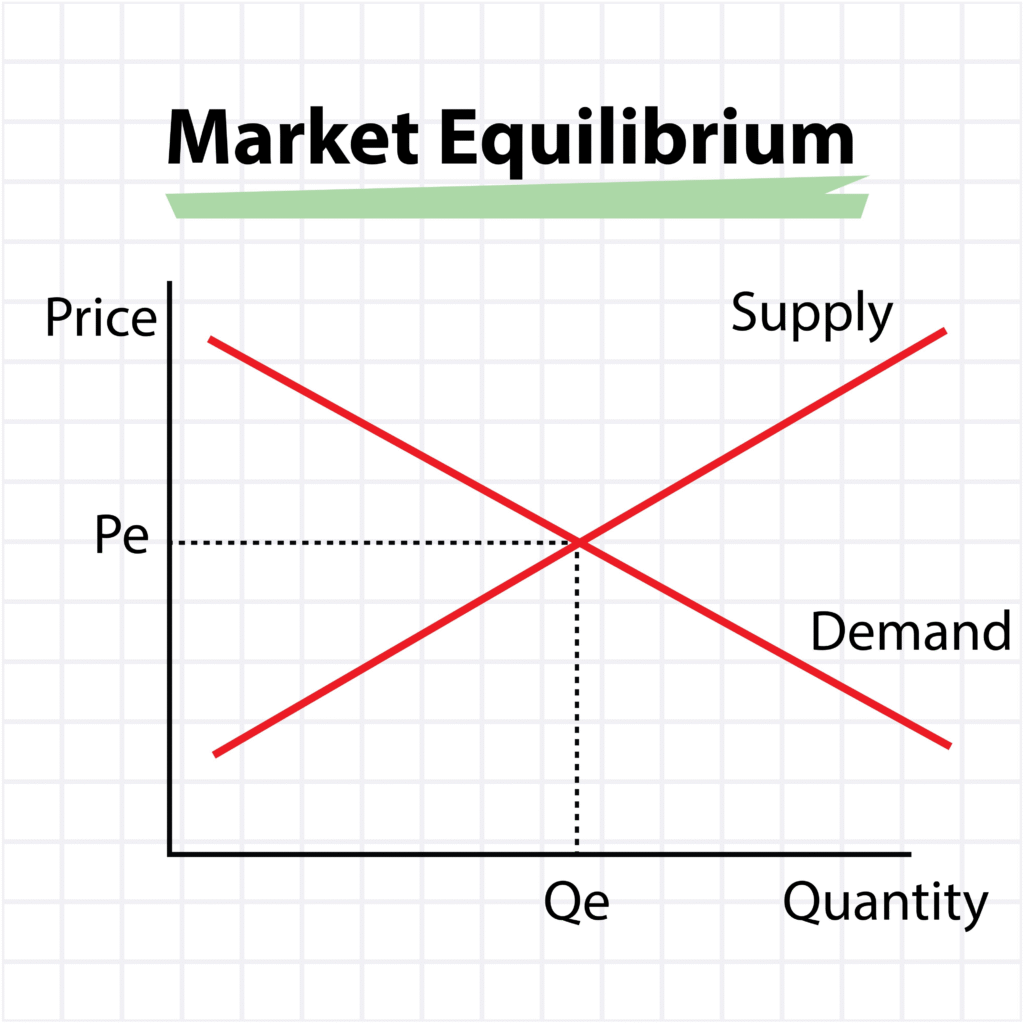
Market Mechanism: Prices aren’t set by a king or a committee; they are determined by Supply and Demand.7 If everyone wants a product (high demand) but there isn’t much of it (low supply), the price goes up.8
Freedom of Choice: Consumers are free to buy what they want, and workers are free to seek jobs with the best pay and conditions.9
Limited Government: The state’s role is usually restricted to protecting property rights, enforcing contracts, and maintaining a stable environment for trade.10
Common Variations of Capitalism
Rarely is any country “100% capitalist.” Most modern nations use a Mixed Economy model:11
Laissez-Faire (“Leave it be”):12 A pure form with almost zero government intervention.13
Welfare Capitalism: Private markets drive the economy, but the government uses high taxes to provide extensive social services (e.g., Sweden or Norway).
State Capitalism: The government has a significant ownership stake in major industries but allows them to compete in a global market (e.g., China).
Comparison: Capitalism vs. Other Systems
Feature
Capitalism
Socialism
Ownership
Private individuals/firms.
The state or the community.
Key Driver
Self-interest and profit.
Social welfare and equality.
Price Setting
Market forces (Supply/Demand).
Central planning or regulation.
Inequality
Can be high (reward based on capital).
Generally lower (redistributed wealth).
Interesting Fact: The term “Capitalism” was actually popularized by its critics (like Karl Marx) to describe a system they believed favored the owners of capital over the workers.
This short video provides a quick, high-level summary of the core features and benefits of a capitalist economic system.
What is the command economy?
In a command economy (also known as a planned economy), a central authority—typically the government—makes the major economic decisions rather than the forces of supply and demand.1
In this system, the government owns the “factors of production” (land and capital) and directs how resources are used to meet specific national goals, such as rapid industrialization or social welfare, rather than individual profit.2
How the Command Economy Answers the 4 Questions
While a market economy relies on price signals, a command economy relies on a central plan:3
What to Produce? The government determines which goods and services are necessary for the country.4 It often prioritizes “capital goods” (like machinery and military equipment) or “social goods” (like public housing) over consumer luxuries.
How to Produce? Central planners dictate production methods.5 They might choose labor-intensive methods to ensure full employment, even if it is less efficient than using robots or automation.
For Whom to Produce? The government decides how goods are distributed.6 Prices are often fixed at low levels to ensure everyone can afford basic necessities, though this can lead to shortages or “black markets.”
How to Progress? Change happens through Multi-Year Plans (like the famous “Five-Year Plans”).7 The government directs research and development toward state-defined priorities rather than letting the market discover new trends.
Key Characteristics
Public Ownership: Most industries and lands are owned by the state.8 Private property is usually very limited.9
Price Controls: The government sets the prices of goods and the wages of workers to maintain stability and prevent “wealth gaps.”10
Lack of Competition: Since the state often runs the only factory for a certain product, there is no pressure to innovate or lower costs to beat a competitor.
Pros and Cons: Theory vs. Reality
Feature
The Potential “Pros”
The Common “Cons”
Employment
Low unemployment (the state assigns jobs).
Underemployment: People are often in jobs that don’t match their skills.
Equality
Reduced income inequality; basic needs met.
Inefficiency: Massive bureaucracies make slow, rigid decisions.
Speed
Can mobilize resources quickly for wars or disasters.
Shortages: Planners can’t predict exactly what people need as well as a market can.
Goals
Focuses on “social good” over private greed.
Incentive Problem: Without a profit motive, there is little reason to work harder or innovate.
Historical and Modern Examples
The Soviet Union (USSR): The most famous historical example, which utilized “Gosplan” to manage its massive economy until 1991.11
North Korea: Currently the most “pure” command economy, where the state controls almost all economic activity.12
Cuba: Historically a command economy, though it has recently introduced some market-based reforms.13
China: Formerly a strict command economy under Mao Zedong, it has now transitioned into a “Socialist Market Economy”—a hybrid that uses state planning alongside global capitalism.14
This video provides a comparison of the two systems, using historical context from the Soviet Union to illustrate the real-world outcomes of central planning.
What is the mixed economic system?
A mixed economic system is a hybrid that blends elements of both capitalism (market economy) and socialism (command economy).1 It is the most common economic system in the world today.2
In a mixed economy, the private sector and the government work in tandem.3 While individuals and businesses have the freedom to own property and seek profit, the government intervenes to regulate the market, provide public services, and ensure a social safety net.4
1. The Balancing Act5
A mixed economy attempts to capture the efficiency of the market while using government oversight to prevent market failures (like monopolies or pollution).6
Private Sector: Driven by supply and demand.7 Businesses compete for customers, which fuels innovation and keeps prices competitive.8
Public Sector: The government provides “public goods”—services that the market might not provide efficiently or fairly on its own, such as national defense, public education, and emergency services.9
2. Key Features of a Mixed Economy
Coexistence: Both private businesses and state-owned enterprises (SOEs) operate simultaneously.10 For example, in many countries, private hospitals exist alongside government-funded healthcare.11
Regulation: The government sets rules for labor rights, environmental protection, and consumer safety to protect the “public good.”12
Redistribution: Through progressive taxation, the government collects money to fund welfare programs, unemployment benefits, and pensions, reducing the extreme wealth gaps often found in pure capitalism.13
Price Intervention: While most prices are market-driven, the government may set “price floors” (like minimum wage) or “price ceilings” (like rent control) to protect vulnerable groups.14
3. Comparison: The Economic Spectrum
Mixed economies aren’t all the same; they sit at different points on the spectrum between a free market and a command system.
Country
Economic “Lean”
Unique Characteristic
United States
Market-Leaning
Strong focus on private property and entrepreneurship, but with regulations like the Clean Air Act and social programs like Social Security.
Norway/Sweden
Social-Leaning
High taxes and heavy government involvement in healthcare and education, but with a very competitive and free-market business sector.
China
State-Leaning
A “Socialist Market Economy” where the state controls “strategic heights” (energy, banks) but allows massive private industry to drive growth.
4. Pros and Cons
Pros: * Promotes innovation through competition.15
Provides a safety net for those who cannot work.16
Allows for the rapid mobilization of resources during national crises.
Cons: * Can lead to high taxes.17
Government intervention can sometimes cause “bureaucratic lag” or inefficiencies.18
Finding the “perfect balance” between freedom and control is a constant political struggle.19
This video provides a deep dive into how modern nations blend market and command elements to manage their resources and social goals effectively.
What is the traditional economy?
A traditional economy is an economic system based on customs, beliefs, and long-standing history.1 It is the oldest type of economic system in the world.2
In this model, the “Four Questions of the Economy” are not answered by a government (Command) or by a market (Capitalist), but by tradition. You do what your parents did, and their parents before them.3
1. How the Traditional Economy Answers the 4 Questions
What to Produce? Whatever has been produced for generations. If your ancestors were caribou hunters, you hunt caribou.
How to Produce? Using ancient methods passed down through oral tradition or apprenticeship.4 There is often a resistance to new technology if it disrupts the social fabric.5
For Whom to Produce? For the community or the tribe.6 These economies are often “subsistence-based,” meaning they produce just enough to survive, with very little surplus.7
How to Progress? Change happens very slowly, if at all. This system is the definition of ideological inertia—the “way things have always been” is seen as the only correct way to live.
2. Key Characteristics
Barter and Trade: Instead of using paper money or digital currency, people exchange goods directly (e.g., trading a basket of fish for a hand-woven blanket).8
Community-Centric: Wealth is often shared.9 The survival of the group is more important than the success of the individual.10
Connection to Geography: These economies are deeply tied to their economic geography.11 They rely entirely on the local land and climate; if the environment changes, the economy often collapses.
3. Pros and Cons
Feature
The Potential “Pros”
The Common “Cons”
Social Cohesion
Everyone knows their role; very little social friction or “career anxiety.”
Lack of Choice: You cannot choose a different career path than your ancestors.
Sustainability
They tend to be very eco-friendly because they don’t pursue “infinite growth.”
Vulnerability: A single drought or natural disaster can lead to starvation because there is no surplus.
Purpose
Labor is directly tied to survival and family, providing a deep sense of belonging.
Low Standard of Living: Lack of modern medicine, technology, and centralized infrastructure.12
4. Where do they exist today?
Pure traditional economies are becoming increasingly rare due to globalization, but elements of them still exist in:
Indigenous Communities: Parts of the Arctic (Inuit), the Amazon rainforest, and parts of Sub-Saharan Africa.
Tea/Rice Cultures: Remote mountainous regions in Asia where farming techniques haven’t changed in centuries.
The “Informal” Economy: Even in modern cities, when families pass down a specific craft or trade through generations without interacting with the formal stock market, they are using a “traditional” logic.
Summary of the Four Systems
To bring our entire conversation together, here is how the four systems compare on the spectrum of control:
System
Decision Maker
Motivation
Traditional
Ancestors/Customs
Survival and Stability
Command
Government/Planners
National Goals/Equality
Market
Individuals/Consumers
Profit and Efficiency
Mixed
Both Govt and Market
Balance and Growth
What should be produced?
The question of “What should be produced?” is the most fundamental problem in economics because of scarcity: we have finite resources (land, labor, and capital) but infinite human wants.1
How a society answers this question reveals its deepest worldviews and the structure of its political economy.
1. The Market Answer: “Consumer Sovereignty”
In a Capitalist or Market economy, this question is answered by the “votes” cast by consumers every time they spend money.2
Price Signals: If people want more electric cars, the price of electric cars rises. This signals to businesses that they should produce more of them to make a profit.
Profitability: If a product costs more to make than people are willing to pay, it won’t be produced. The market filters out products that aren’t “valued” by the public.
2. The Command Answer: “National Priority”
In a Command economy, the government or a central planning committee decides what is necessary based on a specific ideological goal.3
Industrialization: A government might decide the country needs more steel and tractors rather than consumer goods like clothing or electronics.
Social Goods: The state may prioritize producing “merit goods” like vaccines, public housing, or infrastructure that a private market might under-provide.4
The Risk: Without price signals, planners might produce too much of one thing (surplus) and not enough of another (shortage).5
3. The Mixed Answer: “Essential vs. Desired”
In a Mixed economy, the market decides what consumer goods are made, but the government steps in to produce things the market ignores.6
Public Goods: Private companies rarely build lighthouses or national defense systems because it’s hard to charge individual users. The government produces these using tax revenue.
Externalities: The government might discourage the production of “bads” (like cigarettes or pollution) through taxes, while encouraging “goods” (like education) through subsidies.
4. The Traditional Answer: “Historical Continuity”
In a Traditional economy, the question is barely asked because the answer is already written in the past.
Subsistence: Production is focused on immediate survival needs—food, shelter, and clothing—rather than luxury or growth.7
Fixed Roles: If the tribe has always produced corn and pottery, that is what will be produced today.
Comparison Summary
System
Who Decides?
Key Motivation
Market
Consumers (via spending)
Profit and personal utility.
Command
Government Planners
National stability or social goals.
Mixed
Consumers + Regulators
Efficiency balanced with social welfare.
Traditional
Customs and Ancestors
Survival and cultural preservation.
The Modern Dilemma: Sustainability
Today, the question “What should be produced?” is facing a massive shift. Many are asking if we should continue producing disposable goods or fossil-fuel-dependent products, even if they are profitable. This is where worldviews are currently clashing with economic geography as we decide whether to produce for “growth” or produce for “planetary health.”
What is the production possibilities curve?
The Production Possibilities Curve (PPC), also known as the Production Possibilities Frontier (PPF), is a graphical model that represents all the maximum possible combinations of two goods an economy can produce given its current resources and technology.1
It is one of the most fundamental tools in economics because it visualizes the reality of scarcity—you cannot have everything, so you must choose.2
1. Key Components of the Graph
To understand the PPC, imagine a simple economy that only produces two things: Bread and Robots.
The Curve (The Frontier): The line represents the maximum efficiency.3 Any point on the line means the economy is using all its land, labor, and capital perfectly.4
Inside the Curve: Any point inside the curve indicates inefficiency or underutilization.5 This could be due to high unemployment or idle factories (like during a recession).
Outside the Curve: Any point beyond the line is currently unattainable with the existing resources.6 To reach this point, the economy would need to grow through better technology or more resources.7
2. What the PPC Teaches Us
The PPC is more than just a line; it illustrates three vital economic concepts:
A. Scarcity and Trade-offs
Because the line is downward-sloping, it shows that to get more of one good (Robots), you must give up some of the other good (Bread).8 This is the physical manifestation of the “What to produce?” question.9
B. Opportunity Cost
The “cost” of moving from one point on the curve to another is measured in what you lose.10 If moving from Point A to Point B gives you 10 more Robots but costs you 20 loaves of Bread, the opportunity cost of those 10 Robots is 20 loaves of Bread.
C. The Law of Increasing Opportunity Cost
Most PPCs are bowed outward (concave).11 This is because resources are not perfectly adaptable.12
Example: Some land is great for wheat (Bread), and some engineers are great at electronics (Robots). As you try to produce only Robots, you eventually have to force wheat farmers to build circuit boards. They won’t be very good at it, so you lose a lot of Bread for only a tiny gain in Robots. This makes the curve steeper as you move toward the axes.
3. Shifting the Curve: Economic Growth
The PPC is a “snapshot” in time.13 However, it can shift over time:
Outward Shift (Right): Caused by economic growth.14 This happens if there is an increase in the quantity of resources (more workers) or the quality of technology (better ovens for bread).15
Inward Shift (Left): Caused by economic decline. This happens during natural disasters, wars, or any event that destroys a country’s factors of production.
This video provides a visual walk-through of how to read the PPC and explains why the curve is the first graph most economics students learn.
What is future versus present economic growth?
In the study of economic growth, the distinction between present and future growth centers on a fundamental trade-off: Consumption vs.1 Investment.
Every economy must decide how to use its finite resources today.2 This choice is usually modeled using the Production Possibilities Curve (PPC), with Consumer Goods on one axis and Capital Goods on the other.3
1. Present Economic Growth (Consumption)
Present growth refers to an economy focusing its resources on Consumer Goods—things that directly satisfy human wants right now.
Examples: Food, clothing, entertainment, and luxury cars.4
The Benefit: High standards of living in the short term.5 People enjoy more products and services today.
The Cost: By using resources for immediate enjoyment, there are fewer resources available to build factories, conduct research, or improve technology.
Outcome: The economy is “living for today.” While it may be efficient right now, its productive capacity stays the same, and the PPC does not shift outward very quickly.
2. Future Economic Growth (Investment)
Future growth occurs when an economy chooses to sacrifice current consumption in favor of Capital Goods—tools used to produce other goods.6
Examples: Industrial robots, high-speed internet infrastructure, advanced machinery, and education (human capital).
The Benefit: These investments increase the quantity and quality of the factors of production.7
The Cost: A lower standard of living in the present.8 Resources that could have made “bread” are instead used to make “ovens.”
Outcome: Because the economy is adding to its “national factory,” the entire PPC shifts significantly outward over time.9 This allows the country to produce much more of both consumer and capital goods in the future.
Summary of the Trade-off
Focus
Primary Good
Short-Term Effect
Long-Term Effect
Present-Oriented
Consumer Goods
High current satisfaction.
Slow or stagnant growth.
Future-Oriented10
Capital Goods11
Current “sacrifice” or austerity.12
Rapid expansion and higher future wealth.
The “Golden Mean”
Most successful mixed economies try to find a balance. If a country only produces capital goods, its citizens will starve today; if it only produces consumer goods, it will eventually be overtaken by more innovative nations. Political economies often use interest rates and tax incentives to encourage businesses to invest in the future rather than just paying out profits for present consumption.13
This video provides a visual breakdown of how choosing between consumer and capital goods on the PPC directly determines the speed of a nation’s future economic expansion.
Japan Versus the United States
In economic theory, Japan and the United States serve as the primary case studies for the trade-off between Future Growth (Investment) and Present Growth (Consumption).
While both are advanced mixed economies, their “positions” on the Production Possibilities Curve (PPC) reflect fundamentally different worldviews and political-economic strategies.
1. The Strategy: Investment vs. Consumption
The core difference lies in how each nation allocates its resources between capital goods (future) and consumer goods (present).
Japan (The Future-Oriented Strategy): Historically, Japan has prioritized high rates of capital investment and research and development (R&D).
Mechanism: High household savings rates provided banks with capital to lend to industries at low rates.
Result: This pushes the Japanese PPC outward aggressively in the long term, focusing on “becoming better” at production (robotics, high-tech manufacturing).
Current Context (2025): Japan continues this trend with a massive $550 billion investment package targeting infrastructure, AI, and semiconductor chips to ensure future dominance in the “next economy.”1
The United States (The Present-Oriented Strategy): The U.S. political economy is driven by private consumption, which accounts for nearly 70% of its GDP.
Mechanism: Incentives (like low taxes on spending and easy credit) encourage citizens to buy goods and services now.
Result: This leads to a very high current standard of living and immediate “standard of life” satisfaction.
The Trade-off: Because the U.S. saves less and consumes more, it often relies on foreign capital (like Japanese and Chinese investment) to fund its own future growth.
2. Economic Indicators: A 2025 Snapshot
Based on current data, we can see these different worldviews manifesting in real-time performance:
Feature
Japan (2025)
United States (2025)
Primary Driver
Investment & Exports
Household Consumption
Growth Strategy
Fiscal stimulus for AI/Chips ($21T package).
Consumption fueled by wealth effects (stocks).
Household Behavior
High savings; subdued domestic demand.
Low savings; high demand for services.
Potential Growth
Low (~0.5%) due to aging population.
Higher (~1.9-2.0%) due to labor flexibility.
Worldview
“Security through technological mastery.”
“Freedom through individual choice.”
3. The Challenge of “The Ceiling”
Both nations face unique obstacles to shifting their curves further:
Japan’s Demographic Inertia: Despite high investment, Japan’s shrinking labor force acts as a weight on the PPC.2 You can have the best robots (Capital), but if you don’t have enough people (Labor) to manage the system or consume the products, growth slows. Japan is currently “unlearning” its resistance to immigration to fix this.
The U.S. Debt Burden: To maintain its high consumption levels, the U.S. has accumulated massive debt.3 If the cost of servicing that debt rises too high, the U.S. may be forced to cut future-oriented investments (like education or infrastructure) just to pay for past consumption.
Summary
Japan is like the person who puts 40% of their paycheck into a 401k; they have a slower daily life but are building a massive “national factory” for tomorrow.
The United States is like the person who spends their paycheck on a high-quality lifestyle today, relying on their high current income and credit to stay ahead.
How do Somalia and the Sahel of Africa compare?
Comparing Somalia and the Sahel (the belt of territory spanning from Senegal to Chad) is a study in how Economic Geography and Political Economy create different versions of “state fragility.”
While both regions are currently global epicenters of jihadist insurgency and climate-driven displacement, they are moving in opposite directions regarding their relationship with the international world.
1. Geographic Divergence: Landlocked vs. Maritime
The single biggest difference is their physical location, which dictates their economic potential.
Somalia (The Maritime Hub): Somalia has the longest coastline on mainland Africa. It sits on the Red Sea and the Gulf of Aden, the world’s most vital shipping lanes.1 This geography makes Somalia a strategic “prize” for global powers (Turkey, UAE, USA) who invest in its ports.
The Sahel (The Landlocked Belt): Most countries in the “Central Sahel” (Mali, Burkina Faso, Niger) are landlocked. They depend on neighbors for access to the sea, making them more isolated and economically dependent on overland trade routes through hostile territory.
2. Political Economy: Fragmentation vs. Juntas
As of late 2025, the two regions represent two different ways a government can lose control.
Somalia: “Consolidating Fragmented Power”After decades of being the “poster child” for a failed state, Somalia is currently in a phase of re-building.2
The Model: It uses a federal system that shares power between the central government and regional states (like Puntland and Jubaland).3
External Ties: It is deeply integrated with the West and the African Union. In 2025, a new UN-backed mission (AUSSOM) replaced the previous transition mission to continue the fight against al-Shabaab.4
The Goal: Moving from “fragility” to “functionality” through international aid and debt relief.
The Sahel: “The Nationalist Rupture”In contrast, the Sahelian states are de-linking from the West.5
The Model: A series of military coups (2021–2023) led to the creation of the Alliance of Sahel States (AES)—a military junta bloc.
External Ties: They have expelled French and American forces, withdrawn from the regional bloc ECOWAS, and pivoted toward Russia (Africa Corps) and Turkey for security.
The Goal: “Sovereign Security”—rejecting Western liberal democracy in favor of military-led authoritarian stability.
3. Shared Challenges (2025 Status)
Despite their different paths, they are bound by the same “vicious cycle” of environmental and security crises.6
Factor
Somalia (2025)
The Sahel (2025)
Main Insurgent
Al-Shabaab (Al-Qaeda) and IS-Somalia.
JNIM (Al-Qaeda) and IS-Sahel.
Climate Impact
Severe, alternating droughts and floods (El Niño effects).
Rapid desertification reducing arable land by 20% since 2000.
Economic State
High growth potential (3-4% GDP) but reliant on aid.
Risk of economic isolation due to withdrawal from ECOWAS.
Demographics
Massive youth population; 20% unemployment.
World’s fastest-growing population (doubling by 2050).
4. Ideological Inertia: Two Different Battles
In Somalia, the struggle is against the inertia of clan-based divisions.7 The “worldview” is slowly shifting from local tribal loyalty toward a national identity.
In the Sahel, the struggle is against colonial-era inertia. The military juntas are attempting to “unlearn” French institutional structures, but they risk replacing them with a new inertia of dependency on Russian private military contractors.
What are the competing mind-sets in the world economy?
In the world economy of 2025, the competition is no longer just between countries, but between fundamentally different belief systems about how wealth is created, who should control it, and what the ultimate goal of an economy should be.
Following the “Interregnum” period of the early 2020s, four dominant mindsets have emerged as the primary contenders for global influence.
1. Neoliberalism 2.0 (The Efficiency Mindset)
Once the undisputed champion of the world economy, Neoliberalism has been forced to evolve. It still prioritizes free markets and private property, but it has added a “defensive” layer.
The Logic: “The market is the most efficient way to allocate resources, but we must protect it from political interference.”
Current Focus: Deep integration of AI and GenAI to boost productivity. It views technology as the primary engine to solve economic stagnation.
Key Actors: Large tech-multinationals, the World Bank, and “Digital Nomad” hubs like Singapore and the UAE.
2. National Developmentalism (The Security Mindset)
This mindset has seen a massive resurgence in 2025, largely as a reaction to the vulnerabilities of global supply chains.
The Logic: “Economic policy is national security policy.”
Current Focus:Nearshoring and De-risking. Governments actively intervene to build domestic “strategic industries” like semiconductors, EV batteries, and green energy.
Key Actors: The United States (with its “America First” trade policies), China (State-led innovation), and India (building a “Leading AI Hub”).
3. The Regenerative / Green Growth Mindset
This worldview argues that the traditional goal of “infinite GDP growth” is a dangerous distortion of reality that ignores the physical limits of the planet.
The Logic: “Production must stay within the Earth’s carrying capacity.”
Current Focus: Transitioning from “extracting” resources to “circular” systems. In 2025, this is led by emerging markets like Brazil (84% renewable energy) and Indonesia (controlling critical minerals for the energy transition).1
Key Actors: The European Union (Green Deal), environmental NGOs, and “B-Corps” that prioritize social/eco-impact over pure profit.
4. Populist Nationalism (The Sovereign Mindset)
This mindset often views the global world economy as a “rigged game” that benefits global elites at the expense of local workers.
The Logic: “Take back control. Protect the border, the worker, and the culture.”
Current Focus: Using tariffs and restricted immigration as tools to force wealth back into the local economic geography. It is skeptical of international organizations (like the UN or WTO).
Key Actors: Populist movements in the U.S. and Europe, and the Alliance of Sahel States in Africa.
Comparison of Economic Logic
Mindset
Priority
Main Tool
View of Globalization
Neoliberal
Efficiency
AI & Digital Platforms
Essential (must be deepened).
Developmentalist
Security
Industrial Subsidies
Strategic (use only when safe).
Regenerative
Sustainability
Carbon Taxes & Circularity
Transformative (must be green).
Nationalist
Sovereignty
Tariffs & Border Control
Hostile (erodes national identity).
Summary
The world economy in 2025 is no longer a single “global village.” Instead, it is a fragmented landscape where these four mindsets are constantly pushing and pulling against each other. Success for a nation today depends on how well it can balance these competing pressures—for example, using Developmentalist tactics to secure its chips while maintaining Neoliberal trade ties to sell them.
This video features a debate on current development strategies, focusing on how globalization and the rise of new powers like China have challenged traditional neoliberal worldviews in the 21st century.2
What is the Conservative perspective?
The conservative perspective on the world economy and political systems is deeply rooted in the belief that individual freedom and free-market capitalism are the most effective drivers of human prosperity.
This worldview emphasizes that capitalism is not merely an “accumulation of capital,” but a system of social cooperation where success is earned by meeting the needs of others.
1. The Core Philosophy: Service through Profit
From a conservative viewpoint, the market is an “economic democracy” where consumers hold the ultimate power.
Voluntary Exchange: Businesses prosper only if they provide something people want or need. Unlike a “concentration of capital” at the expense of people, it encourages individuals to improve their lives by satisfying the needs of others.
The Power of the Consumer: Every dollar spent is viewed as a “vote.” If a business fails to serve its customers better than its competitors, those competitors will “eat them for lunch”.
2. Critique of Socialism: The Dictatorship of the Elite
Conservatives often argue that while “Democratic Socialism” claims to put society first, it inevitably shifts power from millions of individuals to a small group of government elites.
Central Planning Failure: When a few elites decide what should exist instead of the market, they often get it wrong, leading to shortages of essential items like toilet paper.
Coercion vs. Choice: In a capitalist system, you decide what you get from an unlimited supply; in a socialist economy, the government decides what you get from a limited supply.
3. Role of the Individual and Institutions
Entrepreneurship: The “entrepreneurial mindset” is seen as the engine of progress. While critics argue that workers create all wealth, conservatives point out that CEOs and entrepreneurs take the risks and spend millions to determine what customers actually want [02:07].
Limited Government: The state’s role should be to protect the “rules of the game”—property rights and contracts—rather than picking winners and losers in the economy.
4. Summary Table: Conservative vs. Progressive Worldview
The liberal perspective is a broad and evolving worldview centered on the belief that progress is achieved when individuals are free to pursue their potential and when the government actively works to ensure fairness and equality of opportunity.
While conservatives often see the market as a naturally self-correcting democracy, liberals generally view the market as a powerful engine that requires a “driver” (the government) to prevent it from veering off-course and harming the vulnerable.
1. The Core Philosophy: “Freedom To” vs. “Freedom From”
Modern liberalism distinguishes between two types of freedom:
Classical Liberalism: Focused on “freedom from” government interference (similar to modern libertarianism).
Modern (Social) Liberalism: Argues that a person isn’t truly “free” if they are trapped by poverty, disease, or lack of education. Therefore, the government must intervene to provide the tools—like healthcare and schooling—that allow people to actually exercise their freedom.
2. The Role of Government: The “Visible Hand”
In a liberal political economy, the state is seen as a necessary partner in the market.
Correcting Market Failures: Liberals believe that left alone, markets can create monopolies, pollute the environment, or fail to provide essential services (like public transit). The government must regulate to “level the playing field.”
Economic Experimentation: Liberals are more open to “Keynesian” economics—the idea that during a recession, the government should increase spending to jump-start the economy, even if it means running a deficit in the short term.
Social Safety Nets: A hallmark of the liberal worldview is the belief that a wealthy society has a moral and economic obligation to provide for the “underdog” through unemployment insurance, progressive taxation, and subsidized services.
3. Worldview on Progress and Change
Reason and Science: Liberals tend to believe that social problems can be solved through rational planning, data-driven policy, and scientific advancement (e.g., aggressive action on climate change).
Inclusivity: The perspective emphasizes that the economy is strongest when everyone—regardless of race, gender, or background—can participate. Discrimination is seen not just as a moral failure, but as an economic waste of human capital.
Globalism: Historically, liberals have supported a “Rules-Based International Order.” They favor international organizations like the UN and WTO to resolve conflicts through diplomacy and trade rather than military force.
4. Comparison: Liberal vs. Conservative Perspective
Feature
Liberal Perspective
Conservative Perspective
Market View
A tool that needs a “watchdog” to ensure fairness.
A self-correcting system that rewards service.
Inequality
A systemic problem that government must reduce.
A natural outcome of different levels of risk/effort.
Taxes
A means to fund progress and social stability.
A burden that stifles investment and growth.
Change
Embraces reform and “forward-looking” social shifts.
Values tradition and “tried-and-true” institutions.
5. The 2025 Context
In today’s world, the liberal perspective is increasingly focused on “Human-Centric Capitalism.” * AI and Automation: Liberals are pushing for “upskilling” programs and digital rights to ensure workers aren’t left behind by technology.
Climate Change: It is seen as the ultimate “market failure,” requiring massive government investment in green energy (the “Green Growth” mindset we discussed earlier).
What is the radical perspective?
The radical perspective is a worldview that looks for the “root” (from the Latin radix) of social and economic problems. While liberals look to reform the system and conservatives look to preserve its best parts, radicals believe that the current system is fundamentally flawed and must be replaced or structurally transformed.
In the world economy of 2025, the radical perspective is most often associated with Marxism, Dependency Theory, and Radical Geography.
1. The Core Philosophy: “Systemic Exploitation”
The radical worldview rejects the idea that poverty or inequality are “accidents” or “market failures.” Instead, it sees them as the intended features of a capitalist system.
Class Struggle: Radicals view society as a conflict between two main groups: those who own the means of production (the Bourgeoisie) and those who must sell their labor to survive (the Proletariat).
The Theory of Surplus Value: Radicals argue that profit is essentially “unpaid labor.” If a worker creates $100 worth of value in an hour but is only paid $20, the remaining $80 is “stolen” by the owner. This is seen as the root of all economic inequality.
Alienation: Radical thinkers like Marx argued that capitalism “alienates” humans from their work, their products, and each other, turning people into mere cogs in a machine designed only for growth.
2. Radical Geography: “The Production of Space”
In our earlier discussion of economic geographies, the radical view adds a critical layer: Space is not neutral.
Uneven Development: Radicals argue that capitalism requires some areas to be poor so that others can be rich. Capital flows to where labor is cheapest and environmental laws are weakest, leaving behind “sacrifice zones” (like the Rust Belt or the Global South).
Imperialism and Dependency:Dependency Theory (a major radical branch) argues that wealthy “core” nations keep “peripheral” nations poor by trapping them in a cycle of debt and resource extraction. The poor countries aren’t “behind”; they are being actively “underdeveloped” by the global system.
3. Radical vs. Liberal vs. Conservative
Feature
Conservative
Liberal
Radical
System View
Healthy; needs protection.
Flawed; needs reform.
Broken; needs replacement.
Poverty
Result of individual choice/bad luck.
Result of lack of opportunity.
Result of systemic exploitation.
Role of State
Small; protector of property.
Active; provider of fairness.
Total; tool for the ruling class.
Solution
Markets and tradition.
Regulation and safety nets.
Revolution or structural overhaul.
4. The 2025 Context: “The New Radicals”
Today, the radical perspective has branched out beyond just economics to include:
Abolitionist Movements: Arguing that the “root” of racial inequality is the prison-industrial complex and the history of slavery.
Degrowth: Challenging the radical idea that “infinite growth” is possible on a finite planet, calling for a total reorganization of the economy away from GDP.
Anti-Colonialism: Seen in movements like the Alliance of Sahel States, which seeks to radically break away from Western institutional structures (like the CFA Franc) which they view as modern-day imperialism.
Key Takeaway: For a radical, if a house has a leaky roof, you don’t just patch the holes (Liberal) or tell the owner to work harder (Conservative); you investigate if the foundation was built on a swamp and consider building a new house entirely.
Solved Problems
Global Trade & Geopolitics
1. How do we prevent a “Global Trade War” triggered by aggressive tariffs?
Solution: Strengthen “Rules-Based” international frameworks (like a modernized WTO) and establish “Selective De-risking” instead of total “Decoupling,” allowing trade to continue in non-sensitive sectors.
2. How do landlocked nations in the Sahel overcome their geographic disadvantage?
Solution: Invest in regional “Infrastructure Corridors” (rail and road) and digital “Smart Borders” to reduce the transit time and cost of reaching maritime ports in neighboring coastal countries.
3. What is the solution to “Geoeconomic Fragmentation” (the world splitting into US-led and China-led blocs)?
Solution: Promote “Plurilateralism”—smaller, flexible trade agreements that allow “Middle Powers” (like Brazil, India, or the EU) to act as economic bridges between the two major blocs.
Scarcity & The 4 Questions
4. How can an economy answer “What to produce?” when facing extreme resource scarcity?
Solution: Adopt a Circular Economy model where “waste” is used as a Factor of Production for new goods, reducing the need for raw material extraction.
5. How do we solve the “Shortage vs. Surplus” problem in Command Economies?
Solution: Introduce “Market-Socialist” reforms that allow local managers to use real-time data and price signals to adjust production levels without waiting for a 5-year central plan.
Factors of Production & Labor
6. How do we protect “Labor” from being entirely replaced by “Capital” (AI and Automation)?
Solution: Implement Human Capital Tax Credits for businesses that retrain workers and explore “Robot Taxes” to fund social safety nets like Universal Basic Income (UBI).
7. How do aging nations like Japan solve their shrinking “Labor” factor?
Solution: A dual approach of Silver Economy policies (keeping older adults in the workforce longer) and “Precision Immigration” to fill specific skill gaps in the economy.
8. How do we solve “Skill Mismatch” in emerging markets?
Solution: Shift education systems toward Vocational and Technical Training that is directly linked to the “Entrepreneurship” needs of the local geography.
Inequality & Worldviews
9. How do we reduce the “Global Inequality Gap” where the top 10% earn nearly 50% of all income?
Solution: Implement Progressive Wealth Taxes and expand “Global Redistribution” via direct cash transfers (like GiveDirectly) to the world’s poorest individuals.
10. How do we fix the “Housing Affordability Crisis” in Mixed Economies?
Solution: Move away from “Market-First” housing and toward Supply-Side Incentives, such as zoning reform for higher density and government-funded social housing.
11. How do we overcome “Ideological Inertia” preventing green transitions?
Solution: Use Carbon Dividends—taxing polluters and giving that money directly back to citizens—to build public “buy-in” for expensive environmental policies.
Stability & Growth
12. How do we manage “Unsustainable Public Debt” (currently over 250% of global GDP)?
Solution: A combination of Fiscal Consolidation (spending smarter, not less) and “Debt-for-Nature Swaps,” where developing nations have debt forgiven in exchange for protecting local ecosystems.
13. How do we solve “Information Asymmetry” in the digital economy?
Solution: Pass Digital Transparency Laws that require AI companies to disclose their data sources and algorithms, ensuring “Sovereign Individuals” have the same information as “Big Capital.”
Geography & Environment
14. How do we stop “Climate-Driven Economic Migration”?
Solution: Invest in Climate Adaptation Infrastructure (sea walls, drought-resistant seeds) in the “Peripheral” nations most affected by warming, funded by the “Core” nations responsible for most emissions.
15. How do we solve the “Productivity Gap” in rural economic geographies?
Solution: Universal High-Speed Satellite Internet (like Starlink) to allow rural “Labor” to participate in the global “Digital Capital” market without moving to overcrowded cities.
This video discusses the primary risks and structural hurdles facing the global economy in 2025, providing context for why these specific questions are currently at the top of the international agenda.