
Earth and Atmospheric Sciences
The Principle of Linear Superposition is a fundamental concept in physics that explains what happens when two or more waves meet at the same point in space. It is the “golden rule” for understanding everything from noise-canceling headphones to the shimmering colors on a soap bubble.
1. The Core Principle
The principle states that when two or more waves overlap, the resulting displacement at any point is the algebraic sum of the displacements of the individual waves.
Mathematically, if two waves y1(x, t) and y2(x, t) occupy the same space, the resultant wave $Y$ is:
$$Y = y_1 + y_2$$
Crucially, waves don’t “bounce” off each other. They pass through one another and emerge on the other side unchanged in shape or speed.
2. Describing Interference
Interference is simply the physical manifestation of superposition. Depending on the phase relationship (the timing of the peaks and troughs), we see two primary types:
Constructive Interference
This occurs when waves are in phase—meaning the crest of one wave aligns with the crest of another.
- Result: The amplitudes add up to create a larger wave.
- Visual/Audio effect: Brighter light or louder sound.
Destructive Interference
This occurs when waves are out of phase (specifically by $180^\circ$ or $\pi$ radians). The crest of one wave meets the trough of another.
- Result: The displacements cancel each other out. If the waves have equal amplitude, the result is zero displacement.
- Visual/Audio effect: Darkness or silence.
3. Real-World Applications
Interference isn’t just a lab experiment; it’s happening around you constantly:
- Thin-Film Interference: The rainbow colors in oil slicks or soap bubbles happen because light waves reflecting off the top and bottom surfaces of the film interfere with each other.
- Active Noise Cancellation: Headphones use a microphone to “listen” to outside noise and then generate a second sound wave that is the exact inverse (destructive interference), effectively “subtracting” the noise.
- Beat Frequencies: When two musical notes of slightly different frequencies are played, their superposition creates a “pulsing” sound as they drift in and out of phase.
Comparison Table
| Feature | Constructive Interference | Destructive Interference |
| Phase Difference | 0° (In phase) | 180° (Out of phase) |
| Path Difference | nλ (Integer multiples) | n + (1/2)λ (Half-integer) |
| Amplitude | Maximum | Minimum (or zero) |
What is the principle of linear superposition?
The Principle of Linear Superposition is a fundamental concept in physics and engineering that describes how multiple waves or signals interact when they meet. In short: waves don’t “collide” like solid objects; they simply pass through each other, adding their effects together as they go.
1. The Core Definition
The principle states that when two or more waves overlap in the same medium, the resulting displacement at any point is the algebraic sum of the displacements of the individual waves.
Mathematically, if we have two wave functions, y1(x, t) and y2(x, t), the net displacement Y is:
Y(x, t) = y1(x, t) + y2(x, t)
2. Key Characteristics
- Independence: Waves do not “bounce” off one another. After they pass through the point of intersection, they continue on their original paths with their original shapes, amplitudes, and velocities completely unchanged.
- Linearity: This principle only holds true for “linear” systems, where the medium isn’t permanently deformed by the waves. This applies to most light, sound, and water waves under normal conditions.
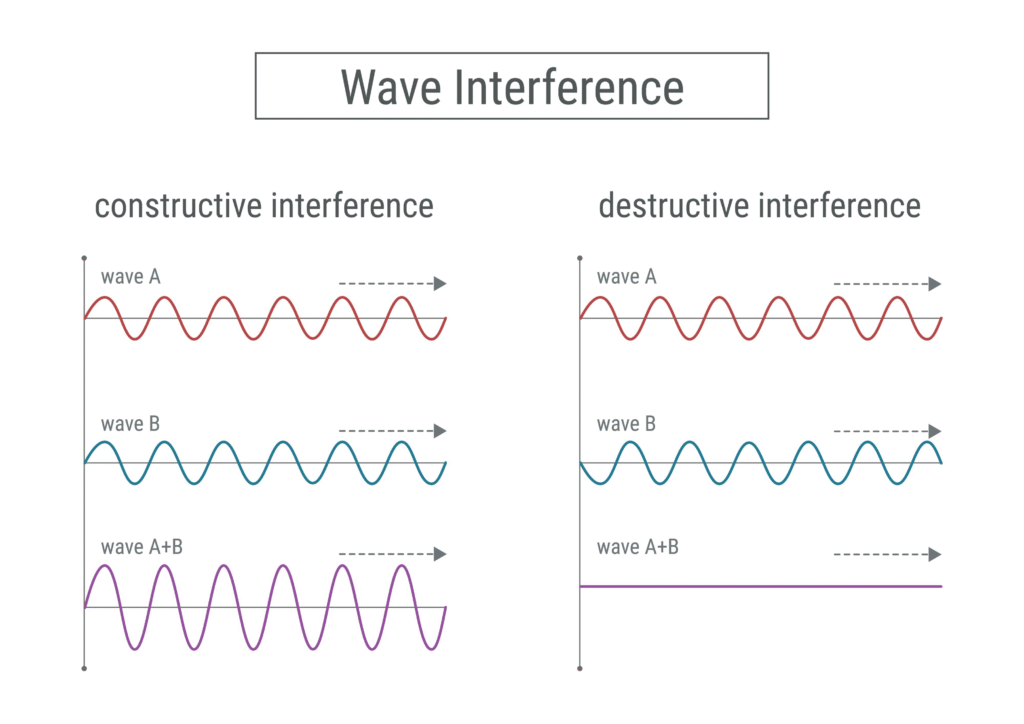
3. Interference: The Result of Superposition
Superposition is the “math,” and interference is the “result.” Depending on how the waves align (their phase), two distinct things can happen:
Constructive Interference
- The Setup: The crest (peak) of one wave meets the crest of another.
- The Result: The amplitudes add together to create a larger wave. For light, this means a brighter spot; for sound, it means a louder volume.
Destructive Interference
- The Setup: The crest of one wave meets the trough (valley) of another.
- The Result: The positive and negative displacements cancel each other out. In a perfect scenario, this results in total silence or darkness.
4. Why It Matters
Without the principle of superposition, many modern technologies wouldn’t exist:
- Noise-Canceling Headphones: They create a “mirror” sound wave to destructively interfere with background noise.
- Radio/Wi-Fi: Thousands of signals occupy the same air space; your device uses these principles to “de-superimpose” and tune into a specific frequency.
- Holography and Lasers: These rely entirely on the precise alignment of light wave phases.
How do we describe constructive and destructive interference of sound waves?
When we describe interference in sound waves, we are looking at how pressure variations combine. Since sound is a longitudinal wave consisting of compressions (high pressure) and rarefactions (low pressure), the “peaks and troughs” are actually “squeezes and stretches” of air molecules.
1. Constructive Interference (Reinforcement)
Constructive interference occurs when sound waves are in phase. This means the compressions of one wave arrive at the same time as the compressions of the second wave.
- The Interaction: High-pressure zones stack on top of high-pressure zones.
- The Result: The amplitude of the pressure wave increases.
- Perception: To the human ear, this results in a louder sound.
2. Destructive Interference (Cancellation)
Destructive interference occurs when waves are out of phase (specifically 180° or π radians out of phase). This means a compression from one source meets a rarefaction from another.
- The Interaction: The high pressure of one wave “fills in” the low pressure of the other. The air molecules essentially stay at their equilibrium positions.
- The Result: The total pressure variation is reduced or neutralized.
- Perception: This results in a quieter sound or, in ideal conditions, total silence.
3. Describing the Math: Path Difference
Whether you hear a “loud” spot or a “dead” spot depends on your distance from the sound sources. This is defined by the Path Difference (ΔL), which is the difference in distance the two waves traveled to reach your ear.
The Conditions:
| Interference Type | Condition for Path Difference | Resulting Sound |
| Constructive | ΔL = nλ | Max Volume |
| Destructive | ΔL = n + (1 / 2)λ | Minimum Volume |
Where λ is the wavelength and n is any integer (0, 1, 2…).
4. Real-World Example: “Dead Spots”
In a poorly designed concert hall, you might experience dead spots. These are specific seats where sound reflecting off the back wall interferes destructively with the sound coming directly from the stage. Because the reflected wave travels a half-wavelength further than the direct wave, they cancel out, making the music sound thin or muted.
Conversely, Active Noise Cancellation (ANC) in headphones works by intentionally creating a sound wave with the exact same frequency but opposite phase to the ambient noise, “destroying” the unwanted sound before it hits your eardrum.
What is diffraction?
In simple terms, diffraction is the bending or spreading of waves as they pass through an opening (aperture) or around the edge of an obstacle.
It is a phenomenon unique to waves—whether they are water, sound, or light—and it occurs because every point on a wavefront can be considered a source of new “wavelets” that spread out in all directions.
1. When Does Diffraction Occur?
The degree of bending depends on the relationship between the wavelength (λ) of the wave and the size of the opening (a):
- Significant Diffraction: Happens when the wavelength is roughly the same size as (or larger than) the opening. The wave spreads out widely.
- Minimal Diffraction: Happens when the opening is much larger than the wavelength. The wave passes through mostly in a straight line, leaving a sharp “shadow.”
2. Common Examples
Diffraction explains many everyday experiences that might otherwise seem strange:
Hearing Around Corners
You can hear someone talking in the hallway even if you can’t see them. This is because sound waves have long wavelengths (meters long), which are large enough to “bend” around doorframes. Light waves, however, have tiny wavelengths (nanometers), so they don’t bend around the door noticeably, which is why you can’t see the person.
The “Fuzzy” Shadow
If you look closely at the shadow of an object cast by a distant light source, the edges aren’t perfectly sharp. This “fuzziness” is caused by light waves diffracting slightly around the edges of the object.
3. Diffraction vs. Interference
While they are related, there is a subtle distinction:
- Diffraction refers to a wave spreading out from a single source or bending around one obstacle.
- Interference refers to what happens when two or more of those spreading waves meet and combine (as we discussed with superposition).
In many physics experiments, like the Single-Slit Experiment, we see both: a light wave diffracts through a slit and then interferes with itself to create a pattern of bright and dark fringes on a screen.
4. Key Factors
The angle of diffraction (θ) can be described by the following relationship for the first “dark” spot in a single-slit pattern:
sin θ = λ/a
- If you increase the wavelength (λ), the wave spreads more.
- If you narrow the gap (a), the wave spreads more.
What are beats?
In physics, beats are the periodic fluctuations in volume heard when two sound waves of slightly different frequencies overlap. It is a perfect real-world demonstration of the Principle of Superposition in action.
1. How Beats Are Produced
When two sound sources (like two tuning forks) play nearly identical notes, their waves continuously drift in and out of alignment.
- Constructive Interference (Loud): When the two waves are “in step” (crests meet crests), they reinforce each other, creating a moment of maximum volume.
- Destructive Interference (Quiet): A fraction of a second later, because one wave is slightly faster than the other, they become “out of step” (crests meet troughs). They cancel each other out, creating a moment of minimum volume.
The result is a distinctive “wa-wa-wa” pulsing sound.
2. The Math of Beats
The frequency at which the volume rises and falls is called the Beat Frequency (fb). It is remarkably simple to calculate: it is the absolute difference between the two original frequencies.
$$f_b = |f_1 – f_2|$$
Example: If you strike a tuning fork at 440 Hz (standard A) and another at 444 Hz, you will hear the sound pulse 4 times per second (a beat frequency of 4 Hz).
3. Practical Applications
The most common use for beats is in tuning musical instruments:
- Piano Tuning: A tuner strikes a reference tuning fork and a piano string simultaneously. If they hear a “beat,” they know the string is out of tune. They tighten or loosen the string until the beating slows down and eventually disappears (fb = 0).
- Orchestral Tuning: Musicians listen for beats against the lead oboe’s “A” note to ensure the entire ensemble is perfectly synchronized.
4. Limits of Human Perception
The human ear is generally good at detecting beats up to about 7 to 10 Hz.
- If the frequency difference is very small (e.g., 1 Hz), you hear a slow swell in volume.
- If the difference is large (e.g., 50 Hz), the beats happen so fast that the ear perceives them as a new, separate “rough” tone rather than individual pulses.
What are transverse standing waves?
A transverse standing wave is a wave pattern that appears to “stand still” rather than travel through a medium. It occurs when two identical waves (same frequency and amplitude) travel in opposite directions and interfere with each other—most commonly when a wave reflects back from a fixed boundary.
In a transverse wave, the particles of the medium move perpendicular to the direction of the wave energy (like a string vibrating up and down while the wave pattern sits horizontally).
1. Anatomy of a Standing Wave
Because of the constant constructive and destructive interference, specific points along the medium behave in unique ways:
- Nodes: Points that never move. They are the result of continuous destructive interference. The displacement here is always zero.
- Antinodes: Points of maximum vibration. They occur halfway between nodes where constructive interference is at its peak. This is where the “loops” of the wave are widest.
2. How They Are Formed
Standing waves are usually the result of resonance. When you pluck a guitar string, the wave travels to the end, hits the bridge, and reflects back. At specific frequencies (harmonics), the reflected wave lines up perfectly with the new waves being created, locking the pattern into a “standing” position.
3. Harmonics and Overtones
A string can vibrate in several different standing wave patterns depending on the frequency. These patterns are called Harmonics:
| Harmonic | Description | Visual Structure |
| 1st Harmonic (Fundamental) | The simplest form; lowest frequency. | 2 nodes (ends) and 1 antinode (middle). |
| 2nd Harmonic | Twice the frequency of the fundamental. | 3 nodes and 2 antinodes; looks like two “loops.” |
| 3rd Harmonic | Three times the fundamental frequency. | 4 nodes and 3 antinodes; looks like three “loops.” |
4. The Mathematical Relationship
For a string of length L fixed at both ends, the wavelengths (λ) that can form standing waves are restricted by the length of the string:
λn = (2L)/n
Where n is the harmonic number (1, 2, 3…). Since velocity v = fλ, the frequencies are:
fn = n(v/(2L))
5. Why They Matter
- Musical Instruments: Every string instrument (violin, guitar, piano) relies on transverse standing waves to produce specific pitches.
- Structural Engineering: Engineers must ensure that bridges and buildings don’t have “resonant frequencies” that match wind or earthquake patterns, which could create standing waves strong enough to tear the structure apart.
What are longitudinal standing waves?
While transverse standing waves (like those on a guitar string) move up and down, longitudinal standing waves vibrate back and forth in the same direction the wave travels. These are most commonly found in musical wind instruments like flutes, clarinets, and organ pipes.
1. How They Form
A longitudinal standing wave is created by the superposition of two longitudinal waves traveling in opposite directions. In an air column (like a pipe), sound waves reflect off the ends of the tube. When the reflected wave interferes with the incoming wave at just the right frequency, a stable pattern of nodes and antinodes is established.
Instead of “peaks” and “valleys,” these waves consist of:
- Compressions: Regions of high air pressure.
- Rarefactions: Regions of low air pressure.
2. Nodes vs. Antinodes (Pressure vs. Displacement)
In longitudinal waves, it is important to distinguish between displacement (how much the air molecules move) and pressure (how much the air is squeezed).
- Displacement Nodes: Points where air molecules do not move at all. These occur at closed ends of a pipe (the air is blocked by a wall).
- Displacement Antinodes: Points where air molecules vibrate with maximum amplitude. These occur at open ends of a pipe (the air is free to move).
3. Open vs. Closed Pipes
The harmonics produced depend on whether the ends of the tube are open or closed.
Open Pipes (Open at both ends)
Since both ends are open, there must be a displacement antinode at each end.
- Fundamental Frequency: The simplest pattern is an antinode at each end and a single node in the middle.
- Harmonics: All harmonics (n = 1, 2, 3…) are possible.
- Example: A flute or a recorder.
Closed Pipes (Closed at one end)
One end is a displacement antinode (open), and the other is a displacement node (closed).
- Fundamental Frequency: The pipe contains exactly one-quarter of a wavelength.
- Harmonics: Only odd harmonics (n = 1, 3, 5…) are produced. This gives closed-pipe instruments (like the clarinet) a “darker” or “hollower” sound.
- Example: A clarinet or a capped organ pipe.
4. Key Mathematical Relationships
The frequency (f) of these standing waves depends on the speed of sound (v) and the length of the pipe (L):
- For Open Pipes: fn = (nv)/(2L) (where n = 1, 2, 3…)
- For Closed Pipes: fn = (nv)/(4L) (where n = 1, 3, 5…)
Comparison at a Glance
| Feature | Open Pipe (Both Ends) | Closed Pipe (One End) |
| End Conditions | Antinode at both ends | Node at one, Antinode at other |
| Fundamental Wavelength | λ = 2L | λ = 4L |
| Available Harmonics | All (1, 2, 3, 4…) | Odd only (1, 3, 5, 7…) |
What are complex sound waves?
In the real world, very few sounds are “pure” single frequencies (like a tuning fork). Most sounds—from a human voice to a slamming door—are complex sound waves.
A complex sound wave is any wave that is not purely sinusoidal. Instead, it is the result of multiple different frequencies, amplitudes, and phases combining through the principle of linear superposition.
1. How They Are Formed
According to Fourier’s Theorem, any complex periodic wave can be broken down into a sum of simple sine waves. When you play a note on a violin, you aren’t just hearing one frequency; you are hearing a “stack” of waves:
- Fundamental Frequency (f0): The lowest frequency produced, which determines the perceived pitch of the note.
- Harmonics/Overtones: Higher frequencies that are usually integer multiples of the fundamental (e.g., 2f0, 3f0).
2. Timbre: The “Color” of Sound
Complex waves explain why a piano and a saxophone sounding the exact same note (same pitch and volume) still sound different. This quality is called timbre.
Each instrument produces a unique “recipe” of overtones. A “bright” sounding instrument has strong high-frequency harmonics, while a “mellow” instrument has a stronger fundamental and weaker overtones. The shape of the resulting complex wave is a visual representation of that instrument’s unique sound.
[Image comparing the wave shapes of a tuning fork, a flute, and a violin playing the same note]
3. Periodic vs. Non-Periodic
Not all complex waves are musical. We generally categorize them into two types:
- Periodic Complex Waves: These have a repeating pattern. They are produced by musical instruments or a steady human voice. Because they repeat, they have a clear, recognizable pitch.
- Aperiodic (Non-Periodic) Complex Waves: These have no repeating pattern. This is what we perceive as noise (like static, a crash, or the “shhh” sound in speech). Since there is no repetition, there is no specific pitch.
4. Visualizing Complex Waves
Engineers and scientists use two main ways to look at these waves:
- Time-Domain (Oscillogram): A graph of air pressure over time. This shows the actual “wiggle” of the wave.
- Frequency-Domain (Spectrum): A graph showing which frequencies are present and how loud each one is. This looks like a bar graph or a series of peaks.
[Image showing a complex wave in the time domain vs its frequency spectrum]
Comparison of Simple vs. Complex Waves
| Feature | Simple Wave (Sine Wave) | Complex Wave |
| Frequencies | Single frequency only | Multiple frequencies |
| Sound Quality | Thin, “pure,” or piercing | Rich, full, or textured |
| Occurrence | Rare (Tuning forks, Synthesizers) | Common (Voices, Nature, Instruments) |
Solved Problems
Learn how we bridge these gaps: [The Starline Philosophy: The Modern Polymath]