“Non-calculus physics” (often called Algebra-based Physics) is an introductory study of the laws of nature that relies on algebra, geometry, and trigonometry rather than calculus.
While physics was originally developed by Isaac Newton alongside calculus to describe a world in constant change, non-calculus physics simplifies these concepts so they can be solved using standard equations and steady-state scenarios.
The main difference is not what you study, but how you calculate it. Both versions cover the same fundamental topics—gravity, motion, energy, and electricity—but they approach the math differently.
Feature
Non-Calculus Physics
Calculus-Based Physics
Math Tool
Algebra & Trig (SOH CAH TOA)
Derivatives & Integrals
Problem Style
Focuses on constant values (e.g., constant acceleration).
In a calculus-based class, you might calculate the work done by a force that changes every second. In a non-calculus class, the problem is simplified: “A constant force of 10 Newtons is applied over 5 meters.”
Example: Finding Velocity
Non-Calculus: You use the “average” formula: v = Δx/Δt (Change in position over change in time).
Calculus: You find the “instantaneous” velocity by taking the derivative of the position function: v(t) = dx/dt.
3. Core Topics Covered
Even without calculus, you still get a comprehensive look at how the universe works. Typical courses (like AP Physics 1 & 2) cover:
Mechanics: Projectile motion, Newton’s Laws, and work/energy.
Thermodynamics: Heat transfer and gas laws.
Electricity & Magnetism: Circuits, voltage, and magnetic fields.
Waves & Optics: Light, sound, and lenses.
Modern Physics: A brief look at relativity and quantum concepts.
4. Why Take It?
Conceptual Focus: Because you aren’t bogged down by complex integration, you can often spend more time understanding the logic of why things happen.
Prerequisites: It’s the standard entry point for students who haven’t taken (or don’t need) high-level math.
Professional Requirements: It is the standard requirement for many medical and health-related graduate programs (like Physical Therapy or Pharmacy).
The nature of physics can be summed up as the quest to find the simplest, most universal rules that govern everything in existence.
The word “physics” comes from the Greek word physis, meaning “nature.” At its core, physics is the study of matter, energy, space, and time, and how they interact with one another.1
1. The “Fundamental” Science2
Physics is often called the fundamental science because it provides the foundation for every other branch of science:3
Chemistry is essentially the physics of how atoms and electrons interact.4
Biology is the physics of how those chemical reactions form complex life systems.
Astronomy is the physics of how gravity and light behave across the cosmos.
2. The Language of Mathematics
The nature of physics is deeply mathematical.5 While a poet might describe a sunset with words, a physicist describes it with equations for refraction and wavelengths.
Precision: Physics doesn’t just say “gravity pulls things down”; it says gravity pulls with an acceleration of exactly 9.8 m/s2 near Earth’s surface.
Predictability: Because nature follows consistent mathematical patterns, we can use physics to predict where a planet will be in 100 years or exactly how much fuel a rocket needs to reach the moon.
3. Two Pillars: The Large and the Small
Physics is generally split into two “natures” depending on the scale of what you are looking at:
Scale
Branch
Primary Focus
Macroscopic (The Big)
Classical Physics
Everyday objects, gravity, motion, and thermodynamics. It’s the world we can see.
Microscopic (The Tiny)
Quantum Physics
Atoms, subatomic particles, and light. Here, the “normal” rules of reality often break down.
4. An Experimental Journey
The nature of physics is experimental.6 It is not a set of “final truths” written in stone, but rather a collection of theories that have yet to be proven wrong.
Observation: We see a phenomenon (like an apple falling).7
Hypothesis: We guess why it happens (gravity).
Testing: We perform experiments to see if our guess holds up.8
Refinement: If an experiment contradicts a theory (as happened when Einstein refined Newton’s laws), the theory must change.
5. The Search for Unity
The ultimate goal of physics is to find a “Theory of Everything”—a single set of equations that connects the four fundamental forces of nature:9
Gravity: Holds galaxies together.
Electromagnetism: Powers our lights and holds atoms together.10
Strong Nuclear Force: Glues the centers of atoms.
Weak Nuclear Force: Responsible for radioactive decay.
Key Takeaway: The nature of physics is to peel back the layers of the universe until we find the “source code” that makes reality work.11
In physics, units are standardized references used to measure and express the magnitude of physical quantities.1
Without units, a number in physics has no meaning. For example, if someone says “the car is moving at 50,” you don’t know if they mean 50 miles per hour (a safe speed) or 50 meters per second (over 100 mph). Units provide the context that turns a number into data.
1. The Two Types of Units
Scientists divide units into two categories: those that are “raw” building blocks and those that are built from others.2
Fundamental (Base) Units
These are the seven independent building blocks of the International System of Units (SI).3 Every other unit in existence is made by combining these seven.4
Quantity
SI Base Unit
Symbol
What it measures
Length
Meter
m
Distance
Mass
Kilogram
kg
Amount of matter
Time
Second
s
Duration
Current
Ampere
A
Flow of electricity
Temperature
Kelvin
K
Average kinetic energy
Substance
Mole
mol
Number of particles
Luminosity
Candela
cd
Brightness
Derived Units
These are created by multiplying or dividing base units.5 For example:
Speed: Distance divided by time 6→ m/s.7
Force (Newton): Mass times acceleration 8→ 9kgm/s2.10
Volume: Length 11x Width 12x Height 13→ 14m3.15
2. Why Do We Need Standards?
Historically, units were chaotic. A “foot” was literally the length of a king’s foot, which changed whenever a new king took the throne.
Consistency: A meter in Tokyo is exactly the same as a meter in Paris.
Communication: Scientists around the world use the SI (Metric) system so they can share data without having to convert from feet, inches, or stones.16
Precision: Today, units are defined by universal constants.17 For instance, a meter is defined by how far light travels in a vacuum in exactly 181/299,792,458 of a second.19
3. Unit Prefixes (Power of 10)20
Since the universe ranges from the size of an atom to the size of a galaxy, we use prefixes to keep the numbers manageable.
Kilo- (k): 1,000 (e.g., a kilometer is 1,000 meters)21
Centi- (c): 1/100th (e.g., a centimeter is 0.01 meters)22
Milli- (m): 1/1,000th (e.g., a milligram is 0.001 grams)
Mega- (M): 1,000,000 (e.g., a megawatt is a million watts)23
Pro Tip: In physics problems, the most common mistake is forgetting to convert units to the standard SI form (like converting grams to kilograms) before starting your calculation.
In physics, units are more than just labels; they are a vital tool for solving problems correctly.1 If the math is the “engine” of a physics problem, units are the “guardrails” that keep you on the road.
The role of units in problem-solving can be broken down into three main functions: verification, strategy, and meaning.
1. Verification: The “Sanity Check”
The most powerful role of units is Dimensional Analysis. This is the practice of checking if the units on both sides of an equation match.2
Spotting Errors: If you are calculating velocity (which should be in 3m/s) but your final answer comes out in 4m2/s, you know immediately that you made an algebraic error.5
Consistency: You can only add or subtract quantities that have the same units.6 You cannot add 5 meters to 10 seconds. If your math tries to force this, the units will “scream” at you that the equation is set up incorrectly.
2. Strategy: Finding the Path
Sometimes, units can actually show you how to solve a problem even if you forget the specific formula.
Unit Mapping: If a problem gives you a value in Joules (Energy) and asks for Watts (Power), and you know that a Watt is a Joule per second, the units tell you the operation: divide the energy by the time.
Conversion Factors: Units guide you through multi-step conversions. By treating units like algebraic variables, you can use “fractions of one” (like 100 cm / 1 m) to cancel out unwanted units and arrive at the goal.
3. Meaning: Real-World Significance
Units turn abstract numbers into physical reality.7
Scale and Magnitude: A result of “10” is meaningless. “10 Newtons” tells you the magnitude of a force, while “10 Kilograms” tells you the amount of mass.
Avoiding Catastrophe: History is full of expensive mistakes caused by unit errors.8 A famous example is the Mars Climate Orbiter (1999), which crashed because one team used Imperial units (pounds-force) while another used Metric units (Newtons).9 The math was right, but the units were mismatched.
Summary Table: Units as a Problem-Solving Tool
Task
How Units Help
Setup
Ensure all given values are in the same system (e.g., all SI units) before starting.
Calculation
Carry units through every step to ensure the algebra stays consistent.
Final Answer
Check if the final unit matches the physical quantity you were asked to find.
Logic Check
Ask: “Does this unit make sense for this phenomenon?”
Pro Tip: Always write your units at every step of your work, not just at the end. It makes it much easier to backtrack and find exactly where a calculation went wrong.
This video explains why standardized units are the foundation of scientific research and how they help researchers communicate and verify data accurately across the globe.
Example Problem 1: The World’s Tallest Man
Tallest man on record was Robert Wadlow, who had a height of 2.72 m. Express his height in feet.
We multiply the original speed by these factors so that the unwanted units (miles and hours) cancel out:
Speed = 65 miles / hour * (1,609.344 m / mile) * (1 hour / 3,600 s)
3. Calculate the Result
Multiply by distance factor: 65 * 1,609.344 = 104,607.36 metres/hour
Divide by time factor: 104,607.36 / 3,600 = 29.0576 m/s
4. Final Answer
Rounding to two significant figures (matching the “65”):
The speed limit is approximately 29 m/s.
Quick Rule of Thumb:
In many physics problems, you can quickly convert mph to m/s by dividing by approximately 2.237.
65 / 2.237 ≈ 29.05 m/s
What is trigonometry?
In physics, trigonometry is the mathematical bridge that allows us to relate the angles of a system to the distances or forces involved.
While the word literally means “triangle measurement,” physicists use it as a tool to “resolve” vectors—meaning we take a diagonal motion (like a plane flying into a headwind) and break it into simple horizontal and vertical parts.1
1. The Right Triangle: Your Basic Tool
Most trigonometry in physics revolves around the right triangle (a triangle with a 2 90° angle).3 When you have a diagonal quantity, like a force or a velocity, you treat it as the hypotenuse of a triangle.
The “Big Three” Ratios (SOH CAH TOA)
To find the missing “legs” of your triangle, you use these three ratios:4
Sine (5 sin):6Opposite/Hypotenuse 7→ SOH8
Cosine (9 cos):10Adjacent/Hypotenuse 11→ CAH12
Tangent (13 tan):14Opposite/Adjacent 15→ TOA16
Example 3: Casting a Shadow
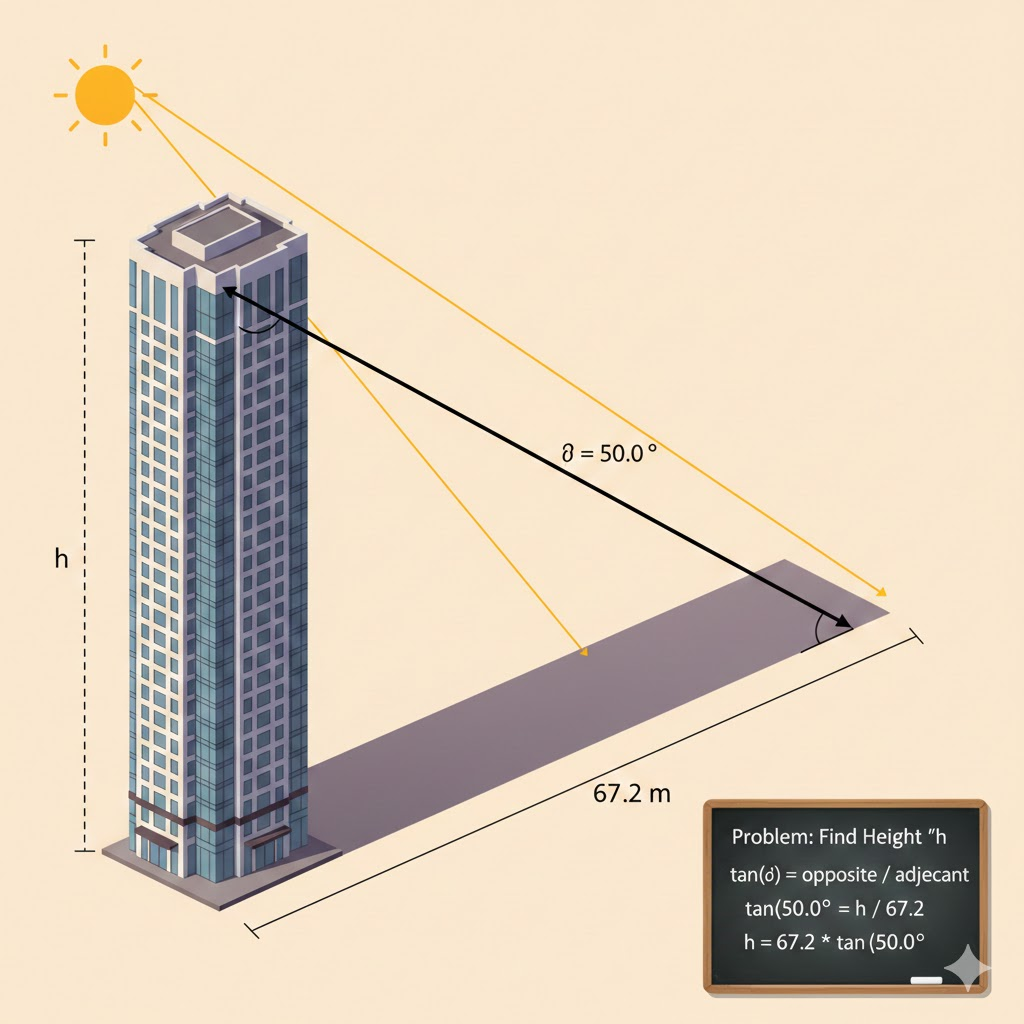
From a value θ and the angle ha of the shadow, the height ho of the building can be found using trigonometry.
On a sunny day, a tall building casts a shadow that is 67.2 m long. The angle between the sun’s rays and the ground is θ = 50.0 °, as the figure shows. Determine the height of the building.
Solution
To determine the height of the building, we can use basic trigonometry. This scenario forms a right-angled triangle where:
The height of the building (h) is the side opposite to the angle θ.
The length of the shadow (s = 67.2 m) is the side adjacent to the angle θ.
The angle θ is 50.0°.
1. Select the Trigonometric Function
We use the tangent function because it relates the opposite side (height) to the adjacent side (shadow):
tan(θ) = Opposite / Adjacent = h / s
2. Rearrange to Solve for Height (h)
h = s ⋅ tan(θ)
3. Plug in the Values
h = 67.2 m ⋅ tan(50.0°)
Using a calculator (ensuring it is in Degree mode):
tan(50.0°) ≈ 1.19175
h = 67.2 ⋅ 1.19175 ≈ 80.0856
4. Final Answer
Rounding to three significant figures (matching the given 67.2 m and 50.0 m):
The height of the building is 80.1 m.
2. Why Physics Needs Trigonometry
In the real world, things rarely move in perfectly straight lines.17 Trigonometry is how we handle the “slant.”
Vector Components: If you pull a sled with a rope at an angle, only some of your force pulls the sled forward; the rest pulls it upward.18 Trigonometry tells you exactly how much force goes in each direction.
Fhorizontal = F cos(θ)
Fvertical = F sin(θ)
Inclined Planes: When a car is parked on a hill, gravity pulls it straight down, but the car wants to roll along the slope.19 We use trig to calculate the “down-the-hill” component of gravity.
Projectile Motion: When you kick a soccer ball at an angle, trig helps you determine its initial horizontal speed (how far it goes) and its initial vertical speed (how high it goes).
3. Beyond Triangles: Waves and Circles
As you move further into physics, trigonometry takes on a second life: describing cycles.
Oscillations: The way a pendulum swings or a spring bounces back and forth is modeled using Sine waves.20
Circular Motion: If you spin a ball on a string, its position at any moment is a function of the angle it has traveled.21
Light and Sound: These are waves.22 The “peaks” and “troughs” of sound or light are represented by trigonometric functions.
4. The Inverse: Finding the Angle23
Sometimes you know the sides but not the angle. For example, if you know a ramp is 3 meters long and 1 meter high, you can use Inverse Trig (sin-1, cos-1, or tan-1) to find the angle of the incline:
θ = tan-1(Height/Base)
Pro Tip: In physics, always check if your calculator is in Degrees or Radians. Using the wrong mode is the #1 reason for “correct” math leading to “wrong” answers!
Example 4: Finding the depth of a lake
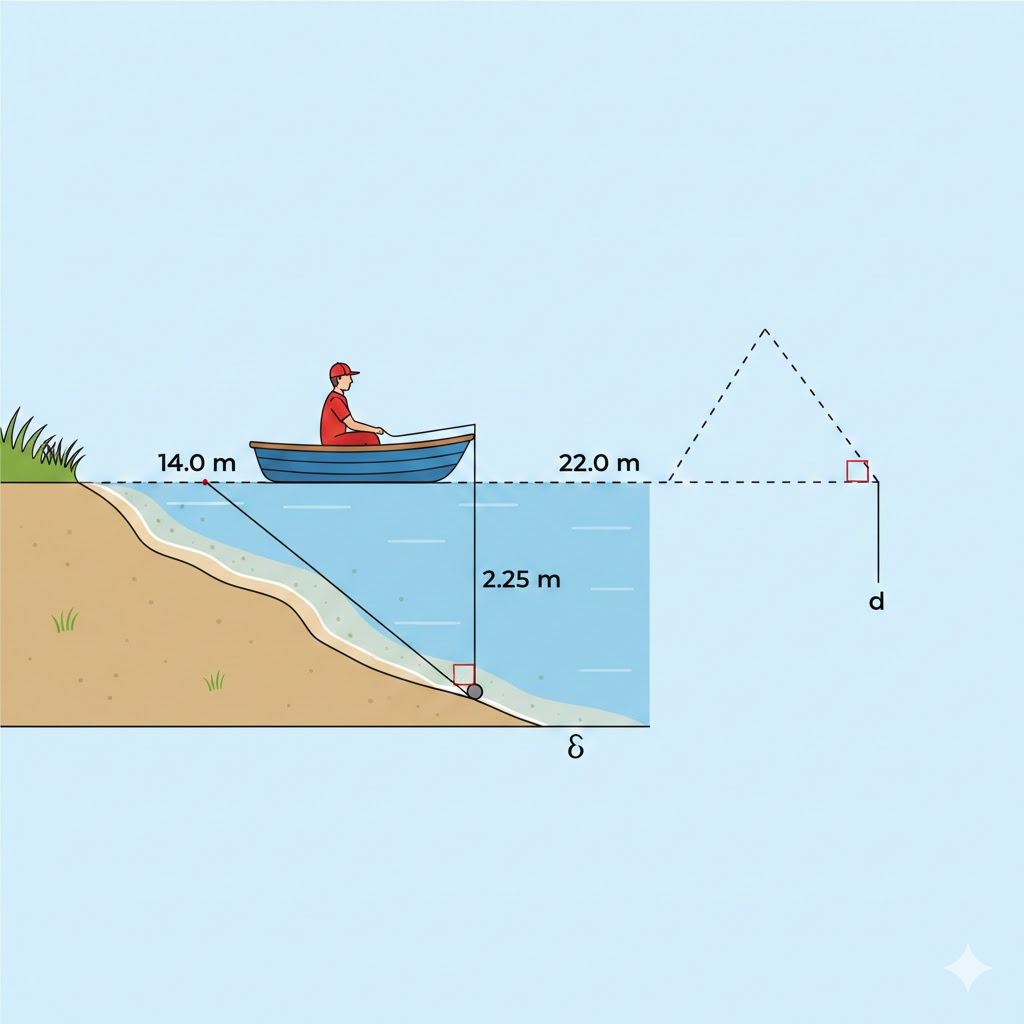
If the distance from the shore and the depth of the water at any one point are known, the angle θ can be found with the aid of trigonometry. Knowing the value of θ is useful, because then the depth d at another point can be determined.
A lakefront beach drops off gradually at an angle θ, as in the figure indicates. For safety reasons, it is necessary to know how deep the lake is at various distances from the shore. To provide some information about the depth, a lifeguard rows straight out from the shore a distance of 14.0 m and drops a weighted fishing line. By measuring the length of the line, the lifeguard determines the depth to be 2.25 m. (a) What is the value of θ? (b) What would be the depth d of the lake at a distance of 22.0 m from the shore?
Solution
This problem can be solved using the properties of a right-angled triangle, where the shore is one vertex and the lake floor forms the hypotenuse.
(a) Determining the value of θ
The distance from the shore represents the adjacent side (x = 14.0 m) and the depth represents the opposite side (y = 2.25 m) relative to the angle $\theta$.
We use the tangent function:
tan(θ) = Opposite / Adjacent = 2.25 m / 14.0 m
To find θ, we take the arctangent:
θ = arctan (2.25 m / 14.0 m)
θ ≈ 9.1301…°
Answer (a): The value of θ is 9.13°.
(b) Determining the depth d at 22.0 m
Since the lake drops off at a constant angle, we can use the same trigonometric relationship or the principle of similar triangles. The ratio of depth to distance remains constant:
Depth1 / Distance1 = Depth2 / Distance2
Substitute the known values:
2.25 m / 14.0 m = d / 22.0 m
Solve for d:
d = (2.25 m / 14.0 m) * 22.0
d ≈ 3.5357… m
Answer (b): The depth of the lake at a distance of 22.0 m is 3.54 m.
Why this works:
Because the problem states the beach “drops off gradually,” we assume the slope is a straight line. This allows us to treat the entire cross-section of the lake as a single triangle where any depth d is directly proportional to its distance from the shore.
What is the nature of physical quantities and what is a vector versus a scalar?
In physics, the nature of physical quantities refers to the properties of matter or systems that can be measured and expressed as a combination of a numerical value and a unit.1
Essentially, if you can measure it and assign a number to it (like 5 kilograms or 10 meters), it is a physical quantity.2 These quantities are the “vocabulary” of the universe.
1. The Two Pillars of Physical Quantities
Physicists categorize every measurement into two main groups based on whether the direction of that measurement matters.3
Scalar Quantities (Magnitude Only)
A scalar is a quantity that is fully described by its size (magnitude) and units alone.4 Direction is irrelevant.
Key Question: “How much?”
Examples: * Mass: 50 kg (It doesn’t matter which way you face; your mass is the same).
Temperature: 22°C.
Time: 10 seconds.5
Distance: “I ran 5 kilometers.”6
Vector Quantities (Magnitude + Direction)
A vector is a quantity that requires both a size (magnitude) and a specific direction to be fully understood.7
Key Question: “How much, and in what direction?”8
Examples: * Velocity: 60 mph North. (Speed is the scalar; adding “North” makes it a vector).
Force: 10 Newtons Downward.9 (If you push a door, the direction you push determines if it opens).
Displacement: “I am 5 kilometers East of my house.”
2. Scalar vs. Vector: Common Pairings
Students often confuse these because they seem similar, but they represent very different physical “natures.”
Scalar
Vector
The Difference
Distance
Displacement
Distance is the total ground covered; displacement is the straight-line “shortcut” from start to finish.
Speed
Velocity
Speed is how fast you move; velocity is how fast you move in a specific direction.
Mass
Weight
Mass is how much “stuff” you’re made of; weight is the force of gravity pulling that stuff down.
3. Visualizing Vectors
In physics diagrams, vectors are represented by arrows.
Length of the arrow: Represents the magnitude (a longer arrow means a stronger force or higher speed).10
Direction of the arrow: Represents the direction of the quantity.11
Why this matters: You can add scalars using simple math ($5\,kg + 5\,kg = 10\,kg$), but adding vectors requires trigonometry. If you walk 3 meters East and then 4 meters North, your “distance” (scalar) is 7 meters, but your “displacement” (vector) is only 5 meters at an angle!
This video provides a clear visual breakdown of how to distinguish between these two types of quantities, which is a foundational skill for all of physics.
How do you perform vector addition and subtraction?
In physics, adding and subtracting vectors is how we determine the “net” result of multiple forces, velocities, or displacements.1 There are two primary ways to do this: graphically (using drawings) and algebraically (using numbers).2
1. Vector Addition
The goal of addition is to find the Resultant Vector (3R), which represents the combined effect of all vectors.4
Graphical Method: Tip-to-Tail
This is the most intuitive way to visualize addition.
Draw the first vector (A) starting from an origin point.
Draw the second vector (5B) so that its tail starts at the tip (arrowhead) of the first vector.6
Draw the Resultant: The sum is the new arrow drawn from the tail of the first to the tip of the last.
Algebraic Method: Component Addition
In non-calculus physics, this is the most common way to get an exact answer. You break each vector into its 7x and 8y parts.9
Break them down: Use trigonometry to find Ax, Ay and Bx, By.
Add the parts:
Rx = Ax + Bx
Ry = Ay + By
Rebuild the Resultant: Use the Pythagorean theorem for magnitude and tangent for the angle:10
Magnitude: R = sqrt(Rx2 + Ry2)
Angle: θ = tan-1(Ry/Rx)
2. Vector Subtraction
Subtracting a vector is exactly the same as adding its opposite.11
The “Flip” Rule
To subtract vector B from A (written as A – B), you simply change the direction of B by 180° and then add it normally.
Algebraically: Subtract the components: 12(Ax – Bx) and 13(Ay – By).14
Graphically: Flip the arrow for B so it points the opposite way, then place it tip-to-tail with A.
Summary Comparison
Method
Best Used For…
Key Concept
Graphical
Visualizing the problem and estimating the answer.
Chaining arrows “Tip-to-Tail.”15
Algebraic
Getting precise numbers for lab reports or exams.
Adding 16X parts to 17X and 18Y parts to 19Y.20
Important Note: Unlike simple numbers (5 + 3 = 8), the “length” of a resultant vector is almost never just the two magnitudes added together unless they are pointing in the exact same direction.
This video demonstrates both the visual “flip” method and the step-by-step component subtraction used to find the precise difference between two vectors.
In physics, the components of a vector are the projections of that vector along the axes of a coordinate system (usually the 1x and 2y axes).3
Think of components as the “ingredients” that make up the vector. If a vector represents a diagonal walk across a field, its components tell you exactly how far you walked East (x-component) and how far you walked North (y-component).
1. Visualizing Components
When you break a vector into components, you are essentially turning a single diagonal arrow into the hypotenuse of a right triangle.4
The Horizontal Component (5Ax): The shadow the vector casts on the x-axis.6
The Vertical Component (7Ay): The shadow the vector casts on the y-axis.8
2. Calculating the Components
If you know the magnitude (9A) of the vector and the angle (10) it makes with the positive x-axis, you can use trigonometry to find the components:11
To find the x-component: Use Cosine (CAH):Ax = A cos(θ)
To find the y-component: Use Sine (SOH):Ay = A sin(θ)
Wait—is it always Cosine for X and Sine for Y?
No. This is a common trap!
Use Cosine for the side adjacent (touching) the angle.14
Use Sine for the side opposite the angle.15If your angle is measured from the vertical y-axis instead of the horizontal x-axis, the formulas will flip!
3. Why Components are Important
Components are the “secret weapon” for solving complex physics problems:
Vector Addition: You cannot easily add 10 N at 30° to 5 N at 110° directly. But you can add their 16x-components together and their 17y-components together to find the total “Net” force.18
Independent Motion: In projectile motion, we treat horizontal speed (constant) and vertical speed (changing due to gravity) as two completely separate problems using components.19
Simplified Math: Components turn a 2D vector problem into two simple 1D math problems.
4. Component Form (Unit Vectors)
In textbooks, you will often see vectors written in component form using the unit vectors i
(for x) and j (for y):
A = Axi + Ayj
Example: V = 3i + 4j means “3 units to the right and 4 units up.”
Pro Tip: When calculating components, pay attention to the quadrant.25 If a vector points left, its x-component must be negative. If it points down, its y-component must be negative.
How do you add vectors by means of components?
Adding vectors by components is the most accurate method for solving physics problems because it converts complex diagonal arrows into simple numbers. Instead of using a ruler and protractor, you use algebra to add the “horizontal effects” and “vertical effects” separately.1
Here is the four-step process used in non-calculus physics:
Step 1: Resolve Each Vector
Break every individual vector into its 2x (horizontal) and 3y (vertical) components using trigonometry.4 If you have a vector A with magnitude A at an angle θ:
Ax = Acos(θ)
Ay = Asin(θ)
Note on Signs: Be careful with direction! If a vector points Left, its x-component is negative. If it points Down, its y-component is negative.
Step 2: Sum the Components
Once you have the components for all your vectors (let’s say vectors A, B, and C), add them together like items in a list. You must not mix 5x and 6y values.7
Sum of x: Rx = Ax + Bx + Cx
Sum of y: Ry = Ay + By + Cy
Rx and 8Ry are the components of your final Resultant Vector.9
Step 3: Find the Resultant Magnitude
Now that you have the total horizontal and vertical parts, you can “rebuild” the diagonal resultant vector using the Pythagorean Theorem:10
R = sqrt(Rx2 + Ry2)
Step 4: Find the Resultant Direction
To find the angle (θ) of the final vector, use the inverse tangent function:
θ = tan-1(Ry/Rx)
Example Summary Table
If you were adding a Force A and a Force B, your scratchpad would look like this:
This video provides a clear walkthrough of the component method, simplifying the process of breaking down and reconstructing vectors using dynamic graphics.
Vector A has a magnitude of 188 units and points 30.0° north of west. Vector B points 50.0° east of north. Vector C points 20.0° west of south. These three vectors add to give a resultant vector that is zero. Find the magnitudes of vectors B and C by using components.
Solution: To find the magnitudes of vectors B and C, we will break all vectors into their horizontal (x) and vertical (y) components using a standard coordinate system where East is +x and North is +y.
1. Vector Components
First, we determine the angles of each vector from the positive x-axis (East):
Vector A: 188 units, 30.0° north of west. The angle from the +x-axis is 180.0° – 30.0° = 150.0°. Ax = 188 cos(150.0°) ≈ -162.81 units Ay = 188 sin(150.0°) = 94.0 units
Vector B: Magnitude B, 50.0° east of north. The angle from the +x-axis is 90.0° – 50.0° = 40.0°. Bx = Bcos(40.0°) By = Bsin(40.0°)
Vector C: Magnitude C, 20.0° west of south. The angle from the +x-axis is 270.0° – 20.0° = 250.0°. Cx = Ccos(250.0°) Cy = Csin(250.0°)
2. Equations for Equilibrium
Since the resultant vector is zero (A + B + C = 0), the sum of the components in each direction must be zero:
X-direction:
Ax + Bx + Cx = 0
-162.81 + Bcos(40.0°) + Ccos(250.0°) = 0
Bcos(40.0°) + Ccos(250.0°) = 162.81 — (Eq. 1)
Y-direction:
Ay + By + Cy = 0
94.0 + Bsin(40.0°) + Csin(250.0°) = 0
Bsin(40.0°) + Csin(250.0°) = -94.0 — (Eq. 2)
3. Solving the System
Substituting the trigonometric values (cos 40.0° ≈ 0.766, cos 250.0° ≈ -0.342, sin 40.0° ≈ 0.643, sin 250.0° ≈ -0.940):
0.766 B – 0.342 C = 162.81
0.643 B – 0.940 C = -94.0
Solving this system of linear equations yields:
Magnitude of Vector B:B ≈ 370 units
Magnitude of Vector C:C ≈ 353 units
Final Answer:
The magnitude of vector B is approximately 370 units, and the magnitude of vector C is approximately 353 units.
Questions
Question 1
The table below lists four variables along with their units:
Variable
Units
x
meters (m)
v
meters per second (m/s)
t
seconds (s)
a
meters per second squared (m/s2)
These variables appear in the following equations, along with a few numbers that have no units. In which of the equations are the units on the left side of the equals sign consistent with the units on the right side?
(a) x = vt
(b) x = vt +(1/2)at2
(c) v = at
(d) v = at + (1/2) at3
(e) v3 = 2ax2
(f) t = √(2x / a)
Answer 1:
To determine which equations are dimensionally consistent, we evaluate the units on both sides of the equals sign for each equation.
Given Variables and Units:
x (distance): meters (m)
v (velocity): meters per second (m/s)
t (time): seconds (s)
a (acceleration): meters per second squared (m/s2)
Analysis of Equations:
(a) x = vt
Left Side (LHS): [x] = m
Right Side (RHS): [v][t] = (m/s) * (s) = m
Result:Consistent
(b) x = vt + (1 / 2)at2
LHS: [x] = m
RHS: * Term 1 (vt): (m/s) * (s) = m
Term 2 (1 / 2)at2): (m/s2) * (s2) = m
Since both terms on the RHS have units of meters, they can be added and match the LHS.
Result:Consistent
(c) v = at
LHS: [v] = m/s
RHS: [a][t] = (m/s2) * (s) = m/s
Result:Consistent
(d) v = at + (1 / 2)at3
LHS: [v] = m/s
RHS:
Term 1 (at): (m/s2) * (s) = m/s
Term 2 (1 / 2)at3):* (m/s2) * (s3) = m * s
The terms on the RHS have different units (m/s vs m * s), so they cannot be added.
Result:Inconsistent
(e) v^3 = 2ax^2$
LHS: [v]3 = (m/s)3 = m3/s3
RHS: [a][x]2 = (m/s2) * (m)2 = m3/s2
Comparing m3/s3 and m3/s2, the units do not match.
Result:Inconsistent
(f) t = √(2x / a)
LHS: t = s
RHS: √([x] / [a]) = √(m / m/s2)= √s2 = s
Result:Consistent
Conclusion:
The equations in which the units are consistent are:
(a), (b), (c), and (f)
Question 2:
The variables x and v have the units shown in the table that accompanies question 1. Is it possible for x and v to be related to an angle θ according to tan θ = x / v? Account for your answer.
Answer 2:
No, it is not possible for the variables x and v to be related to an angle θ in the way described.
The reasoning behind this comes down to the nature of trigonometric functions:
1. The Principle of Dimensionless Arguments
In physics and mathematics, the argument of a trigonometric function (like θ in tan θ) must be dimensionless. Similarly, the result of a trigonometric function is a ratio of lengths, which is also dimensionless.
2. Checking the Ratio x/v
To see if tan θ = x/v is valid, we must check the units of the ratio:
The unit of x is meters (m).
The unit of v is meters per second (m/s).
When we divide them:
[x] / [v] = m / (m/s) = s
The result of the ratio x/v is seconds (s), which is a unit of time.
3. The Contradiction
The Left Side: tan θ is a pure number (dimensionless).
The Right Side: x/v has the dimension of Time [T].
Since a dimensionless quantity cannot equal a quantity with dimensions, the equation is physically impossible. For the expression to be correct, the units would have to cancel out completely (for example, x/y where y is also in meters).
Question 3:
You can always add two numbers that have the same units. However, you cannot always add two numbers that have the same dimensions. Explain why not, and include an example in your explanation.
Answer 3:
It sounds a bit counterintuitive at first, doesn’t it? Usually, we’re taught that dimensions are the “soul” of a measurement and units are just the “outfit” it wears. But in the world of physics and dimensional analysis, the rule is actually quite strict: you can only add quantities that represent the exact same physical property.
The reason you can’t always add numbers with the same dimensions is that dimensions can be broader than specific physical properties. Two quantities might share the same base dimensions but describe entirely different physical phenomena that don’t mix.
The Fundamental Rule
To add two quantities, they must be commensurate. This means they must:
Have the same dimensions (e.g., L2 M T-2).
Represent the same type of physical quantity.
If they have the same dimensions but represent different concepts, adding them is like trying to add “3 gallons of milk” to “3 miles per hour”—it doesn’t result in a meaningful value.
The Classic Example: Torque vs. Energy
This is the most famous “gotcha” in dimensional analysis. Both Torque and Energy (Work) have the exact same dimensions, yet you cannot add them together.
1. The Dimensions
If we look at the base units (SI), both break down as follows:
Energy (Work): Force * Distance = Nm
Torque: Force x Lever Arm = Nm
In terms of fundamental dimensions (L for length, M for mass, T for time), both are:
[M L2 T-2]
2. Why they can’t be added
Energy is a scalar quantity. It describes the capacity to do work. When you calculate work (W = F · d), you use a dot product, meaning the force and displacement are in the same direction.
Torque is a vector (or pseudovector) quantity. It describes a rotational “twist.” When you calculate torque (τ = r x F), you use a cross product, meaning the force is applied perpendicular to the lever arm.
The Result: If you have 10 Joules of energy and 10 Newton-meters of torque, saying you have “20” of something is physically meaningless. One is a measure of “how much” (scalar), and the other is a measure of “turning intent” (vector).
Summary Table
Feature
Energy (Work)
Torque
Dimensions
M L2 T-2
M L2 T-2
SI Unit
Joule (J)
Newton-meter (Nm)
Type
Scalar
Vector
Physical Meaning
Total effort expended
Rotational force applied
Note: This is why we almost always use “Joules” for energy and “Newton-meters” for torque, even though they are mathematically equivalent. It serves as a linguistic safety net to prevent us from trying to add them!