
Play original Arkanoid Online – Arcade, Nintendo, Atari and Sega Games
Why is it important to understand the earth system?
Earth and Atmospheric Sciences
In geology, a rock is a naturally occurring solid mass or aggregate of minerals or mineraloid matter. Think of them as the “hard drive” of our planet; they don’t just sit there—they actively record every major event in Earth’s history through their chemistry, texture, and structure.
Geologists “read” these records by looking at three primary categories of rocks, each of which tells a different part of the story.
1. Igneous Rocks: The Heat Record
Igneous rocks (from ignis, meaning fire) form when molten rock cools and solidifies. They record the thermal history and tectonic activity of an area.
- Cooling Rate: Large crystals (like those in Granite) indicate the rock cooled slowly deep underground (intrusive). Tiny or non-existent crystals (like in Basalt or Obsidian) show the rock erupted and cooled quickly on the surface (extrusive).
- Composition: Rocks rich in silica (felsic) usually point to continental crust activity, while dark, iron-rich rocks (mafic) often indicate seafloor spreading or mantle-derived volcanic activity.
- Magnetic Alignment: As they cool, magnetic minerals align with Earth’s magnetic field, recording the location of the magnetic poles at that specific moment in time.
2. Sedimentary Rocks: The Surface Record
Formed from the accumulation of dust, sand, and organic matter, these rocks are like the pages of a history book. They record past environments and the evolution of life.
- Stratification (Layering): Layers (strata) follow the Law of Superposition, meaning the oldest layers are at the bottom. This allows geologists to build a chronological timeline.
- Fossil Content: Sedimentary rocks are the primary home of fossils, recording what creatures lived when and how they went extinct.
- Depositional Environment: The shape and size of grains tell us how they were moved. Rounded grains suggest a long journey in a river; jagged grains suggest a nearby mountain collapse. Chemical sediments like salt (evaporites) record ancient, drying seas.
3. Metamorphic Rocks: The Pressure Record
Metamorphic rocks are “changed” rocks. They were once igneous or sedimentary but were subjected to intense heat and pressure without melting. They record mountain-building events and crustal collisions.
- Foliation: When rocks are “squished” during tectonic collisions, minerals align into flat, parallel layers or bands (like in Schist or Gneiss). This records the direction and intensity of tectonic forces.
- Mineral “clocks”: Certain minerals only form at specific temperatures and pressures. Finding these minerals tells geologists exactly how deep a rock was buried and how hot it got during a mountain-building event.
How Geologists Read the “Record”
To turn these physical clues into a coherent history, geologists use two main types of dating:
- Relative Dating: Using principles like Cross-Cutting Relationships (a rock that cuts through another is younger) to determine the order of events.
- Absolute Dating: Using Radiometric Dating to measure the decay of radioactive isotopes (like Uranium-Lead) within the minerals to calculate a rock’s exact age in millions of years.
The Rock Cycle: It is important to remember that no rock is permanent. Through the Rock Cycle, any rock can be melted, weathered, or pressurized into a different type, constantly recycling the material while adding new “data” to the geologic record.
What are igneous rocks?
Igneous rocks are known as Earth’s “fire-born” rocks.1 They form when hot, molten rock cools and solidifies.2 This molten material is called magma when it is trapped underground and lava once it breaks through to the surface.3
Geologists classify these rocks into two main groups based on where they cooled, which determines their texture and appearance.4
1. Intrusive (Plutonic) Rocks5
These rocks form from magma that stays trapped deep inside the Earth’s crust.6 Because they are surrounded by other rocks that act like a thermal blanket, they cool very slowly—often over thousands or even millions of years.7
- Texture: Coarse-grained (Phaneritic).8 The slow cooling allows individual mineral crystals to grow large enough to see with the naked eye.9
- Common Examples: * Granite: Often used in countertops; you can easily see the pink, white, and black mineral flecks.
- Gabbro: The dark, coarse-grained equivalent of basalt.
2. Extrusive (Volcanic) Rocks10
These rocks form when magma erupts onto the surface (as lava) or into the atmosphere.11 Exposed to air or water, they cool almost instantly.12
- Texture: Fine-grained (Aphanitic)13 or Glassy. Because they cool so fast, the minerals don’t have time to grow large.
- Unique Features:
- Vesicles: Some extrusive rocks, like Scoria or Pumice, are full of tiny holes.14 These are “frozen” gas bubbles that were trapped as the lava solidified.15
- Volcanic Glass: Obsidian cools so rapidly that no crystals form at all, resulting in a smooth, glass-like appearance.16
- Common Examples:
- Basalt: The most common rock on Earth’s surface (it makes up most of the ocean floor).17
- Rhyolite: The fine-grained “cousin” of granite.
Classification by Composition
Beyond how they cool, igneous rocks are also grouped by the minerals they contain:
| Category | Color | Chemistry | Common Example |
| Felsic | Light | High in Silica ($SiO_2$), Low in Iron/Magnesium | Granite, Rhyolite |
| Intermediate | Salt & Pepper | Balanced Silica and Minerals | Diorite, Andesite |
| Mafic | Dark | Low in Silica, High in Iron/Magnesium | Gabbro, Basalt |
| Ultramafic | Green/Black | Very Low Silica, Very High Magnesium | Peridotite |
Would you like to know more about the “Bowen’s Reaction Series,” which explains the specific order in which these minerals crystallize as magma cools?
Igneous rock identification and examples
This video provides a helpful visual guide to identifying common igneous rocks like obsidian, granite, and basalt based on their unique textures and colors.
What are sedimentary rocks?
Sedimentary rocks are formed from the accumulation of small particles—called sediment—that are pressed and glued together over long periods of time. While igneous and metamorphic rocks often form deep underground, sedimentary rocks typically form at or near the Earth’s surface, making them the most common rocks you see.
How They Form (The 5-Step Process)
The journey from a solid mountain to a sedimentary rock involves five key stages
- Weathering: Older rocks, minerals, or even shells are broken down into tiny pieces. This can be caused by freezing water expanding in cracks, animals digging, or plant roots growing.
- Erosion: These tiny pieces of sediment are carried away by natural forces like wind, moving water (rivers and rain), or gravity.
- Deposition: The sediment eventually settles and collects in a new location, often in layers at the bottom of lakes or oceans.
- Compaction: Over many years, heavy new layers of sediment pile on top of old ones. The immense weight presses the bottom layers tightly together.
- Cementation: Water filled with dissolved minerals fills the tiny gaps between sediments. As the water evaporates, these minerals harden like glue, “cementing” the particles into solid rock.
Common Types of Sedimentary Rock
The type of rock formed depends on the size and source of the sediment:
- Conglomerate: Made of large, rounded pieces like small pebbles cemented together.
- Sandstone: Formed from grains of sand.
- Shale/Mudstone: Created from even finer, smaller particles like mud or clay.
- Limestone: Uniquely formed from the crushed remains of shells and skeletons of sea creatures.
Why They Are Important: The Record of Life
Sedimentary rocks are the primary home of fossils. Because they form through layering, the remains of ancient organisms can be buried and preserved as an imprint within the rock. By studying these layers and fossils, geologists can reconstruct Earth’s history, track the evolution of plants and animals, and see how the planet’s environment has changed over millions of years.
Sedimentary Rocks – LaFountaine of Knowledge
What are metamorphic rocks?
Metamorphic rocks are “transformed” rocks.1 They started as something else—either igneous, sedimentary, or even an older metamorphic rock—but were changed by intense heat, pressure, and chemically active fluids without ever melting.2
If the rock were to melt, it would become magma and eventually form an igneous rock.3 Metamorphism happens entirely while the rock remains solid.4
1. How They Form: The Agents of Change
Metamorphism is like baking a cake; the ingredients stay the same, but the heat and pressure change their texture and chemical structure.
- Heat: Provides the energy for atoms to migrate and reform into new, more stable minerals.5 It can come from being buried deep (geothermal gradient) or from nearby magma “baking” the surrounding rock.6
- Pressure:
- Confining Pressure: Pushes from all sides (like being underwater), making the rock denser.7
- Directed Stress: Occurs during mountain-building when tectonic plates collide.8 This “squeezes” the rock, forcing minerals to align.
- Fluids: Hot, mineral-rich water moving through the rock can dissolve some minerals and deposit others, changing the rock’s chemistry (a process called metasomatism).9
2. Classification: Foliated vs. Non-Foliated10
Geologists divide these rocks into two main categories based on their appearance:11
A. Foliated Rocks (The “Squeezed” Look)
When a rock is subjected to directed pressure, its minerals (like mica) align in parallel layers or bands.12 This creates a striped or layered appearance called foliation. These rocks record the direction of tectonic stress.
| Rock Type | Appearance | Metamorphic Grade |
| Slate | Flat, dull sheets; rings when struck. | Low (Low heat/pressure) |
| Phyllite | Wavy, satiny sheen (silky). | Medium-Low |
| Schist | Scaly; large, visible “glittery” mica flakes. | Medium-High |
| Gneiss13 | Distinct dark and light mineral bands.14 | High (Intense heat/pressure)15 |
B. Non-Foliated Rocks (The “Baked” Look)
These rocks show no layering because they either formed under equal pressure from all sides or are made of minerals (like quartz or calcite) that don’t easily form flat flakes.16
- Marble: Metamorphosed Limestone.17 It’s soft, decorative, and reacts with acid.
- Quartzite: Metamorphosed Sandstone.18 It is incredibly hard and looks like a mass of fused glass grains.
- Hornfels: Fine-grained rock usually formed by “contact metamorphism” (being baked by nearby magma).19
3. How They Record Geologic Processes
Metamorphic rocks are the “pressure gauges” and “thermometers” of the Earth.20 They record:
- Mountain Building: Strong foliation and folds tell geologists where ancient continents collided.
- Depth and Temperature: Geologists look for Index Minerals.21 For example, finding Garnet or Sillimanite tells us the rock was once buried miles deep at temperatures over 600°C.
- Plate Boundaries: Certain rocks like Blueschist only form in subduction zones (high pressure, but relatively low temperature), proving a tectonic plate once dived beneath another.
How can rocks be described by their chemical composition?
Describing rocks by their chemical composition is one of the most precise ways geologists classify them, especially when the minerals are too small to see with the naked eye. While we usually identify rocks by their mineralogy (the specific crystals present), those minerals are ultimately just a reflection of the underlying elemental chemistry.
Eight elements make up approximately 98% of the Earth’s crust: Oxygen, Silicon, Aluminum, Iron, Magnesium, Calcium, Sodium, and Potassium.1
1. Igneous Rocks: The Silica Scale
Igneous rocks are almost exclusively classified by their Silica (2$SiO_2$) content.3 Silica is the primary building block of most rock-forming minerals.4 As silica levels change, the concentrations of Iron ($Fe$) and Magnesium ($Mg$) typically shift in the opposite direction.
| Chemical Group | Silica Content | Elements Present | Common Rock |
| Felsic | >65% | High Si, Al, Na, K; Low Fe, Mg | Granite / Rhyolite |
| Intermediate | 55% – 65% | Balanced mix of silica and metal oxides | Diorite / Andesite |
| Mafic | 45% – 55% | Low Si; High Fe, Mg, Ca | Gabbro / Basalt |
| Ultramafic | <45% | Very Low Si; Very High Mg, Fe | Peridotite |
- Felsic (Feldspar + Silica) rocks are light-colored because they lack iron-rich minerals.5
- Mafic (Magnesium + Ferric/Iron) rocks are dark because they are loaded with heavy, dark-colored metal oxides.6
2. Sedimentary Rocks: Clastic vs. Chemical
Chemical description in sedimentary rocks depends on whether the rock was “built” from pieces or “precipitated” from water.
Chemical Sedimentary Rocks
These are defined by their unique chemical formulas rather than grain size.
- Carbonates: Dominated by the carbonate ion (CO32-). Examples include Limestone (7CaCO3) and Dolostone (8CaMg(CO3)2).9
- Evaporites: Formed when mineral-rich water evaporates.10 Examples include Rock Salt (11$NaCl$) and Gypsum (12CaSO4 * 2H2O).13
- Siliceous Rocks: Composed almost entirely of silica (SiO2), such as Chert or Flint.
Clastic Sedimentary Rocks
While these are usually described by texture (sand vs. mud), their chemistry tells us about their source. For example, a quartz-rich sandstone suggests the sediment was heavily weathered, leaving only the most chemically stable element (Silica) behind.
3. Metamorphic Rocks: Protolith Chemistry
Metamorphism rarely changes the total chemical makeup of a rock (a principle called isochemical change); it just rearranges the atoms into new minerals. Geologists describe them based on their Protolith (the original rock):14
- Pelitic: High in Aluminum (Al), derived from clay-rich shales.
- Calcareous: High in Calcium (Ca), derived from limestones.
- Mafic/Basaltic: High in Iron and Magnesium, derived from volcanic rocks.
How is this measured?
Because we can’t always see the chemistry, geologists use tools like:
- XRF (X-ray Fluorescence): Shoots X-rays at a rock to see which elements “glow” back.
- Thin Sections: Slicing rock so thin that light passes through it, allowing a microscope to reveal the chemical identity of individual crystals.15
- Whole Rock Geochemistry: Grinding a rock into powder and dissolving it in acid to measure the exact percentage of every element in the periodic table.
Where do we see rocks?
Rocks are effectively everywhere, but how we see them changes depending on whether we are looking at the surface, deep underground, or even off our planet.
1. At the Earth’s Surface (Outcrops)
Most of the rocks we see daily are outcrops—places where the solid bedrock is exposed because the overlying soil and vegetation have been removed by nature or humans.
- Natural Landscapes: You see massive rock exposures in mountains (like the Rockies), cliffs along the ocean, and canyons carved by rivers (like the Grand Canyon).
- Human-Made Exposures: One of the most common places to see rock is a road cut. When engineers blast through hills to build highways, they leave behind “walls” of rock that act like a giant, open-air textbook for geologists.
- Urban Environments: Even in cities, you see rocks used as building materials. Your granite kitchen counter, marble lobby floors, or the limestone blocks in old cathedrals are all rocks moved from the crust into our daily lives.
2. Deep Underground (The Hidden Layers)
Rocks form the entire structural shell of our planet. Even if you can’t see them beneath your feet, they are there:
- The Crust: This is the thin “skin” of the Earth. Continental crust is mostly light-colored granite, while the oceanic crust is hidden deep under the sea and is made of dark, dense basalt.
- The Mantle: Below the crust lies the mantle. It is composed of a rock called peridotite, which is rich in magnesium and iron. We rarely see these rocks unless they are “coughed up” by volcanoes or pushed up during massive mountain-building events.
3. Rocks in the Solar System
Rocks aren’t just limited to Earth. They are the primary building blocks of the “Terrestrial Planets.”
- Other Planets: Mars and the Moon are covered in rocks, mostly basalt. Because they lack the active plate tectonics of Earth, their surface rocks are much older than ours—billions of years old!
- Asteroids and Meteorites: We see “space rocks” when they fall to Earth as meteorites. Some of these are the oldest materials in the solar system, dating back roughly 4.6 billion years.
Why can’t we see rocks everywhere?
In many places, rocks are hidden by:
- Regolith: A layer of loose, broken-up material (dust, soil, and gravel) that sits on top of the solid bedrock.
- Vegetation: Thick forests and jungles act like a green blanket covering the geologic story beneath.
What is the rock cycle?
The rock cycle is a fundamental concept in geology that describes how rocks change from one type to another over millions of years. It’s essentially Earth’s giant recycling system; the planet doesn’t typically get “new” material, it just continuously reshapes, melts, and reforms what is already here.
The Three Main Pathways
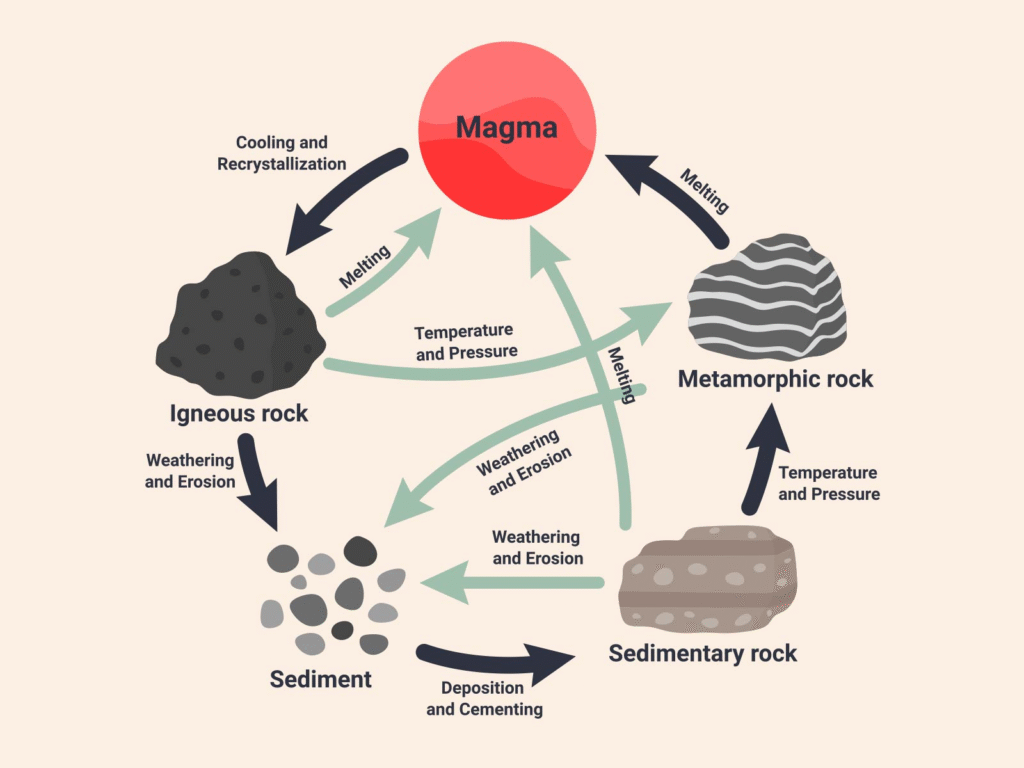
While the cycle is often drawn as a circle, it is more like a web with many “shortcuts.” Any rock can become any other type of rock depending on the forces acting upon it.
1. To become Igneous (Melting and Cooling)
Any rock—sedimentary, metamorphic, or even an existing igneous rock—can be pushed deep into the Earth where it melts into magma. When that magma (or lava) cools and hardens, it becomes a brand-new Igneous rock.
2. To become Sedimentary (Weathering and Erosion)
When rocks are pushed to the surface, they are attacked by wind, water, and ice. This breaks them down into sediment (sand, mud, or pebbles). Over time, these sediments are buried, compacted, and “glued” together (lithification) to form Sedimentary rock.
3. To become Metamorphic (Heat and Pressure)
If a rock is buried deep enough to be squeezed by the weight of mountains or heated by nearby magma—but not quite enough to melt—it undergoes a solid-state transformation. Its minerals rearrange into more stable forms, turning it into a Metamorphic rock.
Key Driving Forces
The rock cycle is powered by two main engines:
- The Sun: Powers the water cycle and weather, which causes the weathering and erosion needed to make sedimentary rocks.
- Earth’s Internal Heat: Powers plate tectonics, which creates the heat and pressure for metamorphism and the melting required for igneous rocks.
The “Shortcuts”
Rocks don’t always follow a perfect circle. For example:
- Igneous → Metamorphic: An igneous rock can be buried and turned into a metamorphic rock without ever becoming sediment first.
- Sedimentary → Sedimentary: A sedimentary rock can be eroded and turned back into new sediment.
- Metamorphic → Sedimentary: A mountain made of metamorphic rock can erode directly into a riverbed.
The Rock Cycle Diagram This video provides a clear visual breakdown of how rocks transform through weathering, melting, and pressure.
Solved Problems
Igneous & Tectonic Problems
- Problem: You find a rock with giant, 5 cm crystals. How did it form?Solution: Slow cooling deep underground. The rock is “Intrusive,” meaning it was insulated by miles of crust, giving atoms time to build large crystal lattices.
- Problem: A rock is full of tiny holes (vesicles) and feels light. Why?Solution: Rapid gas expansion. This is an “Extrusive” rock (like Pumice) that erupted from a volcano; the holes are “frozen” bubbles from volcanic gases.
- Problem: You find a dark, dense rock (Basalt) on a high mountain peak. How did it get there?Solution: Plate Tectonics. This was once the ocean floor, but tectonic collision (Orogeny) pushed the oceanic crust upward to form a mountain range.
- Problem: Two layers of rock have a vertical “wall” of different rock cutting through them. Which is older?Solution: Cross-Cutting Relationships. The vertical wall (a Dike) must be younger because you cannot cut through something that doesn’t exist yet.
- Problem: Why does a volcano erupt explosively instead of flowing like a river?Solution: High Silica Content. High silica ($SiO_2$) makes magma “sticky” (high viscosity), trapping gas until the pressure causes an explosion.
Sedimentary & Environmental Problems
- Problem: You find a layer of rock made of perfectly rounded pebbles. What was the environment?Solution: A high-energy river or beach. The constant tumbling in water acted like a rock tumbler, smoothing the jagged edges over time.
- Problem: A desert Sandstone has slanted, diagonal internal layers. Why?Solution: Cross-bedding. These represent the “lee side” of ancient sand dunes, recording the direction the wind was blowing millions of years ago.
- Problem: A rock layer contains a thick deposit of pure Salt ($NaCl$). How did it form?Solution: Evaporation. An ancient sea or lake was cut off from the ocean and dried up in a hot climate, leaving mineral “evaporites” behind.
- Problem: You find a Limestone layer full of coral fossils in the middle of a cold, dry desert.Solution: Paleoclimate Shift. This area was once a warm, shallow tropical sea. Plate tectonics drifted the landmass to its current desert location.
- Problem: A sedimentary layer has mud cracks preserved in stone. What does this tell us?Solution: Wet/Dry Cycles. The area was once a floodplain or lake bed that dried out completely, causing the mud to shrink and crack before being buried.
Metamorphic & Pressure Problems
- Problem: A rock has wavy, alternating bands of black and white minerals. What happened?Solution: High-Grade Metamorphism. Intense heat and pressure caused the minerals to migrate into distinct layers (Gneissic banding) without melting.
- Problem: You find “Slickensides” (polished, grooved surfaces) on a rock face.Solution: Faulting. These grooves were “scraped” into the rock as two massive blocks of crust ground past each other during an earthquake.
- Problem: A Sandstone has been turned into Quartzite, which is much harder. How?Solution: Recrystallization. Intense heat caused the individual sand grains to fuse together into a solid, interlocking mass of quartz.
- Problem: Why is Marble so much smoother and more decorative than the Limestone it came from?Solution: Contact Metamorphism. Heat from nearby magma “baked” the limestone, causing the tiny shell fragments to grow into larger, uniform calcite crystals.
Geologic History & Time Problems
- Problem: There is a “gap” in the rock record where layers are missing. What happened?Solution: Unconformity. Erosion (wind/rain) removed millions of years of rock before new sediment was deposited on top, leaving a “missing chapter” in history.
- Problem: How do we know a specific rock is exactly 252 million years old?Solution: Radiometric Dating. We measure the ratio of “parent” isotopes (like Uranium) to “daughter” isotopes (like Lead) inside minerals like Zircon.
- Problem: A fossil-rich layer is upside down (youngest on bottom). How?Solution: Tectonic Overturning. Extreme tectonic forces folded the Earth’s crust so severely that the entire stack of “pages” flipped over.
- Problem: You find a rock with “Glacial Striations” (deep scratches). What do they record?Solution: Ice Age Activity. A massive glacier carrying rocks in its “belly” dragged them across the bedrock, acting like giant sandpaper.
Learn how we bridge these gaps: [The Starline Philosophy: The Modern Polymath]
Why is it important to understand the earth system?