Why the Wind Doesn’t Move in a Straight Line
In our previous lecture, we established that the Pressure Gradient Force (PGF) pushes air from high to low pressure. If the Earth were stationary, wind would travel in a direct, straight path between these systems. However, because our planet is a rotating sphere, a deceptive force known as the Coriolis Effect comes into play.
Named after the French mathematician Gaspard-Gustave de Coriolis, this phenomenon describes how the rotation of the Earth deflects moving objects—including the vast currents of our atmosphere—away from their intended path.
The Physics of Deflection
The Coriolis Effect is a result of inertia. Points at the Earth’s equator are traveling significantly faster (about 1,600 km/h) than points near the poles. As air moves toward the poles, it maintains its equatorial momentum, causing it to “outrun” the ground beneath it.
- In the Northern Hemisphere: Air is deflected to the right of its path of motion.
- In the Southern Hemisphere: Air is deflected to the left.

The strength of this deflection is zero at the equator and reaches its maximum at the poles. It is also dependent on speed; the faster the wind blows, the more dramatic the “curve” becomes.
Geostrophic Flow and Canavu Starline
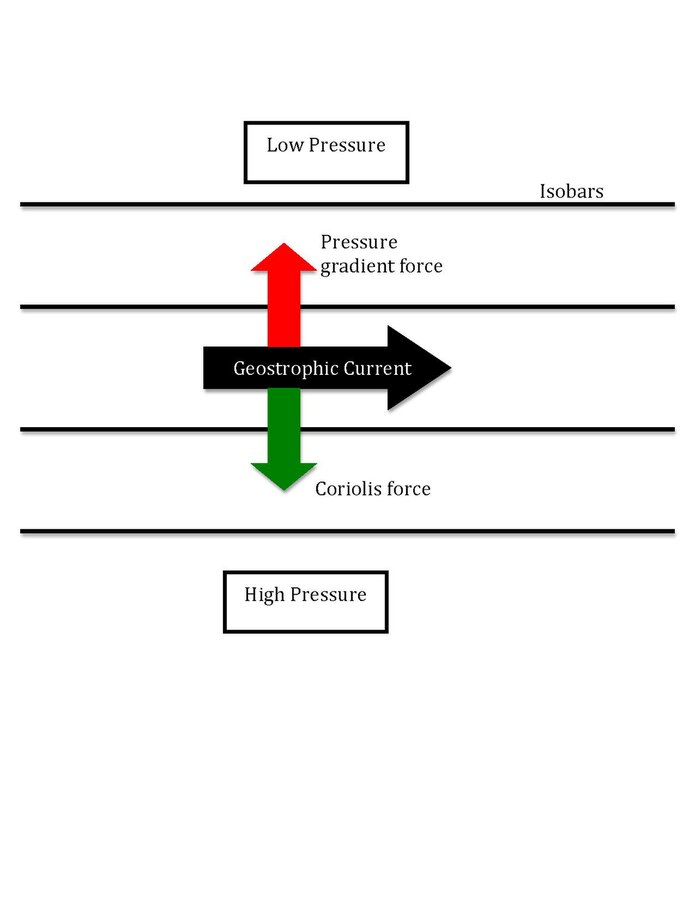
When the Pressure Gradient Force and the Coriolis Effect reach a state of equilibrium, we achieve what meteorologists call Geostrophic Flow. In this state, the wind blows parallel to the isobars rather than across them.
At Canavu Starline, we utilize satellite-derived velocity data to identify these balanced flows in the upper atmosphere. This allows us to track the Jet Stream—the high-speed “river of air” that steers major storm systems across the globe. Understanding the Coriolis Effect is essential for translating satellite observations into accurate movement predictions.