
Earth and Atmospheric Sciences
In physics, work and energy are essentially two sides of the same coin.1 They are so closely related that they even share the same unit of measurement: the Joule (J).2
The simplest way to think about their relationship is this: Work is the process of transferring energy, while Energy is the capacity to do work.3
The Fundamental Relationship
When you perform work on an object, you are physically transferring energy from yourself (or another source) into that object.4
1. The Work-Energy Theorem
This is the most direct mathematical link between the two.5 It states that the net work done by all forces acting on an object is equal to the change in its kinetic energy.6
Wnet = ΔKE = 1/2mvf2 – 1/2mvi2
- Positive Work: If you push an object in the direction it’s moving, you do positive work, and the object speeds up (its energy increases).7
- Negative Work: If you apply a force opposite to the direction of motion (like friction or braking), you do negative work, and the object slows down (its energy decreases).8
2. Work and Potential Energy
Work isn’t always about speed; it can also be about position. When you lift a book off the floor, you are doing work against gravity.9 That work doesn’t disappear; it is “stored” in the book as Gravitational Potential Energy. If you drop the book, that stored energy is converted back into kinetic energy.10
W = ΔPE = mgh
Summary Table
| Concept | Definition | Role in the Relationship |
| Work | Force applied over a displacement (W = F*d cosθ). | The action of transferring energy. |
| Energy | The ability to exert a force and cause a change. | The stored potential or active state of a system. |
Analogy: Think of energy like money in a bank account and work like a bank transfer. Work is the movement of the “funds” from one place to another.11
Work and the work-energy principle
This video provides a clear visual breakdown of how force and displacement combine to change an object’s energy state.
What is work?
In physics, work has a very specific meaning that is different from our everyday use of the word.1 You might “work” hard studying for an exam, but in physics, that doesn’t count as work!2
Work is the measure of energy transfer that occurs when an object is moved over a distance by an external force.3
The Recipe for Work
For work to be done on an object, three things must happen:4
- Force: You must apply a force to the object.5
- Displacement: The object must actually move (change its position).6
- Direction: There must be a component of the force acting in the same direction as the movement.7
The Mathematical Formula
The standard way to calculate work is using this equation:
W = Fdcos θ
- W: Work (measured in Joules, 8 J)9
- F: Magnitude of the force (in Newtons, 10 N)11
- d: Magnitude of the displacement (in meters, 12 m)13
- θ: The angle between the force and the direction of motion.14
When is Work NOT Done?
This is where physics gets counter-intuitive. In the following scenarios, the work done is zero:
| Scenario | Why it’s “Zero Work” |
| Pushing a wall | You are applying force, but there is no displacement (d = 0). |
| Carrying a box horizontally | You are lifting “up,” but moving “forward.” Since the force is perpendicular to the motion (cos 90° = 0), you do no work on the box. |
| A planet orbiting a star | The gravity pulls inward, but the motion is tangential. The angle is 15 90°, so the net work is zero.16 |
Positive vs. Negative Work
- Positive Work: Occurs when the force helps the motion (e.g., pushing a car forward).17 This adds energy to the object.18
- Negative Work: Occurs when the force opposes the motion (e.g., friction slowing down a sliding box).19 This removes energy from the object.20
Key Takeaway: If nothing moves, no work is done. If the force is perpendicular to the movement, no work is done.21
What is Work in Physics?
This video provides a great visual explanation of the dot product and how the angle between force and displacement changes the amount of work being done.
What is the relationship between the Work-Energy Theorem and kinetic energy?
The relationship between the Work-Energy Theorem and kinetic energy is fundamental: the theorem states that the net work done on an object is exactly equal to the change in its kinetic energy.1
If you think of kinetic energy as the “current state” of an object’s motion, then work is the “transaction” that changes that state.
1. The Definitions
To see how they connect, we first look at them individually:
- Kinetic Energy (KE): The energy an object has because it is moving. It depends on mass (m) and velocity (v): KE = 1/2mv2
- Net Work (7Wnet): The total result of all forces acting on an object over a distance (8d).9
2. The Theorem Equation
The Work-Energy Theorem acts as the bridge between force (Newton’s Laws) and energy:10
Wnet = ΔKE
Wnet = KEfinal – KEinitial
This means that if you know how much work was done on a car, you can tell exactly how much its speed increased, without even knowing how long it took or the specific path it traveled.
3. Why are they linked? (A Quick Derivation)11
The reason they are linked comes directly from Newton’s Second Law (12F = ma).13 If we look at an object moving in a straight line:
- Work is 14W = Fd.15
- Substitute 16 F = ma: 17 W = (ma)d.18
- From kinematics, we know that ad = (vf2 – vi2)/2.
- Plug that back into the work formula: W = m(vf2 – vi2)/2 = 1/2mvf2 – 1/2mvi2
This results in the final kinetic energy minus the initial kinetic energy!
4. Direct Consequences
| Action | Work Done | Effect on Kinetic Energy |
| Speeding Up | Net work is Positive. | KE increases; the object gains energy. |
| Slowing Down | Net work is Negative (e.g., friction). | KE decreases; the object loses energy. |
| Constant Speed | Net work is Zero. | KE stays the same. |
Pro Tip: The Work-Energy Theorem is often much easier to use than Newton’s Laws because work and energy are scalars (numbers), whereas force and acceleration are vectors (which require direction and complex math).19
Work and Kinetic Energy explained
This video provides a deep dive into the mathematical relationship between work and motion, offering several worked examples to help clarify the theorem.
What is gravitational potential energy?
Gravitational Potential Energy (GPE) is the energy an object possesses because of its position in a gravitational field. Essentially, it is “stored” energy that has the potential to be converted into other forms, like motion (kinetic energy).
If you lift a ball off the ground, you are doing work against gravity. That work doesn’t disappear; it gets stored in the ball as GPE. The higher you lift it, the more energy it stores.
The Formula
For objects near the surface of the Earth, we use a simple linear equation to calculate this energy:
PEg=mgh
- m: The mass of the object (in kilograms, kg)
- g: The acceleration due to gravity (approximately 9.8 m/s2 on Earth)
- h: The height of the object relative to a reference point (in meters, m)
The Role of the “Reference Point”
One unique thing about potential energy is that it is relative. To measure height (h), you must first decide where the “zero point” is.
- If you are standing on a balcony, you could set the balcony floor as h=0. In that case, a ball in your hand has zero GPE.
- If you set the ground far below as h=0, that same ball suddenly has a large amount of GPE.
The math works out the same regardless of what you choose, as long as you stay consistent throughout your calculation, because physics is usually interested in the change in energy (ΔPEg).
Energy Transformation: The Roller Coaster
A roller coaster is a perfect laboratory for seeing GPE in action.
- Going Up: The motor does work to pull the car to the top of the first hill, maximizing its GPE.
- At the Top: The car has maximum GPE but very little kinetic energy (KE).
- The Drop: As the car falls, gravity does work on it, converting that stored GPE into kinetic energy. The car loses height but gains speed.
Summary of Factors
| Factor | Effect on GPE | Why? |
| Mass | Increases GPE | More mass requires more work to lift against gravity. |
| Height | Increases GPE | Moving further from the source of gravity stores more energy. |
| Gravity | Increases GPE | On a planet with stronger gravity (like Jupiter), the same object would have much more GPE at the same height. |
Export to Sheets
Pro Tip: In space or at very large distances from a planet, the mgh formula is no longer accurate because g changes. In those cases, physicists use a more complex “Universal” formula: U=−GMm/r.
Gravitational Potential Energy, Example Problems This video walks through practical word problems to help you practice using the mgh formula with different masses and heights.
Gravitational Potential Energy, Example Problems – YouTube
What are conservative forces and what are nonconservative forces and is there a relationship between them?
In physics, forces are categorized based on whether the work they do depends on the path taken.1 This distinction is crucial because it determines whether a system “saves” its energy for later or “loses” it to the environment.
1. Conservative Forces
A force is conservative if the work it does on an object depends only on the starting and ending points, not on the specific path taken.2
- Path Independence: Whether you lift a box straight up or move it up a zigzagging ramp, the work done by gravity is the same if the total vertical height change is the same.3
- Closed Loops: If you move an object in a complete circle and return to the starting point, the net work done by a conservative force is zero.4
- Potential Energy: You can only define “Potential Energy” for conservative forces.5 The work done is essentially “stored” in the system.6
Examples: Gravity, Spring force (elastic), Electrostatic force.7
2. Nonconservative Forces
A force is nonconservative if the work it does depends on the path taken.8 These are often called “dissipative forces.”
- Path Dependence: If you slide a crate across a floor, the longer the path you take, the more work friction does.9 The start and end points aren’t enough to calculate the work; you need the full history of the motion.
- Energy Loss: These forces usually convert mechanical energy into non-recoverable forms, such as heat, sound, or internal deformation.10
- No Potential Energy: You cannot “store” energy in friction. Once it’s gone, it’s dissipated into the environment.11
Examples: Friction, Air resistance (drag), Tension, Applied force (a person pushing).12
The Relationship: The Work-Energy Connection
The relationship between these two types of forces is best seen through the Mechanical Energy (ME) of a system. Total mechanical energy is the sum of kinetic and potential energy: 13ME = KE + PE.14
The Master Equation
We can split the total work done on an object into work from conservative forces (Wc) and nonconservative forces (Wnc):
Wnet = Wc + Wnc
Since the Work-Energy Theorem says Wnet = ΔKE, and we know that work done by conservative forces is the negative change in potential energy (Wc = -ΔPE), we get:
ΔKE = -ΔPE + Wnc
Wnc = ΔKE + ΔPE
Wnc = ΔME
Key Takeaways
- If only conservative forces act: Wnc = 0, meaning ΔME = 0. Mechanical energy is conserved (it just swaps between 15 KE and 16PE).17
- If nonconservative forces act: Mechanical energy changes.18 Friction usually makes 19 Wnc negative, meaning the system loses mechanical energy.20 An applied force (like an engine) makes Wnc positive, adding energy to the system.
Summary Comparison
| Feature | Conservative Forces | Nonconservative Forces |
| Path Dependent? | No | Yes |
| Work on Closed Path | Zero | Non-zero |
| Associated PE? | Yes (e.g., mgh, 1/2kx2) | No |
| Effect on Mechanical Energy | Conserves it | Changes it (adds or removes) |
Conservative & Nonconservative Forces, Kinetic & Potential Energy, Mechanical Energy Conservation
This video provides a helpful introduction to how these forces interact and explains their role in the broader law of conservation of energy.
What is the conservation of mechanical energy?
The Law of Conservation of Mechanical Energy states that in an isolated system where only conservative forces (like gravity or spring force) are doing work, the total mechanical energy remains constant over time.1
Essentially, energy is never “lost” or “created” in these systems; it simply transforms back and forth between Kinetic Energy (2 KE) and Potential Energy (3 PE).4
The Formula
The principle is expressed mathematically as the sum of initial energies being equal to the sum of final energies:
MEi = MEf
KEi + PEi = KEf + PEf
Or, in its expanded form for a falling object:
1/2mvi2 + mghi = 1/2mvf2 + mghf
When Does This Apply?
Mechanical energy is only conserved if there are no nonconservative forces doing significant work on the system.
| Condition | Status | Effect on Mechanical Energy |
| Only Gravity/Springs acting | Conserved | ME stays the same; KE and PE swap values. |
| Friction/Air Resistance present | Not Conserved | ME decreases as it turns into heat or sound. |
| Applied Force (Pushing/Engine) | Not Conserved | ME increases as you add energy to the system. |
Real-World Examples
1. The Swinging Pendulum5
When you pull a pendulum back, it has maximum Potential Energy and zero Kinetic Energy. As it swings down:
- At the bottom: It has maximum speed (KE) and minimum height (PE).
- At the opposite peak: It stops momentarily, meaning all its KE has turned back into PE.
- The total (6 KE + PE) stays the same at every single point in the arc.7
2. The Roller Coaster
A roller coaster (ignoring friction for a moment) is a giant energy converter.8
- Top of the first hill: Maximum 9$PE$, minimum 10 KE.11
- Bottom of the drop: Minimum 12$PE$, maximum 13 KE (highest speed).14
- Entering a loop: The car slows down as it gains height, trading speed (KE) for height (PE).
Summary of Energy States
In a perfect system (no friction), the “trade-off” looks like this:
| Position of Object | Kinetic Energy (KE) | Potential Energy (PE) | Total Mechanical Energy (ME) |
| Highest Point | Zero (at rest) | Maximum | Constant |
| Falling/Mid-way | Increasing | Decreasing | Constant |
| Lowest Point15 | Maximum16 | Minimum (Zero)17 | Constant18 |
Note: In the real world, mechanical energy usually appears to “disappear” because of friction.19 In those cases, we say the Total Energy (including heat) is conserved, even if the Mechanical Energy is not.
Conservative & Nonconservative Forces and Mechanical Energy Conservation
This video explains how to distinguish between different force types and shows how they impact the total energy of a system.
How does the work-energy theorem apply to nonconservative forces?
When nonconservative forces (like friction, air resistance, or a person’s push) are present, the Work-Energy Theorem expands to account for the fact that mechanical energy is no longer conserved.1
In these cases, work is the mechanism that either “robs” the system of mechanical energy or “adds” to it.2
1. The Expanded Formula
To understand how it applies, we split the net work (3 Wnet) into two parts: work done by conservative forces (4 Wc, like gravity) and work done by nonconservative forces (5 Wnc).6
Wnc + Wc = ΔKE
Since we know that the work done by conservative forces is equal to the negative change in potential energy (7 Wc = -ΔPE), we can rearrange the equation:8
Wnc = ΔKE + ΔPE
Wnc = ΔME
This tells us that the work done by all nonconservative forces equals the change in the total mechanical energy of the system.9
2. Two Types of Nonconservative Work
Depending on the force, Wnc can be positive or negative, leading to very different outcomes:
Negative Work (Energy Dissipation)
Forces like friction and air resistance always act opposite to the direction of motion.10
- Effect: They remove mechanical energy from the system.11
- Result: This energy isn’t “gone” from the universe, but it is converted into thermal energy (heat) or sound, which cannot be easily turned back into motion.12
- Equation: MEinitial – |Wfriction| = MEfinal
Positive Work (Energy Addition)
Forces like an applied push, a motor, or a propellant can act in the direction of motion.
- Effect: They add mechanical energy to the system.13
- Result: The object gains speed or height that it didn’t have before.
- Equation: MEinitial + Wapplied = MEfinal
3. Practical Example: The Sliding Player14
Imagine a baseball player sliding into second base.15
- Initial State: The player has a high amount of $KE$ but zero $PE$ (on the ground).
- Action: Friction (a nonconservative force) acts against the slide.
- Final State: The player stops (KE = 0).
- The Theorem: The work done by friction (Wnc) is exactly equal to the loss of KE. If the player had 500 J of KE, friction must do -500 J of work to stop them.
Summary Comparison
| Force Type | Work-Energy Role | Impact on Mechanical Energy (ME) |
| Conservative | Converts KE ↔ PE | No change in total ME |
| Nonconservative16 | Transfers energy In/Out17 | Changes total 18 ME |
What is power?
In physics, power is the rate at which work is done or the rate at which energy is transferred over time.1
While work tells you how much energy was used, power tells you how fast that energy was used.2 For example, if you and a friend both climb the same flight of stairs, you both do the same amount of work.3 However, if you run up while your friend walks, you have more power because you did that work in less time.4
The Formulas for Power
There are two primary ways to calculate power depending on the information you have.5
1. The Work-Time Formula
This is the standard definition of power. It is a scalar quantity (no direction).6
$$P = \frac{W}{t}$$
- P: Power (measured in Watts, W)
- W: Work done (in Joules, 7 J)8
- t: Time taken (in seconds, 9 s)10
2. The Force-Velocity Formula
If an object is moving at a constant velocity while a force is being applied to it, you can calculate power directly:11
P = F ⋅ v
- F: Force applied (in Newtons, N)
- v: Velocity of the object (in m/s)12
Units of Power
The standard SI unit for power is the Watt (W), named after James Watt.13
1 Watt = 1 Joule per second
Horsepower (hp)
In the automotive and industrial worlds, we often use horsepower. This unit was originally created by James Watt to compare the output of his steam engines to the strength of draft horses.14
1 hp ≈ 746 Watts
Analogy: If Energy is the total “gas” in your tank, and Work is the “distance” you drive, then Power is how fast you are burning that gas to accelerate.
Power vs. Energy: A Comparison
It is common to confuse these two, especially with electricity.
| Feature | Energy / Work | Power |
| Definition | Total capacity to do stuff. | How fast you do that stuff. |
| Unit | Joule (J) | Watt (W) |
| Example | A battery holding 1000 J. | A lightbulb using 60 J every second (60 W). |
Power, Physics
This video provides a clear breakdown of the power formulas and walks through several real-world examples, such as the power generated by athletes and car engines.
Are there other forms of energy and how can they be described by the Conservation of Energy?
Beyond the mechanical energy (1$KE$ and 2$PE$) we’ve discussed, energy exists in several other forms.3 The Law of Conservation of Energy is the “universal rule” that states the total energy in a closed system remains constant, even as it shifts between these different forms.4
While we often use the word “lost” (e.g., “energy lost to friction”), it isn’t actually gone; it has simply transformed into a less useful form.5
Other Major Forms of Energy
Almost all forms of energy can be categorized as either a type of potential energy (stored) or kinetic energy (motion-based).6
| Form | Type | Description |
| Thermal | Kinetic | The internal energy of an object due to the random vibration/motion of its atoms. More motion equals higher temperature. |
| Chemical | Potential | Energy stored in the bonds of chemical compounds (atoms and molecules). Examples: food, gasoline, batteries. |
| Electrical | Kinetic | Energy caused by the movement of electrons through a conductor (like a wire). |
| Radiant | Kinetic | Electromagnetic energy that travels in transverse waves. Examples: light, X-rays, radio waves. |
| Nuclear | Potential | Energy stored in the nucleus of an atom. It’s released during fusion (joining) or fission (splitting). |
| Elastic | Potential | Energy stored in an object when it is temporarily deformed, like a stretched rubber band or compressed spring. |
How Conservation of Energy Describes Them
The general Law of Conservation of Energy is more inclusive than the conservation of mechanical energy. It can be written as:
Etotal = KE + PE + Wnc + OE = Constant
Where 7 OE stands for “Other Energies” like thermal or chemical.8
1. Energy Transformation (The Chain)
Conservation of energy is best seen through transformations.9 For example, when you use a flashlight:
- Chemical Energy (in the battery) is converted into…
- Electrical Energy (flowing through the circuit), which is converted into…10
- Radiant Energy (the light) and Thermal Energy (the heat you feel on the bulb). If you add up the light and heat produced, it will exactly equal the chemical energy lost from the battery.
2. The “Efficiency” Problem
The Law of Conservation of Energy tells us that 12 EnergyIn = EnergyOut.13 However, 14$Energy_{Out}$ is usually split into useful work and wasted energy (usually heat).15
- In a car engine, only about 20% of the Chemical Energy in gasoline becomes Mechanical Energy (motion). The other 80% is “lost” as Thermal Energy through the exhaust and engine block. The energy is still conserved, but it is no longer useful.
Summary: The Universe’s Balance Sheet
The Law of Conservation of Energy acts like a perfect accountant. Every Joule of energy must be accounted for. If a system’s mechanical energy decreases, a non-mechanical form (like heat or sound) must increase by the exact same amount.
The Law of Conservation of Energy
This video explains how energy is never truly “lost” but instead transforms between states like chemical, thermal, and mechanical, keeping the total energy of the universe constant.
How is work done by a variable force described?
In most real-world situations, forces are not constant.1 For example, as you stretch a spring, it gets harder and harder to pull; the force you apply changes with every millimeter of distance.2 This is a variable force.
Because the force (3 F) is constantly changing, you can’t simply multiply it by the total distance (4 d).5 Instead, you must calculate the work done over tiny, infinitesimal segments of the path and add them all together.6
1. The Graphical Method
The most intuitive way to describe work done by a variable force is by looking at a Force vs. Displacement (F-d) graph.7
- The Rule: The total work done is equal to the area under the curve on the graph.8
- Simple Shapes: If the force changes at a constant rate (like a straight diagonal line), the area might form a triangle or a trapezoid, which you can calculate using basic geometry.9
- Complex Curves: If the force changes irregularly, you can approximate the work by dividing the area into many thin rectangles and summing their areas.
2. The Calculus Method (Integration)
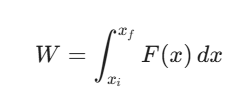
To find the exact amount of work for a force that varies continuously, we use integration.10 This mathematical tool “adds up” the work done over infinitely small displacements (11 dx).12
The Formula
If a force is a function of position, F(x), the work done from an initial position xi to a final position xf is:
Real-World Example: Stretching a Spring
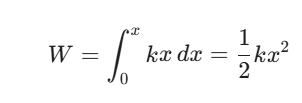
According to Hooke’s Law, the force required to stretch a spring is 13 F = kx (where 14 k is the spring constant).15 Since the force increases linearly with distance, the work is calculated as:
Summary Comparison
| Force Type | Calculation Method | Visual Representation |
| Constant Force | W = F ⋅ d | Area of a Rectangle |
| Linearly Variable | W = Average Force ⋅ d | Area of a Triangle/Trapezoid |
| Complex Variable16 | W = ∫F(x)dx | Total Area under the curve17 |
Work Done by a Variable Force
This video provides a deep dive into the calculus of variable forces, specifically using the spring force to demonstrate how integration “sums up” work over a distance.