Why is it important to understand the earth system?
Earth and Atmospheric Sciences
Scientists understand Earth not as a collection of isolated parts, but as a single, complex Earth System.1 This approach, known as Earth System Science (ESS), focuses on how energy and matter cycle through five major “spheres”: the Atmosphere (air), Hydrosphere (water), Biosphere (life), Geosphere (land/rocks), and Cryosphere (ice).2
To study these interactions, scientists use three primary “pillars” of research:
1. Global Observation (The “Eyes” on Earth)
Scientists collect massive amounts of data to see how the system is behaving in real-time.3
- Remote Sensing: Satellites like NASA’s Landsat or the European Sentinel missions monitor everything from ocean temperatures and sea-level rise to deforestation and greenhouse gas concentrations.4
- In-situ Measurements: Thousands of physical sensors are placed directly in the environment—ocean buoys (like the Argo floats), weather stations, and flux towers in forests—to provide “ground truth” for satellite data.5
2. Paleoclimatology (The “History” of Earth)
Because human records only go back a few centuries, scientists look at “proxy” data to understand how the Earth system handled changes in the deep past.6
- Ice Cores: Bubbles of ancient air trapped in Antarctic ice allow scientists to measure CO2 levels from 800,000 years ago.
- Tree Rings and Sediments: The width of tree rings or the chemical composition of lake-bottom mud reveals past cycles of drought, heat, and volcanic activity.7
3. Earth System Models (The “Laboratory”)
Since we can’t run experiments on the actual planet, scientists build digital “twin” Earths using supercomputers. These are called Earth System Models (ESMs).8
- Mathematical Grids: The Earth is divided into a 3D grid of “cells.”9 In each cell, the model solves complex equations—based on the laws of physics and chemistry—to simulate how air and water move, how plants grow, and how heat is exchanged.10
- Feedback Loops: Models are essential for spotting “tipping points.” For example, as Arctic ice melts (Cryosphere), the darker ocean absorbs more heat (Hydrosphere), which accelerates warming (Atmosphere).
Why this matters
By integrating these methods, scientists can move beyond simple cause-and-effect. They can see how a volcanic eruption in the Geosphere might cool the Atmosphere, which then alters rainfall patterns for the Biosphere. This holistic view is currently our most important tool for predicting the future impacts of climate change and human activity.
How is a planet built?
Building a planet is a multi-million-year construction project that starts with microscopic dust and ends with massive worlds. Astronomers generally agree on a “bottom-up” process called Core Accretion, which happens in four major stages.
1. The Protoplanetary Disk (The Construction Site)
It all begins in a solar nebula—a giant, rotating cloud of gas and dust. When the center of this cloud collapses to form a star, the leftover material flattens into a spinning “pancake” called a protoplanetary disk.
- The Materials: This disk is 99% gas (mostly hydrogen and helium) and 1% solid dust (microscopic grains of rock, metal, and ice).
- The Heat Zone: Near the hot center, only metal and rock can stay solid. Farther out, past the “frost line,” it’s cold enough for water and methane to freeze into ice.
2. Accretion (From Dust to Rocks)
Within the disk, dust grains begin to collide. Because they are so small, they don’t have enough gravity to pull each other in; instead, they stick together through static electricity—much like “dust bunnies” under a bed.
- Pebbles to Planetesimals: As these clumps grow to the size of pebbles, they start to sweep up more material. Once they reach about a kilometer in diameter, they are called planetesimals.
- Runaway Growth: At this size, gravity takes over. The larger a planetesimal gets, the more it “tugs” on its neighbors, growing faster and faster in a process called runaway accretion.
3. Planetary Embryos (The Great Merge)
The disk becomes a chaotic “demolition derby.” Thousands of planetesimals collide and merge to form protoplanets (or planetary embryos), which are roughly the size of our Moon or Mars.
- Terrestrial Planets: In the inner solar system, these rocky embryos continue to smash into each other until only a few large, stable planets remain (like Earth and Venus).
- Gas Giants: In the outer solar system, embryos have access to vast amounts of ice. They grow so large (about 10 times the mass of Earth) that their gravity becomes strong enough to vacuum up the surrounding hydrogen and helium gas, ballooning into giants like Jupiter.
4. Differentiation (Organizing the Interior)
As a young planet grows, it becomes incredibly hot due to constant impacts and radioactive decay. This heat turns the planet into a molten ball of “space lava.”
- The Iron Catastrophe: Gravity causes the densest materials (like iron and nickel) to sink to the center, while lighter materials (like silicates/rocks) float to the top.
- The Result: This process, called differentiation, creates the layered structure we see today: a dense metallic core, a rocky mantle, and a thin crust.
What are different aspects of geology?
Geology is a vast field that is generally split into two main umbrellas: Physical Geology, which focuses on the materials and processes occurring today, and Historical Geology, which seeks to reconstruct the timeline of Earth’s past.
To understand the whole system, scientists specialize in several different aspects:
1. Composition and Material
This is the “inventory” phase of geology—identifying what the Earth is actually made of.
- Mineralogy: The study of minerals, their crystalline structure, and chemical properties.
- Petrology: The study of rocks (igneous, sedimentary, and metamorphic) and the conditions under which they form.
- Geochemistry: Using chemistry to understand the distribution and migration of elements within the Earth’s crust and mantle.
2. Physical Processes and Dynamics
These specialists look at the forces that shape the planet’s surface and interior.
- Structural Geology: The study of how rocks bend and break under stress (creating folds and faults).
- Volcanology: The investigation of volcanoes, magma, and lava to understand how heat is transferred from the interior to the surface.
- Seismology: The study of earthquakes and the propagation of elastic waves through the Earth, which helps us “see” the internal layers of the planet.
- Geomorphology: Examining how landscapes are sculpted by water, wind, and ice (erosion and deposition).
3. The History of Earth
These branches act like forensic investigators, piecing together billions of years of history.
- Paleontology: The study of fossils to understand the evolution of life and past environments.
- Stratigraphy: The study of rock layers (strata) to determine the chronological sequence of events.
- Geochronology: Using radiometric dating (like carbon or uranium-lead dating) to assign absolute ages to rocks and fossils.
4. Applied and Economic Geology
This is where geological knowledge meets human needs and safety.
- Economic Geology: Searching for and managing natural resources like metals, minerals, and fossil fuels.
- Hydrogeology: The study of how water moves through underground aquifers.
- Engineering Geology: Applying geological data to the design of safe bridges, dams, and buildings.
- Environmental Geology: Managing the impact of human activity, such as cleaning up soil contamination or predicting natural hazards like landslides.
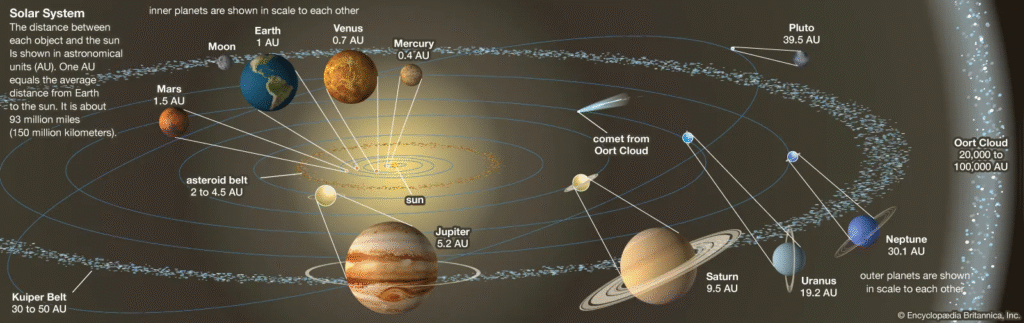
What is the origin of the system of planets?
The origin of the system of planets is explained by the Solar Nebula Hypothesis. This theory suggests that the Sun and all the planets formed at the same time, roughly 4.6 billion years ago, from a single, massive cloud of interstellar gas and dust.
The process unfolded in a series of dramatic steps that transformed a chaotic cloud into the ordered system we see today.
1. The Solar Nebula Collapse
The story begins with a nebula—a cold, swirling cloud mostly made of hydrogen and helium, with a tiny amount of heavier elements (dust).
- The Trigger: A nearby event, likely a supernova (exploding star), sent a shockwave through the cloud.
- The Result: This shockwave caused the cloud to collapse under its own gravity. As it shrank, it began to spin faster and faster, much like an ice skater pulling in their arms.
2. The Protoplanetary Disk
As the nebula spun, it flattened out into a disk (the protoplanetary disk) with a bulging center.
- The Sun’s Birth: Most of the material (99.8%) fell into the center, eventually becoming hot and dense enough to ignite nuclear fusion—this was the birth of our Sun.
- The Leftovers: The remaining 0.2% of the material stayed in the disk, circling the new Sun. This “leftover” material is what built the planets.
3. The “Frost Line” Division
Temperature played a crucial role in deciding which planets formed where. This created a boundary called the Frost Line (or Snow Line).
- Inside the Frost Line: Near the Sun, it was too hot for volatile gases or ices to condense. Only metals and rocks could remain solid. This led to the formation of small, rocky Terrestrial Planets (Mercury, Venus, Earth, and Mars).
- Outside the Frost Line: Farther out, it was cold enough for water, methane, and ammonia to freeze into ice. Since there was much more ice and gas available than rock, the planets grew much larger, becoming the Gas Giants (Jupiter, Saturn) and Ice Giants (Uranus, Neptune).
[Image showing the frost line in the solar system and the difference between inner rocky planets and outer gas giants]
4. Accretion: Building the Worlds
The actual “building” happened through a process called accretion:
- Dust to Pebbles: Microscopic dust particles collided and stuck together due to static electricity.
- Planetesimals: These clumps grew into “planetesimals” (kilometers wide), large enough to have their own gravity.
- Protoplanets: Planetesimals smashed into each other, merging to form “protoplanets.”
- Clearing the Neighborhood: Finally, the largest protoplanets used their gravity to vacuum up the remaining debris in their orbits, leaving behind the clean paths we see today.
Evidence for this Theory
Scientists are confident in this model because of several key observations:
- The Orbital Plane: All planets orbit the Sun in the same direction and in roughly the same flat plane, matching the shape of the original disk.
- Composition: The chemical makeup of the Sun and the planets matches the materials we find in ancient meteorites.
- Other Solar Systems: With modern telescopes like James Webb and ALMA, we have actually photographed other stars currently surrounded by these exact same types of dusty disks.
How can the earth be described as an evolving planet?
To describe Earth as an evolving planet means to view it not as a static rock, but as a dynamic system that has undergone radical physical, chemical, and biological transformations over 4.6 billion years.1
Unlike many of its neighbors, Earth’s “evolution” is characterized by feedback loops between the ground, the air, and life itself.
1. Geological Evolution: From Molten to Layered
In its infancy, Earth was a “hellish” world of molten magma.2 It evolved into a structured planet through a process called differentiation.3
- The Iron Catastrophe: As the young planet melted, heavy metals (iron and nickel) sank to form the core, while lighter rocks (silicates) floated to form the mantle and crust.4
- Plate Tectonics: Earth is the only known planet with active plate tectonics.5 Over eons, the crust has “evolved” by constantly recycling itself, breaking apart supercontinents like Rodinia and Pangea, and forging new ocean floors.6
2. Atmospheric Evolution: The Three Atmospheres
Earth’s air has been “re-written” at least three times.
- First Atmosphere: Composed of hydrogen and helium captured from the solar nebula; it was quickly stripped away by solar winds.7
- Second Atmosphere: Created by volcanic outgassing, this was a thick, “Venus-like” mix of 8$CO_2$, water vapor, and nitrogen.9 It lacked oxygen and was held in place by the newly formed magnetic field.10
- Third (Modern) Atmosphere: This is a biological invention.11 The evolution of photosynthetic life (cyanobacteria) led to the Great Oxygenation Event roughly 2.4 billion years ago, which permanently altered the planet’s chemistry.
3. Biological Evolution: Life as a Planetary Force
On most planets, “evolution” is purely geological. On Earth, the Biosphere acts as a geological force that reshapes the planet.
- Creating Minerals: Of the ~5,000 types of minerals on Earth, more than half would not exist without the presence of oxygen or organic life.
- The Ozone Shield: Life evolved the ability to photosynthesize, which created oxygen, which in turn created the Ozone Layer.12 This “shield” allowed life to leave the oceans and colonize the land, leading to the greening of the continents.
- The Carbon Cycle: Life helps regulate Earth’s temperature by burying carbon in the ground (as limestone or fossil fuels), acting as a biological thermostat that has kept Earth habitable for billions of years.
4. Summary of Major Eons
Scientists track this evolution through four major blocks of time:
| Eon | Time Period | Major Evolutionary Step |
| Hadean | 4.6 – 4.0 Ga | Formation of the Moon, cooling of the magma ocean. |
| Archean | 4.0 – 2.5 Ga | First oceans form; first single-celled life appears. |
| Proterozoic13 | 2.5 – 0.5 Ga14 | Oxygen fills the air; complex “Eukaryotic” cells evolve.15 |
| Phanerozoic | 0.5 Ga – Present | “Visible life”: Plants, dinosaurs, and humans emerge. |
What is plate tectonics and how is it a modern paradigm for geological science?
Plate tectonics is the scientific theory that describes the Earth’s outer shell, the lithosphere, as a set of rigid plates that glide over a soft, semi-molten layer called the asthenosphere.1
It is considered the modern paradigm (or “unifying theory”) of geology because it provides a single, elegant explanation for almost every major geological feature on Earth—from the deepest ocean trenches to the highest mountain peaks.2 Before this theory was accepted in the 1960s, geologists had no way to explain why earthquakes, volcanoes, and mountains occurred in specific patterns across the globe.
1. How the System Works
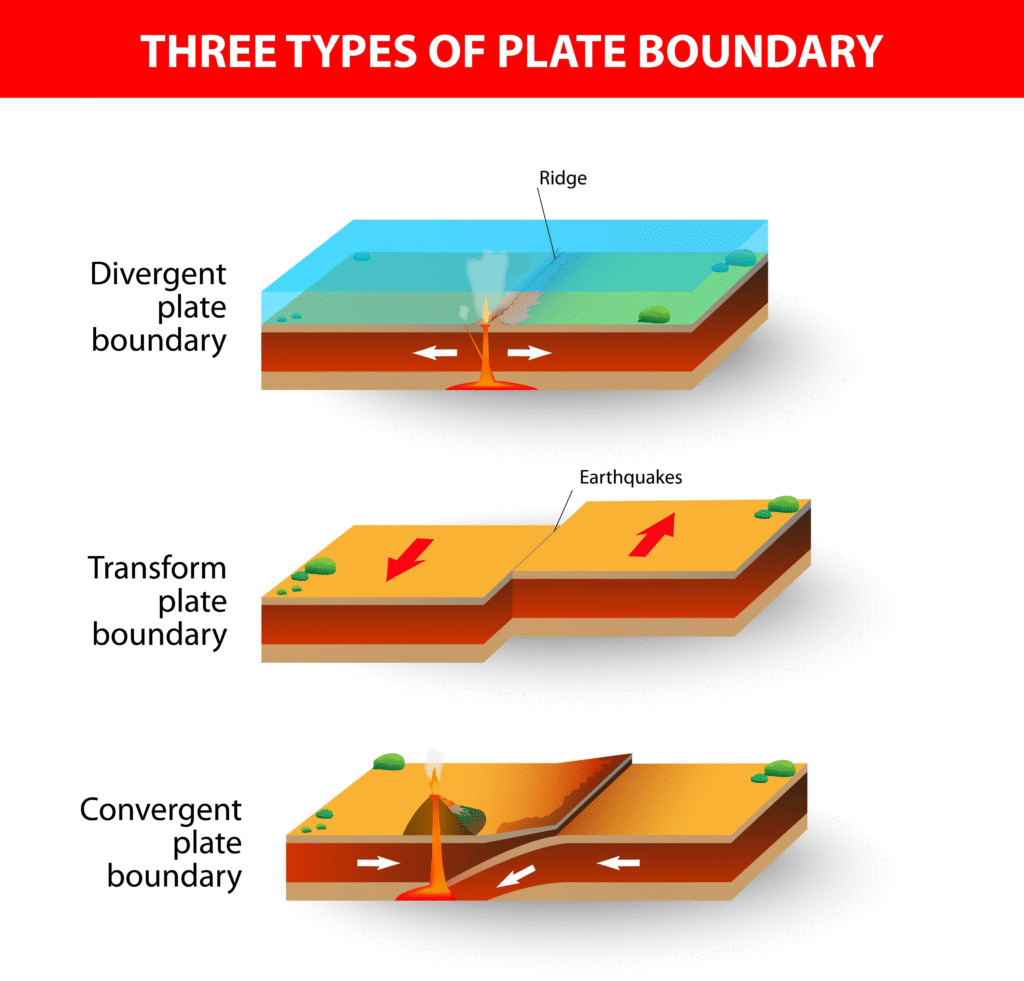
The Earth’s surface is broken into about 15–20 major and minor plates.3 These plates are constantly in motion, driven by mantle convection—a process where heat from the Earth’s core causes the mantle to flow in slow, circular currents, dragging the plates along like a conveyor belt.4
There are three primary ways these plates interact at their boundaries:5
- Divergent (Moving Apart): Plates pull away from each other, allowing magma to rise and create new crust.6 This happens at mid-ocean ridges.7
- Convergent (Crashing Together): Plates collide.8 If one is oceanic and the other continental, the denser oceanic plate sinks in a process called subduction.9 If two continental plates collide, they crumple upward to form massive mountain ranges like the Himalayas.10
- Transform (Sliding Past): Plates grind past each other horizontally.11 No new crust is created or destroyed, but the friction causes massive energy build-ups, leading to earthquakes like those along California’s San Andreas Fault.
2. Why It Is a Paradigm Shift
A “paradigm shift” occurs when a new idea completely replaces the old way of thinking.12 Before plate tectonics, scientists thought the continents were “anchored” in place and that mountains were caused by the Earth shrinking as it cooled (like a drying grape turning into a raisin).13
Plate tectonics revolutionized the field by connecting three previously “unsolved” mysteries:
| Feature | The Plate Tectonics Explanation |
| Continental Drift | Continents aren’t moving through the ocean; they are passengers on larger plates that are being recycled. |
| Seafloor Spreading | The discovery of “magnetic stripes” on the ocean floor proved that new crust is constantly being born at ridges and pushing older crust away. |
| The Ring of Fire | This explains why 90% of the world’s earthquakes and volcanoes occur in a specific circle around the Pacific—it’s the edge where several plates are subducting. |
3. The Evidence That “Sealed the Deal”
The theory moved from a wild idea to a scientific fact in the 1960s thanks to several key pieces of evidence:14
- The Jigsaw Fit: The coastlines of South America and Africa fit together almost perfectly.15
- Fossil Matches: Identical fossils of plants and animals (that couldn’t swim) were found on continents separated by thousands of miles of ocean.16
- GPS Measurements: Today, we can actually measure the movement of plates using satellites. We know, for example, that North America and Europe are moving apart at about the same rate your fingernails grow (2.5 cm per year).
What is geologic time?
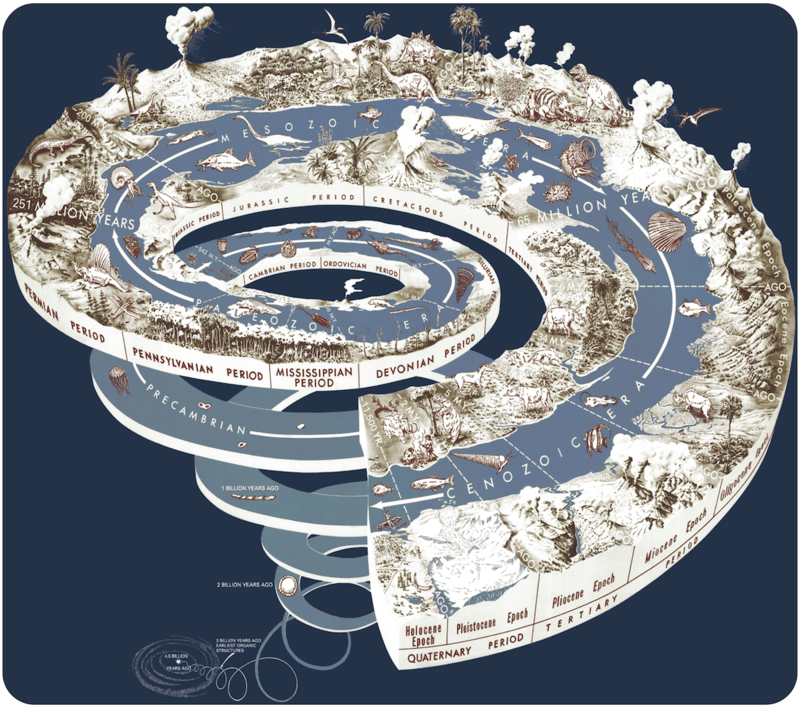
Geologic time is the vast chronological framework used by scientists to describe the history of our planet, spanning from Earth’s formation approximately 4.54 billion years ago to the present day.1
Because the history of Earth is so immense, geologists do not use standard calendars.2 Instead, they use the Geologic Time Scale (GTS), which acts as a “calendar” of Earth’s history, divided based on major events like the appearance of new life forms or massive extinctions.3
1. The Two Ways to Measure Time
Scientists use two distinct methods to determine where an event fits in geologic history:
- Relative Dating: This determines the order of events.4 Using the “Principle of Superposition,” geologists know that in undisturbed layers of rock, the oldest layers are at the bottom and the youngest are at the top.5
- Absolute (Radiometric) Dating: This determines the actual age in years. By measuring the decay of radioactive isotopes (like Uranium-238) within rocks, scientists can calculate exactly how many millions or billions of years have passed since that rock formed.6
2. The Hierarchy of Time
Geologic time is broken down into nested units, similar to how we divide time into years, months, and days. These divisions are defined by significant changes in the fossil record.
| Unit | Description | Example |
| Eons | The largest division, lasting hundreds of millions to billions of years. | Phanerozoic Eon (The age of visible life) |
| Eras | Subdivisions of eons marked by major changes in Earth’s biota. | Mesozoic Era (The age of dinosaurs) |
| Periods | Subdivisions of eras; the most commonly cited unit. | Jurassic Period |
| Epochs | Smaller subdivisions used mostly for the most recent periods. | Holocene Epoch (Our current time)7 |
3. “Deep Time” and the Clock Analogy
To help us grasp the staggering scale of geologic time (often called Deep Time), scientists often compress Earth’s 4.54-billion-year history into a single 24-hour clock:
- 00:00 (Midnight): Earth forms.
- 04:00 AM: First simple single-celled life appears.
- 09:00 PM: The first plants and animals move onto land.8
- 10:56 PM: Dinosaurs appear.
- 11:39 PM: Dinosaurs go extinct.9
- 11:58 PM: Human ancestors appear.
- 11:59:59 PM: All of recorded human history occurs in the final second.
Why it Matters
Understanding geologic time allows us to see that the Earth is a work in progress. It helps us understand the slow pace of evolution, the causes of past climate changes, and the long-term impact of human activity on a planetary scale.
The Geologic Time Scale Explained
This video provides a helpful overview of how the geologic time scale is organized and why it is a fundamental tool for anyone studying the history of our planet.
What is the scientific method?
The scientific method is a systematic, logical approach that scientists use to investigate the natural world, acquire new knowledge, or correct previous knowledge.1
Rather than a rigid, one-way street, it is often a cyclical process.2 If an experiment fails to support a hypothesis, scientists don’t “fail”; they use that new data to refine their ideas and try again.3
1. The Core Steps4
While different fields may adapt these steps, the standard process follows this path:
- Observation: It begins with noticing something interesting or unusual in the world (e.g., “Plants near the window grow taller than plants in the corner”).5
- Question: Defining a specific, testable problem (e.g., “Does the amount of sunlight affect plant height?”).6
- Hypothesis: Formulating an “educated guess”—a testable explanation for the observation (e.g., “If a plant receives more sunlight, then it will grow taller”).7
- Experimentation: Designing a fair test.8 This involves identifying variables:
- Independent Variable:9 The factor you change (amount of light).10
- Dependent Variable:11 The factor you measure (height of the plant).
- Control Variables:12 The factors you keep the same (soil type, amount of water, pot size).13
- Data Analysis: Collecting measurements and organizing them into graphs or tables to look for patterns.14
- Conclusion: Deciding if the data supports or refutes the hypothesis.15
2. A “Self-Correcting” System
The most important part of the scientific method is what happens after the conclusion.
- Peer Review: Before results are accepted as “scientific fact,” other experts in the field must review the experiment to ensure the methods were sound and the logic was unbiased.
- Replicability: A result isn’t considered reliable until other scientists can repeat the exact same experiment and get the same result.
- Iteration: If the data proves the hypothesis wrong, scientists go back to the beginning and form a new, better-informed hypothesis.16 This is how science “evolves.”
3. Hypothesis vs. Theory vs. Law
In everyday speech, people often use the word “theory” to mean a guess. In science, these terms have very specific, different meanings:
| Term | Meaning | Example |
| Hypothesis | A limited, testable explanation for a specific observation. | “This specific rock will sink in water.” |
| Theory | A broad, powerful explanation for why something happens, supported by a massive body of evidence. | Theory of Plate Tectonics |
| Law | A description of what happens under certain conditions, often expressed as a mathematical equation. | Law of Gravity |
[Image comparing a scientific hypothesis, theory, and law]
Why it Matters for Earth Science
Because we cannot “re-run” Earth’s history in a lab, Earth scientists often use the comparative method. They observe processes happening today (like a volcanic eruption) and use the scientific method to test if those same processes explain features from the past (like ancient lava flows).
Solved Problems
1. Question:
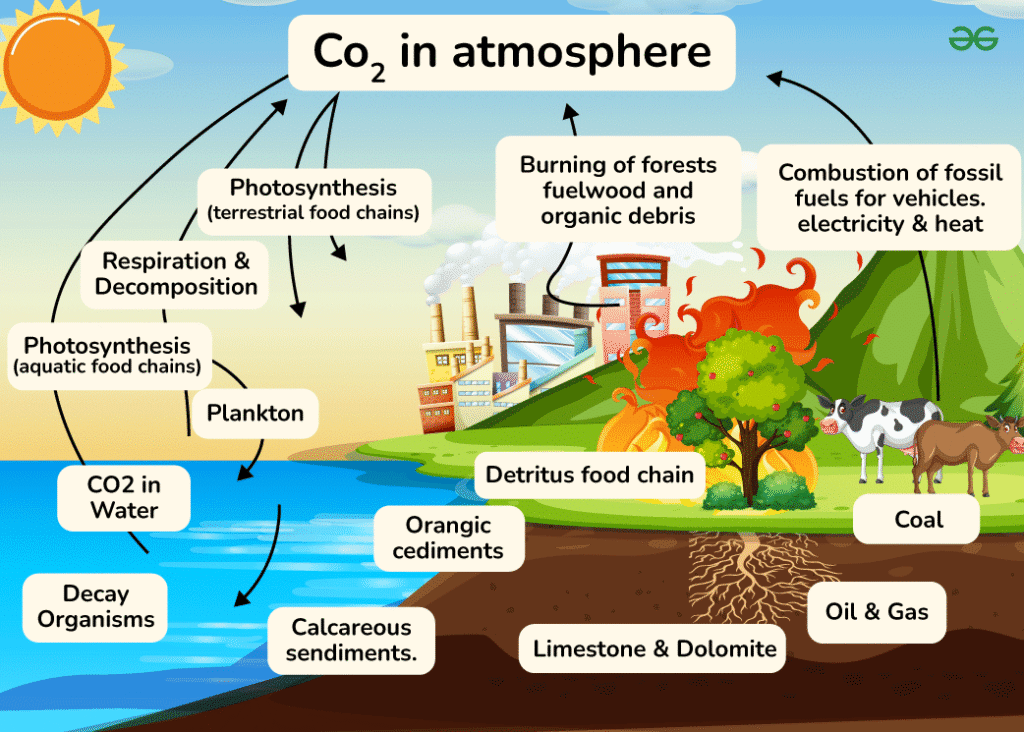
Explain how the carbon cycle connects the atmosphere, biosphere, and hydrosphere as a story of matter exchange.
Solution:
Carbon moves between spheres: plants absorb CO₂ (biosphere), oceans dissolve CO₂ (hydrosphere), and respiration/combustion releases CO₂ to the atmosphere. The narrative is a cycle of carbon flowing, being stored, and being released over time.
2. Question:
If global temperatures rise 2°C, what are the cascading effects on the cryosphere and sea levels?
Solution:
Warmer temperatures → ice melt → sea level rise → coastal flooding → habitat loss. The “story” shows chain reactions linking one sphere (atmosphere) to others (cryosphere, hydrosphere, biosphere).
3. Question:
Describe a scenario where a volcanic eruption affects climate and ecosystems.
Solution:
Eruption releases ash and CO₂ → blocks sunlight → temporary cooling → acid rain affects soil and water → plant and animal populations shift. This is a “plot twist” showing interconnected Earth processes.
4. Question:
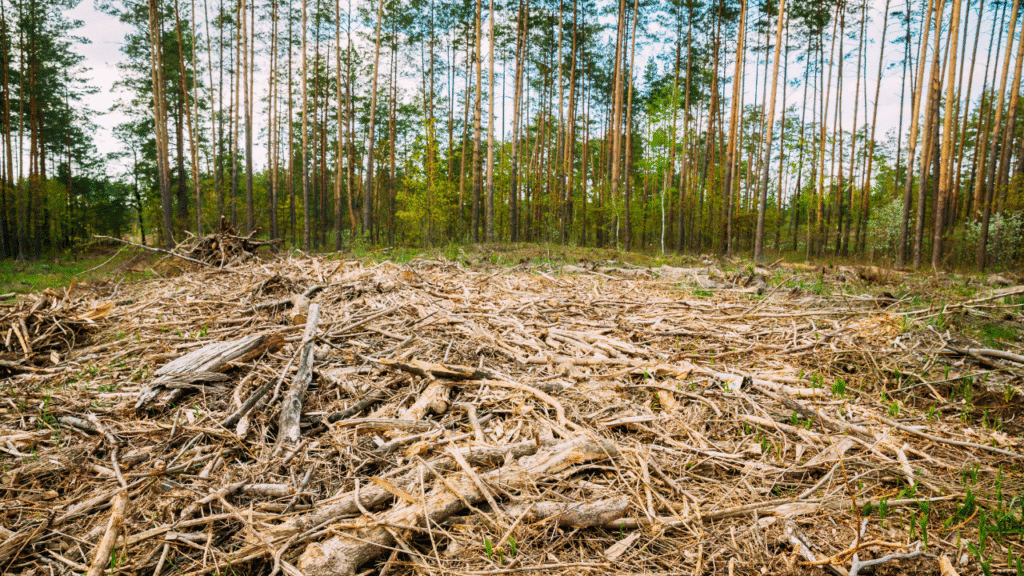
How does deforestation alter the Earth system narrative?
Solution:
Fewer trees → less CO₂ absorption → increased atmospheric CO₂ → enhanced greenhouse effect → climate change → shifts in species distributions. Humans act as major plot influencers.
5. Question:
What evidence from ice cores tells us the “story” of Earth’s past climate?
Solution:
Ice layers trap bubbles of ancient air. Scientists measure CO₂ and isotopes → reconstruct temperature changes → identify periods like ice ages or warming. Ice cores are “historical chapters.”
6. Question:
Explain the feedback loop between Arctic sea ice and global warming.
Solution:
Melting ice → less sunlight reflected → more heat absorbed → faster melting. Positive feedback accelerates the story of warming in polar regions.
7. Question:
How does plate tectonics drive the narrative of Earth’s surface changes?
Solution:
Tectonic movement → earthquakes, mountain building, volcanic activity → alters landscapes, creates habitats, affects climate. Each tectonic event is a “chapter” in Earth’s geological story.
8. Question:
Problem: A coastal city is experiencing rising sea levels of 3 mm/year. Predict the impact over 50 years.
Solution:
Sea level rise = 3 mm/year × 50 years = 150 mm = 15 cm. Consequences: increased flooding risk, shoreline erosion, saltwater intrusion. Planning must anticipate these narrative consequences.
9. Question:
How do ocean currents influence regional climates in the narrative of Earth’s climate system?
Solution:
Currents transport heat → warm currents raise temperatures, cold currents lower them. Example: Gulf Stream warms Europe → shapes human and ecological systems. Ocean currents are “storylines” moving energy globally.
10. Question:
Describe the narrative impact of human urbanization on the hydrological cycle.
Solution:
Impermeable surfaces → reduced infiltration → increased runoff → flooding → altered groundwater recharge. Urbanization is a “modern plot twist” changing water availability and ecosystem responses.
11. Question:
Problem: A forest absorbs 2,000 tons of CO₂/year. If 500 hectares are deforested, estimate the lost absorption if the forest originally covered 2,500 hectares.
Solution:
Absorption per hectare = 2,000 ÷ 2,500 = 0.8 tons/hectare. Loss = 500 × 0.8 = 400 tons CO₂/year. The narrative shows how removal of vegetation changes the carbon story.
12. Question:
How does an El Niño event demonstrate the narrative of interconnected systems?
Solution:
Pacific warming → altered ocean currents → atmospheric circulation changes → global rainfall and temperature anomalies → effects on agriculture and ecosystems. El Niño is a “chapter” connecting ocean and atmosphere.
13. Question:
Problem: A glacier retreats 10 m/year. Over 80 years, how far will it retreat?
Solution:
Retreat = 10 × 80 = 800 m. The glacier’s “storyline” shows how climate change influences landscape evolution.
14. Question:
Explain how biodiversity loss affects the Earth system narrative.
Solution:
Species extinction → weakened ecosystems → disrupted nutrient cycles → altered climate and human resources. Loss of characters in the story changes outcomes across spheres.
15. Question:
Problem: A city emits 1,000,000 tons of CO₂ annually. If carbon capture reduces emissions by 25%, how much CO₂ is removed?
Solution:
CO₂ removed = 1,000,000 × 0.25 = 250,000 tons. The city’s action “rewrites” its chapter in the global carbon story.
16. Question:
Describe how wildfires act as both a destructive and renewing plot point in the Earth system.
Solution:
Wildfires → vegetation loss → CO₂ release → soil changes → regrowth of fire-adapted species. They are destructive but drive ecosystem renewal, advancing the Earth system narrative.
17. Question:
How does permafrost thaw connect climate and ecosystems in Earth’s story?
Solution:
Thaw → releases trapped greenhouse gases → amplifies warming → affects habitats and human infrastructure. Feedback loops accelerate the narrative of change.
18. Question:
Problem: Sea surface temperature rises by 1.5°C. Predict the potential impact on hurricane intensity.
Solution:
Warmer ocean → more energy for storms → stronger, more frequent hurricanes → coastal and ecosystem damage. The story shows cause-and-effect between heat and weather events.
19. Question:
Explain how human-induced nitrogen runoff affects freshwater systems.
Solution:
Excess nitrogen → algal blooms → oxygen depletion → fish kills → disrupted aquatic ecosystems. Humans introduce a major plot change altering natural balance.
20. Question:
Problem: An area receives 100 mm of rainfall in 10 hours. Calculate the rainfall rate and discuss potential impacts.
Solution:
Rainfall rate = 100 ÷ 10 = 10 mm/hour. High intensity → flooding, soil erosion → affects landscapes and human settlements. Intense rain is a dramatic “event” in the narrative.
Learn how we bridge these gaps: [The Starline Philosophy: The Modern Polymath]