Have you ever wondered why the sky is blue, how a thunderstorm forms, or how forecasters can predict rain days in advance? You are not alone. The science of meteorology—the study of the Earth’s atmosphere and its phenomena—is at the heart of these questions. From your local weather report to global climate patterns, meteorology impacts every aspect of our lives.
In this post, we’ll take a deep dive into the essentials of atmospheric science, exploring the forces that drive the weather, the technology behind modern weather forecasting, and why this field is more crucial than ever in our changing world.
In a Nutshell: What is Meteorology?
Contrary to what many think, meteorology is more than just forecasting. It is a robust branch of physical science dedicated to understanding the atmosphere’s physical chemical characteristics, dynamics, and interactions with the Earth’s surface and oceans.
While weather refers to short-term atmospheric conditions, meteorologists examine the processes and laws of physics that create these conditions, seeking to model and predict them accurately.
The Fundamentals of Atmospheric Science
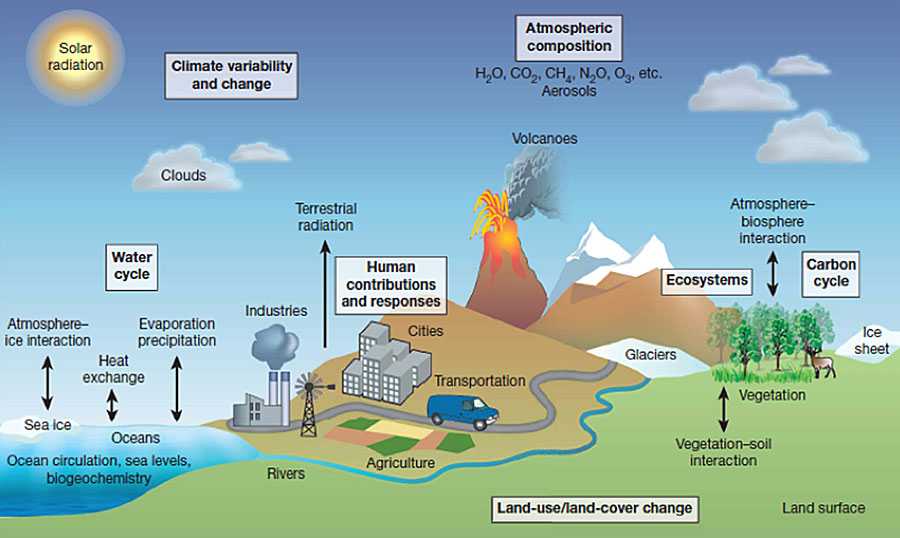
The atmosphere is a dynamic, complex fluid, driven primarily by the energy from the sun. The unequal heating of the Earth’s surface—more direct energy at the equator and less at the poles—creates imbalances that the atmosphere and oceans work constantly to redistribute. This redistribution is what we experience as weather.
The Key Ingredients: Core Meteorological Variables
To understand and predict the weather, meteorologists must constantly measure and analyze a specific set of variables.
| Variable | What It Is | Why It Matters | Instrument |
| Temperature | A measure of the average kinetic energy of molecules in the air. | Influences air density, pressure, and the form of precipitation. | Thermometer |
| Atmospheric Pressure | The weight of the air above a given point. | Differences in pressure create wind and drive weather systems. | Barometer |
| Humidity | The amount of water vapor in the air. | Essential for cloud formation, energy transfer (latent heat), and precipitation. | Hygrometer |
| Wind | Air moving from areas of higher pressure to areas of lower pressure. | Transports heat, moisture, and weather systems horizontally. | Anemometer (Speed), Wind Vane (Direction) |
| Precipitation | Any form of water, liquid or solid, that falls to the ground. | A critical part of the water cycle, vital for life and ecosystems. | Rain Gauge |
Did You Know? The average atmospheric pressure at sea level is approximately 1013.25 millibars (or 29.92 inches of mercury).
The Four Stages of Modern Weather Forecasting
Today’s weather forecasts are the result of a highly technical, multi-stage process involving global cooperation and massive computing power.
- Observation & Data Collection: Millions of observations are gathered daily from a vast network of sources, including surface weather stations, marine buoys, satellites, weather radar, and radiosondes (instruments carried by high-altitude weather balloons).
- Data Assimilation: All this raw data is analyzed, quality-controlled, and “fed” into mathematical models to create a coherent snapshot of the current state of the atmosphere.
- Numerical Weather Prediction (NWP): Powerful supercomputers run complex software models that use the laws of physics and fluid dynamics to simulate how the current atmosphere will evolve over time, from hours to weeks.
- Expert Interpretation & Post-Processing: Human forecasters review the model outputs, consider local geography, historical trends, and potential errors, and refine the data into clear, actionable public forecasts, warnings, and advisories.
See the Science in Action
Why Meteorology Matters
The importance of this field goes far beyond knowing if you need an umbrella.
- Public Safety: Meteorologists provide vital, early warnings for severe weather, including hurricanes, tornadoes, floods, and winter storms, saving countless lives and reducing property damage.
- The Economy: Industries like agriculture, aviation, energy production (wind/solar), and shipping rely heavily on accurate weather information for planning, efficiency, and safety.
- Climate Change & Environmental Health: Understanding atmospheric chemistry and long-term climate trends is critical for tracking and modeling climate change, analyzing its impacts, and developing strategies for mitigation and adaptation.
- Resource Management: Information on precipitation and snowpack is essential for water management, agricultural planning, and predicting droughts.
Beyond the Forecast: The Future of Atmospheric Science
The field of meteorology is in a constant state of rapid innovation, driven by new technologies that are transforming how we observe and understand our sky.
Key Technological Trends to Watch
- High-Resolution Satellite Data: A new generation of geostationary and polar-orbiting satellites is providing real-time, high-definition data and advanced imagery of the atmosphere on a global scale.
- Artificial Intelligence (AI) and Machine Learning: AI is already being used to improve pattern recognition in storm detection, automate data processing, and even generate nowcasts (very short-term forecasts) of severe weather with unprecedented speed and accuracy.
- Advanced Weather Radar: Doppler and dual-polarization radar technologies allow forecasters to “see” inside storms, determining not only the intensity of precipitation but also its exact type (rain, snow, hail) and the detailed internal wind structure, providing better tornado warnings.
- Next-Generation Computing: As computing power continues to grow, so do the accuracy and detail of Numerical Weather Prediction models, allowing us to simulate smaller-scale phenomena like individual thunderstorms and model climate patterns with more confidence.
Wrapping Up: The Dynamic, Essential Science
The science of meteorology is a vibrant, interconnected discipline that blends a deep curiosity about our world with cutting-edge technology and a profound sense of public service. Every time you check the forecast, you are benefiting from centuries of scientific research and the ongoing, innovative work of global teams dedicated to unlocking the secrets of our sky.
Learn More and Engage
Have a question about a specific type of weather phenomenon? Interested in learning how to read a weather radar like a pro? Check out our other posts on the topic, and leave your thoughts or questions in the comments below!