
Earth and Atmospheric Sciences
It’s a classic point of confusion, but think of it like the difference between total height and the potential to fall. One depends on who is standing there, while the other is just a property of the hill itself.
In physics terms, here is how they relate:
1. The Fundamental Difference
- Electric Potential Energy (U): This is the energy a specific charged particle possesses due to its position in an electric field. It depends on the size of the charge.
- Electric Potential (V): This is the potential energy per unit charge. It is a property of the location in space, regardless of whether a charge is actually there.
2. The Mathematical Connection
The relationship is defined by a simple linear equation. If you place a charge q at a point where the electric potential is V, the electric potential energy U is:
U = qV
From this, we can derive that the electric potential is:
V = U / q
3. The Gravity Analogy
If you’re finding the math a bit dry, the gravitational analogy is almost perfect:
| Feature | Gravity Analogy | Electric Equivalent |
| The “Field” | Earth’s Gravity | An Electric Field |
| Potential (V) | Height (h): A cliff is 100 meters high whether a pebble or a boulder is at the top. | Voltage: A battery terminal has 12V whether it’s connected to a lightbulb or not. |
| Potential Energy (U) | mgh: A boulder at that height has way more energy than a pebble. | qV: A large charge at that potential has more energy than a small one. |
Key Takeaway
If you double the charge (q), you double the energy (U), but the potential (V) stays exactly the same because it’s a characteristic of the field’s “terrain,” not the object traveling through it.
What is electric potential energy?
Think of Electric Potential Energy ($U$) as “stored” energy. It is the energy a charged object has because of its position relative to other charged objects.
If you have two magnets and you try to push the north poles together, you can feel the “push back”—that’s potential energy being stored. The moment you let go, that energy converts into motion. Electricity works the same way.
How It Works
Electric potential energy exists whenever a charge is placed in an electric field.
- Work and Energy: To move a charge against an electric force (like pushing two positive charges toward each other), you have to do work. That work is “stored” as electric potential energy.
- Release: If you release the charge, the field will push it away, converting that stored potential energy into kinetic energy (motion).
The Formula
For two point charges, q1 and q2, separated by a distance r, the electric potential energy is calculated as:
U = ke(q1q2) / r
Where:
- U is the electric potential energy (measured in Joules).
- ke is Coulomb’s constant (8.99 * 109 N • m2 / C2).
- q1 and q2 are the magnitudes of the charges.
- r is the distance between them.
Why the Sign Matters
Unlike some other types of energy, electric potential energy can be positive or negative:
- Like Charges (Positive U): If both charges are positive (or both negative), they naturally want to repel. You have to force them together. The closer they get, the higher the potential energy.
- Opposite Charges (Negative U): Since opposites attract, they “want” to be close. You actually have to do work to pull them apart. In this case, the potential energy is negative, and it increases (becomes less negative) as you pull them away from each other.
Summary Table
| Situation | Movement | Potential Energy (U) |
| Repelling (Like charges) | Pushing them closer | Increases |
| Repelling (Like charges) | Letting them move apart | Decreases |
| Attracting (Opposite charges) | Pulling them apart | Increases |
| Attracting (Opposite charges) | Letting them snap together | Decreases |
What is electric potential difference?
While electric potential is the “height” at a single point, electric potential difference is the change in “height” between two different points. You probably know it by its more common name: Voltage.
It represents the amount of work needed to move a unit of charge from point A to point B.
1. The Core Definition
The electric potential difference (ΔV) between two points is the change in electric potential energy (ΔU) per unit charge (q).
ΔV = VB – VA = ΔU / q
- Unit: The Volt (V). One Volt is defined as one Joule of energy per Coulomb of charge (1V = 1J/C).
- The “Push”: It is the “pressure” that drives an electric current through a circuit. Without a difference in potential, charges have no reason to move.
2. High Potential vs. Low Potential
In a standard circuit or electric field, charges move based on their sign:
- Positive Charges: Naturally “fall” from high potential (+) to low potential (-). This is like a ball rolling down a hill.
- Negative Charges (Electrons): Naturally move from low potential to high potential. They essentially “fall up” the hill because they are attracted to the positive side.
3. Practical Example: The Battery
Think of a 9-volt battery.
- The negative terminal is at 0V (the “bottom” of the hill).
- The positive terminal is at 9V (the “top” of the hill).
- The potential difference is 9V – 0V = 9V.
When you connect a wire, the battery provides the “slope” that allows energy to flow. If you have two points that are both at 9V, the difference is zero, and no current will flow—just like a ball won’t roll on a perfectly flat table.
Summary Table: Potential vs. Potential Difference
| Term | Symbol | Meaning | Analogy |
| Electric Potential | V | Potential at a single spot. | Elevation at one point on a mountain. |
| Potential Difference | ΔV | The difference between two spots. | The change in height between two points. |
What is the electric potential difference created by point charges?
When we talk about the electric potential difference created by a point charge, we are measuring the difference in “electrical pressure” between two specific distances from that charge.
If you have a source charge Q, it creates an electric potential (V) at every point in the space surrounding it. The potential difference (ΔV) is simply the subtraction of the potential at one radius (rB) from the potential at another (rA).
1. The Formula for a Single Point
First, remember that the potential V at a distance r from a point charge Q is:
V = ke (Q / r)
2. Calculating the Difference
To find the potential difference ($\Delta V$) between two points, $A$ and $B$, located at distances $r_A$ and $r_B$ from the charge, we use:
ΔV = VB – VA
Substituting the formula for V, we get:
ΔV = ke Q(1 / rB – 1 / rA)
- ke: Coulomb’s constant (≈ 8.99 * 109 N • m2 / C2).
- Q: The magnitude of the source charge.
- rA, rB: The distances from the charge to the points in question.
3. Visualizing the “Hill”
Think of a point charge like a mountain peak (if it’s positive) or a deep well (if it’s negative).
- Positive Charge (+Q): The potential is highest near the charge and drops toward zero as you move away. Moving from r=1m to r=2m is like walking downhill.
- Negative Charge (-Q): The potential is a large negative number near the charge and increases toward zero as you move away. Moving from r=1m to r=2m is like climbing out of a hole.
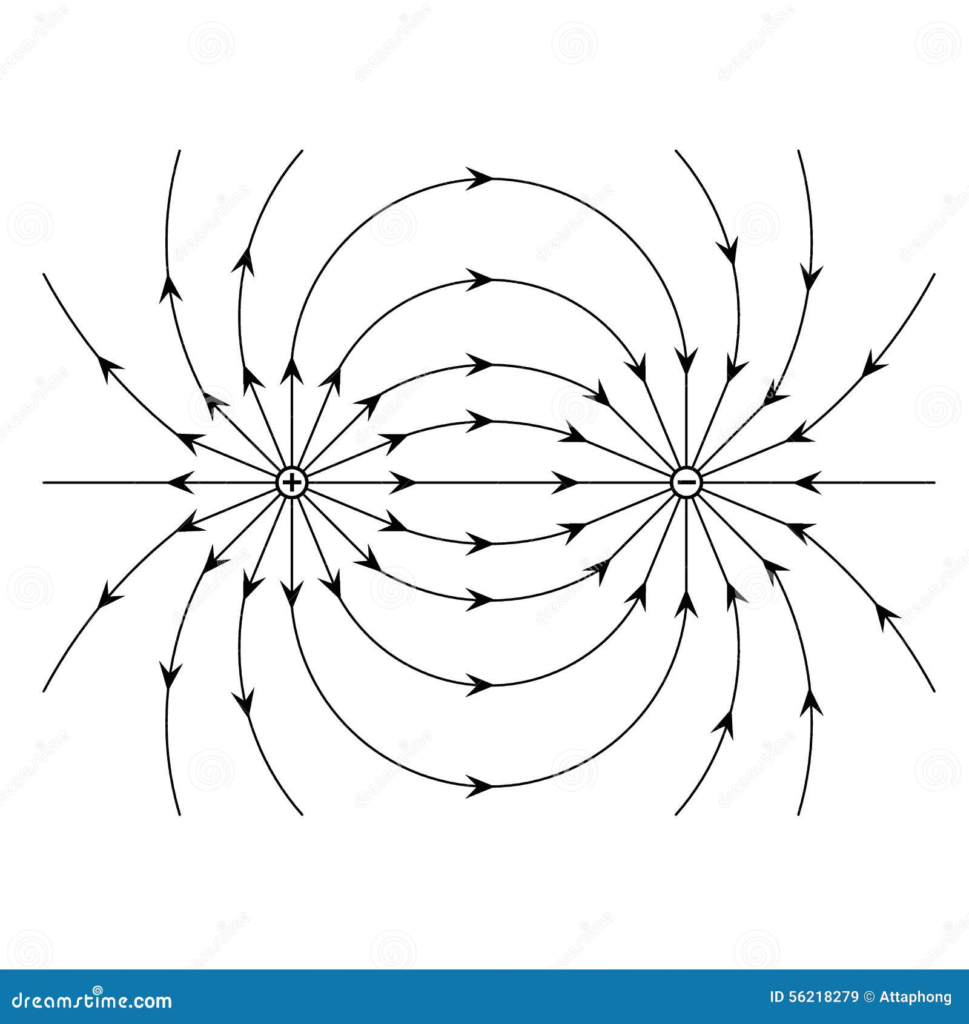
4. What if there are multiple charges?
The beauty of electric potential is that it is a scalar quantity (it doesn’t have a direction, just a value). If you have multiple point charges, you don’t need complex trigonometry or vectors. You simply calculate the potential from each charge at point A, add them up, do the same for point B, and then find the difference.
Vtotal = V1 + V2 + V3 + . . . .
Example Scenario:
If you move a test charge halfway between two identical positive charges, the potential difference would be zero because the “hills” from each charge cancel out the work needed to move laterally between them.
What are equipotential surfaces and what is their relationship to the electric field?
Think of an equipotential surface as a “contour line” on a map. Just as a contour line connects all points at the same elevation, an equipotential surface connects all points in space that have the same electric potential (V).
If you move a charge along one of these surfaces, you aren’t going “up” or “down” the electrical hill—meaning the potential energy stays constant.
1. Defining Characteristics
- Zero Work: Because the potential is the same everywhere on the surface (ΔV = 0), it takes zero work to move a charge from one point to another on that same surface (W = qΔV = 0).
- 3D Geometry: While we often draw them as lines on paper, in the real world, these are 3D “shells” or shapes surrounding charges.
2. Relationship to the Electric Field (E)
The relationship between equipotential surfaces and electric field lines is very specific and mathematically strict:
- Perpendicularity: Electric field lines are always perpendicular (90°) to equipotential surfaces at every point.
- Direction of Flow: Electric field lines always point in the direction of decreasing potential. They point “downhill.”
- Spacing and Strength: Where equipotential surfaces are crowded close together, the electric field is strongest. Where they are spread far apart, the field is weaker.
3. Common Visualizations
| Configuration | Shape of Equipotential Surfaces |
| Point Charge | Concentric spheres centered on the charge. |
| Uniform Electric Field | A series of parallel planes perpendicular to the field lines. |
| Electric Dipole | Complex “kidney” shapes that distort as they get closer to the opposite charge. |
| Conducting Surface | The surface of any conductor in equilibrium is itself an equipotential surface. |
4. Why are they always perpendicular?
If the electric field had a component parallel to the surface, it would exert a force on a charge moving along that surface. That force would do work, which would mean the potential is changing. Since the potential is, by definition, not changing on an equipotential surface, the field cannot have any component along it. It must be perfectly perpendicular.
Mathematically, this is expressed as the gradient:
E = -∇V
(The field is the negative gradient, or “steepness,” of the potential).
What are capacitors and what are dielectrics?
Think of a capacitor as a temporary storage tank for electric charge, and a dielectric as the specialized insulation that allows that tank to hold even more.
1. What is a Capacitor?
A capacitor is a passive electronic component that stores energy in an electric field. In its simplest form, it consists of two conducting plates separated by an insulating gap.
How it Works:
- When connected to a battery, electrons flow onto one plate (making it negative) and away from the other (making it positive).
- These opposite charges attract each other across the gap, creating an electric field.
- Even if you disconnect the battery, the charges remain “stuck” on the plates because they want to reach each other but can’t cross the gap.
Capacitance (C):
This is the measure of a capacitor’s ability to store charge. It is defined as the ratio of the charge (Q) on one plate to the potential difference (V) between them:
C = Q / V
- Unit: The Farad (F). (Most real-world capacitors are measured in microfarads, μF, or picofarads, pF).
2. What are Dielectrics?
A dielectric is an insulating material (like glass, plastic, or ceramic) placed between the plates of a capacitor.
While an insulator simply stops current, a dielectric does something special: it polarizes. When placed in the electric field between the plates, the molecules in the dielectric align themselves to create their own mini-electric field pointing in the opposite direction.
Why use a Dielectric?
- Prevents Arcing: It keeps the plates from touching or sparks from jumping across.
- Increases Capacitance: By opposing the main electric field, the dielectric reduces the overall voltage between the plates for the same amount of charge. Since C = Q/V, a lower V means a higher C.
The factor by which the capacitance increases is called the Dielectric Constant (κ):
C = κC0
(Where C0 is the capacitance with a vacuum between the plates).
3. Summary Comparison
| Component | Role | Analogy |
| Capacitor | The Device | A spring being compressed (storing potential energy). |
| Plates | Conductors | The ends of the spring where you apply force. |
| Dielectric | The Insulator | A physical block that prevents the spring from over-compressing or snapping. |
Key Formulas for a Parallel Plate Capacitor:
For plates with area A and separation d, the capacitance is:
C = (κϵ0A) / d
- Increase Area (A): More room for charge = More capacitance.
- Decrease Distance (d): Charges are closer/attract more = More capacitance.
- Better Dielectric (κ): Better polarization = More capacitance.
What are the medical applications of electric potential differences?
In medicine, the body is essentially a complex circuit. Our cells maintain their own tiny “batteries,” and our nerves and muscles function by rapidly changing their electric potential. Doctors use these potential differences in two main ways: Diagnostic (reading the body’s signals) and Therapeutic (applying external signals).
1. Diagnostic: Reading the Body’s “Voltages”
Every time your heart beats or a muscle twitches, a wave of changing electric potential spreads through your tissues. We can measure these differences using electrodes on the skin.
- Electrocardiogram (ECG/EKG): Measures the potential differences generated by the heart. As the heart’s chambers contract, the “depolarization” creates a measurable voltage shift that tells doctors if the heart rhythm is healthy.
- Electroencephalogram (EEG): Measures the rapid fluctuations in electric potential across the scalp caused by billions of neurons firing in the brain. It is used to diagnose epilepsy, sleep disorders, and brain death.
- Electromyogram (EMG): Measures the electrical activity of muscles at rest and during contraction to identify nerve damage or muscle disease.
2. Therapeutic: Using Potential to Heal
Sometimes the body’s natural “electrical timing” fails, and we have to apply an external potential difference to fix it.
- Defibrillation: When a heart is in “fibrillation” (quivering uselessly), a large potential difference is applied across the chest. This forces all heart cells to depolarize at once, essentially “rebooting” the heart’s natural pacemaker.
- Pacemakers: These are tiny implanted capacitors and batteries that deliver a small, timed potential difference directly to the heart muscle to maintain a steady heart rate.
- TENS Units: (Transcutaneous Electrical Nerve Stimulation) These devices apply a small potential difference across the skin to interfere with pain signals traveling to the brain.
3. Cellular Level: The Resting Potential
Every living cell maintains a Resting Membrane Potential. This is a tiny potential difference (usually about -70 mV) between the inside and outside of the cell membrane.
- The “Pump”: Cells use energy to pump ions (like Sodium and Potassium) across the membrane, creating a concentration gradient.
- Medical Significance: Many drugs work by affecting this potential. For example, local anesthetics (like Lidocaine) work by “plugging” the channels that allow ions to flow, preventing the potential change required to send a pain signal to your brain.
Summary Table: Medical Electricity
| Application | Measured/Applied | Primary Goal |
| ECG | Measured | Monitor heart health/rhythm. |
| Defibrillator | Applied | Stop life-threatening arrhythmias. |
| EEG | Measured | Study brain activity/seizures. |
| Electroporation | Applied | Use high voltage to “open” cell pores for drug delivery. |
Solved Problems
How did physics solve the mystery of sharks as electromagnetic predators?
For a long time, marine biologists were baffled by how sharks could locate prey buried deep under the sand or in pitch-black water where sight, smell, and sound were useless. The “mystery” was solved through the discovery of a biological sensor that functions exactly like a sensitive voltmeter.
Physics explains this through a specialized organ called the Ampullae of Lorenzini.
1. The Biological “Voltmeter”
Sharks have hundreds of tiny pores on their snouts filled with a highly conductive jelly. These pores lead to sensory cells that detect electric potential differences.
- The Jelly: The jelly in these tubes has one of the highest electrical conductivities of any biological substance. This allows the potential at the surface of the skin to be transmitted directly to the sensory nerves at the base of the pore.
- The Sensitivity: A shark can detect potential differences as small as 5 nanovolts (5 * 10-9 V). To put that in perspective, if you connected a standard AA battery to two electrodes 1,000 miles apart, a shark could detect the “slope” of that electric field.
2. The Source of the Signal: Bioelectricity
Physics tells us that every living creature is an electrochemical machine. Sharks exploit two specific physical phenomena:
- Muscle Contraction: Every time a fish moves its muscles or its heart beats, ions (Na+, K+, Ca2+) flow across cell membranes. This movement of charge creates a tiny electric current, which in turn creates a localized electric field in the seawater.
- The Battery Effect: Seawater is an electrolyte (it conducts electricity). A fish has a different internal salt concentration than the ocean. This creates an electrochemical potential difference between the fish’s mucous membranes (like gills) and the water—essentially turning the fish into a faint, living battery.
3. Solving the Navigation Mystery
Physics also solved how sharks navigate open oceans without landmarks. They use Electromagnetic Induction.
As a shark swims through the Earth’s magnetic field (B), the ions in its body are moving charges (q) with a velocity (v). According to the Lorentz Force Law:
F = q(v x B)
This force pushes the positive and negative ions in opposite directions within the shark’s snout, creating a tiny, measurable induced potential difference. By “feeling” the strength of this voltage, the shark can determine its orientation relative to the North Pole, acting like a biological compass.
Summary Table: Shark Electromagnetism
| Feature | Physical Principle | Function |
| Prey Detection | Electric Potential (V) | Sensing the “voltage” of a hidden fish’s heartbeat. |
| Conductive Jelly | Electrical Conductivity | Transporting the signal with zero loss. |
| Navigation | Magnetic Induction | Sensing the voltage created by swimming through Earth’s magnetic field. |
Why this matters for humans
Because we understand this physics, engineers have developed “Shark Shields” for surfers and divers. These devices emit a specific, high-voltage electric field that overloads the shark’s sensitive sensors, causing a localized (but harmless) muscle spasm that turns the shark away.