
Earth and Atmospheric Sciences
At its simplest, wave motion is the transfer of energy from one point to another without the permanent transfer of matter.
Think of it like a “stadium wave” at a sports game: the fans stay in their seats, but the disturbance (the visual wave) travels all the way around the arena. The particles of the medium (the fans) just move up and down, while the energy moves horizontally.
How It Works
Wave motion occurs when a source creates a disturbance in a medium (like air, water, or a string). This disturbance causes neighboring particles to oscillate, passing the energy along the line.
Types of Wave Motion
There are two primary ways particles can move relative to the direction of the wave:
- Transverse Waves:
- The particles move perpendicular to the direction of the wave.
- Examples: Light waves, ripples on a pond, or a plucked guitar string.
- Structure: It consists of peaks (crests) and valleys (troughs).
- Longitudinal Waves:
- The particles move parallel (back and forth) to the direction of the wave.
- Examples: Sound waves or a compressed slinky.
- Structure: It consists of crowded areas (compressions) and spread-out areas (rarefactions).
Key Characteristics
To describe wave motion accurately, we use a few specific measurements:
- Wavelength (λ): The distance between two consecutive identical points (e.g., crest to crest).
- Frequency (f): How many waves pass a point in one second (measured in Hertz, Hz).
- Amplitude: The maximum displacement of a particle from its rest position (the “height” of the wave).
- Velocity (v): How fast the wave is moving, calculated by: v = fλ
Why It Matters
Wave motion is the “delivery service” of the universe. Without it, you wouldn’t be able to hear music (sound waves), see the stars (electromagnetic waves), or use your smartphone (radio waves).
What is the relationship between waves and sound?
In short: Sound is a specific type of wave. While “wave” is a broad category that includes light, radio, and ocean swells, sound is the result of mechanical energy traveling through a medium (like air, water, or solids) as a longitudinal wave.
1. How Sound Moves
Sound is created by vibrations. When an object vibrates (like a vocal cord or a drumhead), it pushes against the air molecules next to it. These molecules then bump into their neighbors, creating a “domino effect” of energy.
- Compressions: Areas where molecules are squeezed together (high pressure).
- Rarefactions: Areas where molecules are spread apart (low pressure).
Unlike light, sound is a mechanical wave, meaning it requires a physical medium to travel. This is why “in space, no one can hear you scream”—there are no molecules to bump into each other.
2. Translating Wave Properties to Sound
The physical characteristics of a wave dictate exactly what we hear. We perceive these mathematical properties as sensory experiences:
| Wave Property | Sound Perception | Description |
| Frequency | Pitch | High frequency = high-pitched squeak; Low frequency = deep bass. |
| Amplitude | Volume | Larger “swings” in pressure create louder sounds. |
| Waveform | Timbre | The unique shape of the wave allows you to tell a piano from a trumpet. |
3. The Speed of Sound
Because sound relies on particles hitting each other, the density of the medium changes the speed of the wave:
- Solids: Sound travels fastest here because molecules are packed tightly together.
- Liquids: Medium speed.
- Gases (Air): Slowest because molecules are far apart and have to travel further to “hit” their neighbor.
4. The Doppler Effect
You’ve likely experienced the relationship between wave motion and sound when a siren passes you. As the ambulance moves toward you, it “bunches up” the sound waves in front of it, increasing the frequency and making the pitch sound higher. As it moves away, the waves stretch out, and the pitch drops.
What is the nature of waves?
To understand the nature of waves, you have to look past the “stuff” (the water, the air, or the string) and focus on the behavior of energy.
At its core, the nature of a wave is defined by oscillation and propagation. It is nature’s way of moving energy from point A to point B without actually moving any mass from A to B.
1. The Duality of Motion
A wave is essentially a conflict between two types of motion happening at the same time:
- The Medium’s Motion: The individual particles (like a molecule of water) move back and forth or up and down around a fixed central point. They never actually “leave” their neighborhood.
- The Wave’s Motion: The overall disturbance or “pattern” moves forward through the medium.
Analogy: If you do “the wave” at a stadium, you stand up and sit down (vertical motion), but the wave itself travels around the entire stadium (horizontal motion). You are the medium; the cheer is the energy.
2. Fundamental Properties
Every wave, regardless of its source, shares four defining characteristics. These are not just descriptions; they are the “DNA” of the wave.
- Period (T): The time it takes for one complete cycle to pass a given point.
- Speed (v): How fast the energy is traveling. Unlike physical objects, the speed of a wave is usually determined by the medium it travels through (e.g., sound travels faster in water than in air).
- Phase: Where a wave is in its cycle at a specific time. Two waves “in phase” reinforce each other, while waves “out of phase” can cancel each other out.
3. The Two Broad Families
While we categorize waves by how they move (transverse vs. longitudinal), their “nature” is also defined by whether or not they need a “home” (a medium).
Mechanical Waves
These require a physical substance to travel. They cannot exist in a vacuum.
- Nature: Physical bumping of atoms.
- Examples: Ocean waves, sound, seismic (earthquake) waves.
Electromagnetic Waves
These are “self-sustaining.” They consist of oscillating electric and magnetic fields that regenerate each other.
- Nature: Pure energy; they do not require a medium and can travel through the vacuum of space.
- Examples: Light, X-rays, Radio waves, Microwaves.
4. Wave Behaviors
The true nature of a wave is revealed when it interacts with its environment. Unlike solid objects, which just bounce off each other, waves can:
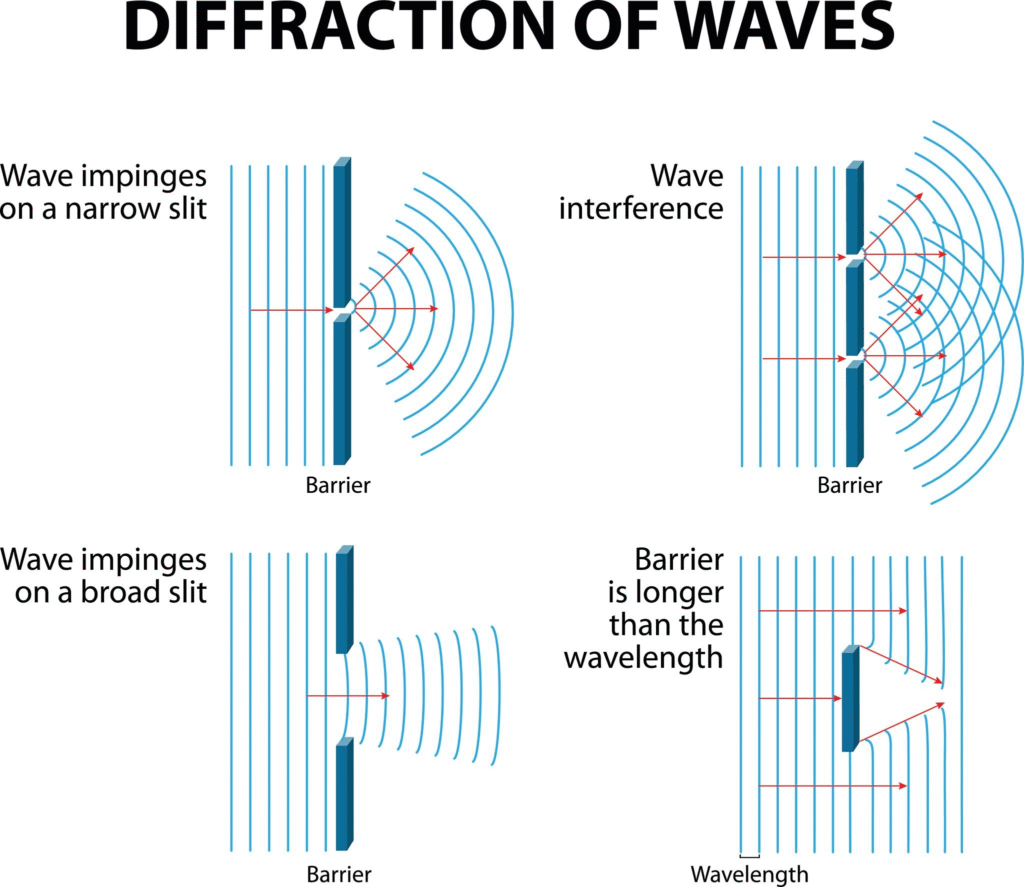
- Interfere: Two waves can pass right through each other, momentarily combining their heights.
- Diffract: Waves can bend around corners or spread out after passing through a gap.
- Refract: They change direction and speed when moving from one material to another (like light hitting water).
What are periodic waves?
A periodic wave is a wave that repeats the same pattern of motion at regular intervals of time.
If you splash your hand in a pool once, you get a single “pulse.” But if you move your hand up and down at a steady, rhythmic pace, you create a periodic wave. It is defined by its consistency and predictability.
1. The Anatomy of Periodicity
For a wave to be truly periodic, every cycle must be an exact replica of the one before it. We measure this “rhythm” using two main concepts:
- Period (T): The time (in seconds) it takes for one full wave cycle to pass a point.
- Frequency (f): The number of full cycles that happen in one second.
These two are inversely related. If a wave has a high frequency, it has a very short period. This relationship is expressed as:
f =1 / T
2. Harmonic Motion
The most common type of periodic wave is a sinusoidal wave (or sine wave). This occurs when the source of the wave is undergoing Simple Harmonic Motion—like a weight bouncing on a spring or a swinging pendulum.
In nature, periodic waves are rarely “perfect” due to friction or interference, but many systems aim for this stability:
- Musical Notes: A steady vibration of a violin string creates a periodic wave, which we hear as a clear, sustained pitch.
- The Power Grid: The electricity in your wall outlets is a periodic wave of alternating current (AC), usually cycling at 60 Hz (60 times per second).
3. Wave Trains
You will often hear periodic waves referred to as a “wave train.” Imagine a train with identical cars passing by; if you know the length of one car and how fast they are moving, you can predict exactly when the next one will arrive.
In a periodic wave train, the wavelength (λ)—the distance between peaks—remains constant as long as the medium doesn’t change.
4. Periodic vs. Non-Periodic
Not all waves are periodic. It’s helpful to see the contrast:
| Feature | Periodic Wave | Non-Periodic (Pulse/Shock) |
| Pattern | Repeats indefinitely. | Occurs once or randomly. |
| Frequency | Constant and measurable. | No single defined frequency. |
| Example | A humming tuning fork. | A single clap of thunder. |
Why is this distinction important?
Periodicity allows us to use waves for communication. Because the wave is predictable, we can “encode” information into it by slightly changing its frequency (FM) or amplitude (AM).
How is the speed of a wave on a string described?
The speed of a wave on a string isn’t a fixed number; it is a tug-of-war between how tightly the string is pulled and how heavy the string is.
Unlike a car that accelerates using an engine, a wave’s speed is determined entirely by the physical properties of the string itself.
1. The Governing Formula
The speed (v) of a transverse wave on a stretched string is described by the following relationship:
v = sqrt(T / μ)
Where:
- T is the Tension in the string (measured in Newtons).
- μ (mu) is the Linear Mass Density (mass per unit length, kg/m).
2. The Two Main Variables
Tension (T)
Think of tension as the “restoring force.” When you pluck a string, the tension is what pulls the string back toward its resting position.
- Higher Tension = Faster Wave: If you tighten a guitar string, the particles react more quickly to the pull, snapping back into place and passing the energy to their neighbors faster.
Linear Mass Density (μ)
This represents the “inertia” or heaviness of the string.
- Higher Density = Slower Wave: A thick, heavy bass string has more mass to move. It is “sluggish” and resists acceleration, meaning the wave takes longer to travel down the length of the string.
3. Real-World Application: The Piano
You can see this physics in action inside a piano or on a guitar:
- The High Notes: Use thin, lightweight wires pulled to high tension. Low mass + high tension = fast waves (high frequency).
- The Low Notes: Use thick wires (often wrapped in copper to add mass). High mass = slow waves (low frequency).
4. Wave Speed vs. Particle Speed
It is important to make a distinction between two types of motion happening on that string:
- Wave Speed (v): How fast the “hump” or disturbance moves horizontally from the bridge to the nut.
- Particle Speed: How fast an individual bit of string moves up and down.
While the wave speed is constant (as long as the tension doesn’t change), the particle speed is constantly changing as it oscillates up and down.
What is the mathematical description of a wave?
The mathematical description of a wave is a way to track the position of a particle at any given point in space (x) and at any given moment in time (t).
To do this, we use a Wave Function, typically represented as y(x, t). This function tells you the displacement (height) of the wave at any coordinate x and time t.
1. The Standard Wave Equation
For a basic periodic wave (a sine wave) traveling to the right, the displacement is written as:
y(x, t) = Asin(kx – ωt + φ)
Breaking Down the Variables:
- A (Amplitude): The maximum height of the wave from the center.
- k (Wave Number): This describes how many waves fit into a unit of distance. It is related to wavelength (λ) by k = 2π / λ.
- ω (Angular Frequency): This describes how fast the wave oscillates in radians per second. It is related to frequency (f) by ω = 2πf.
- φ (Phase Constant): This tells us the starting position of the wave at x=0, t=0.
- (kx – ωt): This is the phase. If the sign is negative (-), the wave moves to the right. If it is positive (+), the wave moves to the left.
2. The Relationship Between Speed and Components
You can find the velocity (v) of the wave directly from the wave function by looking at the ratio of the angular frequency to the wave number:
v = ω / k
This is a more “calculus-friendly” version of the classic v = fλ.
3. The General Linear Wave Equation
While the sine function describes the shape of the wave, the Linear Wave Equation is a partial differential equation that describes the physics of how waves behave in any medium.
If a function y(x, t) represents a wave, it must satisfy this second-order differential equation:
∂2y / ∂x2 = (1 / v2)(∂2y / ∂t2)
In plain English, this says: “The way the wave’s shape curves in space is directly proportional to how it accelerates in time.”
4. Superposition Principle
Because these equations are linear, waves have a unique mathematical property: you can add them together. If y1 and y2 are both solutions to the wave equation, then:
ytotal = y1 + y2
This simple addition is the math behind complex phenomena like interference patterns, standing waves, and even how your ears distinguish different instruments in an orchestra.
What is the nature of sound?
The nature of sound is that it is a mechanical, longitudinal pressure wave. While we often visualize sound as a wavy line, its physical reality is much more “push and pull” than “up and down.”
To truly understand sound, you have to look at it through three lenses: its physical requirement, its movement style, and its sensory perception.
1. The Physical Requirement: A Medium
Sound is a mechanical wave, meaning it cannot exist in a vacuum. It requires a medium—gas, liquid, or solid—to travel.
The nature of sound is essentially a relay race of atoms. A vibrating object (the source) knocks into nearby particles, which knock into the next, and so on. Without atoms to act as “messengers,” the energy has nowhere to go. This is why space is silent.
2. The Movement: Longitudinal Motion
Sound moves as a longitudinal wave. Unlike light waves which wiggle up and down, sound particles move back and forth in the same direction the wave travels.
As a sound wave passes through a medium, it creates two distinct regions:
- Compressions: High-pressure zones where molecules are jammed together.
- Rarefactions: Low-pressure zones where molecules are spread apart.
The Key Distinction: The individual air molecules don’t actually travel from the speaker to your ear; they just oscillate back and forth. Only the pressure disturbance (the energy) makes the full trip.
3. The Wave-Particle Interaction
The speed and “character” of sound are determined by the nature of the material it is moving through:
- Elasticity: Materials that “snap back” into shape quickly (like steel) transmit sound much faster than materials that are “squishy” (like rubber).
- Density: Generally, sound travels faster in solids than in liquids, and faster in liquids than in gases, because the atoms are closer together and can “hit” each other more quickly.
4. Sensory Translation
Our ears and brains translate the mathematical nature of these pressure waves into what we call “sound”:
| Wave Nature | Human Perception |
| Frequency (Cycles per second) | Pitch (High vs. Low) |
| Amplitude (Pressure intensity) | Loudness (Volume) |
| Harmonics (Wave complexity) | Timbre (Sound quality/tone) |
Summary of the “Nature of Sound”
- It is Energy in transit through matter.
- It is Pressure changes moving through a medium.
- It is Predictable (we can calculate exactly when a sound will arrive based on temperature and material).
What is the speed of sound?
The speed of sound is the rate at which a sound wave travels through a substance. In dry air at 20°C (68°F), the speed of sound is approximately 343 meters per second (about 1,235 km/h or 767 mph).
However, unlike the speed of light, which is a constant in a vacuum, the speed of sound changes significantly depending on what it is traveling through.
1. What Determines the Speed?
The speed of sound is dictated by two main properties of the medium: elasticity and density.
- Elasticity (Stiffness): Materials that are “stiff” or highly elastic (like steel) allow sound to travel faster because the atoms snap back into place quickly, passing the vibration to the next atom almost instantly.
- Density: In materials of the same phase (like two different gases), sound typically travels slower through denser materials because the heavier molecules have more inertia and are harder to move.
2. Speed in Different Media
Because of the factors above, sound travels at vastly different speeds depending on the state of matter:
| Medium | Approximate Speed (m/s) | Why? |
| Air (Gas) | 343 | Molecules are far apart; energy transfer is “slow.” |
| Water (Liquid) | 1,482 | Molecules are closer; sound travels ~4x faster than in air. |
| Steel (Solid) | 5,960 | High stiffness/density; sound travels ~17x faster than in air. |
3. The Role of Temperature
In gases like air, temperature is the most important variable. As air gets warmer, the molecules move faster and collide more often, which allows the sound wave to propagate more quickly.
For air near room temperature, you can calculate the speed (v) using this formula:
v = 331.3 + 0.606T
(Where T is the temperature in Celsius.)
4. Breaking the “Sound Barrier”
When an object, like a supersonic jet, travels faster than the speed of sound, it outruns the pressure waves it is creating. This causes the waves to “pile up” behind the object, creating a massive shock wave known as a sonic boom.
- Mach 1: Traveling at exactly the speed of sound.
- Subsonic: Traveling slower than the speed of sound.
- Supersonic: Traveling faster than the speed of sound.
What is sound intensity?
Sound intensity is the amount of energy that a sound wave carries per unit of time across a unit area. In simpler terms, it measures the “power” of the sound as it spreads out through a medium.
While we often use “intensity” and “loudness” interchangeably in casual conversation, they are different: intensity is a physical, objective measurement of energy, while loudness is a subjective human perception.
1. The Mathematical Definition
Intensity (I) is defined as the sound power (P) divided by the area (A) over which that power is spread:
I = P / A
- Unit: It is measured in Watts per square meter (W/m2).
- The Threshold of Hearing: The faintest sound a human ear can detect is approximately 10-12 W/m2.
- The Threshold of Pain: Sound becomes physically painful at around $1 \ W/m^2$.
2. The Inverse Square Law
Because sound waves usually spread out in all directions from a source (like a sphere), the area they cover increases as they travel further away. This means the intensity drops off very quickly as you move back.
If you double your distance from a sound source, the intensity doesn’t just cut in half—it drops to one-fourth of its original value.
3. Intensity vs. Decibels (dB)
Because the human ear can hear an incredibly wide range of intensities (from the drop of a pin to a jet engine), scientists use a logarithmic scale called the Decibel Scale to make the numbers more manageable.
| Source of Sound | Intensity (W/m2) | Intensity Level (dB) |
| Whispering | 10-10 | 20 dB |
| Normal Conversation | 10-6 | 60 dB |
| Power Lawn Mower | 10-2 | 100 dB |
| Jet Takeoff (close) | 102 | 140 dB |
Note on the Logarithmic Scale: Every increase of 10 dB represents a 10-fold increase in physical intensity. So, a 70 dB sound is 10 times more intense than a 60 dB sound, and 100 times more intense than a 50 dB sound.
4. Factors Affecting Intensity
- Amplitude: Intensity is proportional to the square of the wave’s amplitude (I ∝ A2). If you double the vibration width, you quadruple the intensity.
- Distance: As discussed with the Inverse Square Law, intensity fades as the distance from the source increases.
- Medium: Sound retains its intensity longer in denser media (like water) because the energy is less likely to be absorbed or scattered as heat.
What are Decibels?
A decibel (dB) is a logarithmic unit used to measure the intensity or “level” of a sound.
Unlike a ruler that measures distance in equal increments (1 inch, 2 inches, 3 inches), the decibel scale is logarithmic because human hearing is incredibly sensitive. We can hear everything from a mosquito’s wings to a rocket launch—a range where the loudest sound is about one trillion times more intense than the quietest one. Using a standard linear scale would result in numbers too massive to be practical.
1. How the Scale Works
The decibel scale compares a sound’s intensity to a reference point—the Threshold of Hearing (0 dB), which is the quietest sound a healthy human ear can detect.
Because it is logarithmic, the math works in powers of 10:
- An increase of 10 dB means the sound is 10 times more intense.
- An increase of 20 dB means the sound is 100 times more intense (10 * 10).
- An increase of 30 dB means the sound is 1,000 times more intense (10 * 10 * 10).
2. Common Sound Levels
To put these numbers into perspective, here is how everyday sounds rank on the decibel scale:
| Decibel Level | Sound Example | Perception |
| 0 dB | Threshold of Hearing | Nearly silent |
| 30 dB | Whisper, Quiet Library | Very quiet |
| 60 dB | Normal Conversation | Moderate |
| 90 dB | Hair Dryer, Lawnmower | Loud (Potential damage) |
| 120 dB | Rock Concert, Chainsaw | Threshold of Pain |
| 140 dB | Jet Engine Takeoff | Immediate hearing damage |
3. Intensity vs. Loudness
There is a catch to how we perceive these numbers:
- Intensity (Energy): As mentioned, every 10 dB is a 10-fold increase in physical energy.
- Loudness (Perception): Our brains don’t hear “10 times the energy” as “10 times louder.” Most humans perceive a 10 dB increase as being roughly twice as loud.
Example: A 70 dB vacuum cleaner has 10 times more energy than a 60 dB conversation, but to your ears, it only sounds about twice as loud.
4. Why Decibels Matter for Safety
Hearing damage is a function of both intensity and time. Because the scale grows so rapidly, sounds at higher decibels can damage the tiny hair cells in your inner ear much faster than you might realize.
- 85 dB: The “danger zone” begins. You can listen to this for about 8 hours.
- 100 dB: Safe exposure drops to only 15 minutes.
- 110 dB: Safe exposure is less than 2 minutes.
The Mathematical Formula
If you want to calculate the decibel level (L) from a physical intensity (I), the formula is:
L = 10log10 (I / I0)
Where I is the sound’s intensity and I0 is the threshold of hearing (10-12 W/m2).
What are some applications of sound?
Because sound is essentially a predictable mechanical wave, humans have developed ways to use it for everything from seeing inside the human body to mapping the dark reaches of the ocean floor.
Here are the primary applications of sound across different fields:
1. Medical Imaging (Ultrasound)
Doctors use high-frequency sound waves (ultrasound)—far above the range of human hearing—to “see” inside the body without using radiation.
- How it works: A probe sends sound pulses into the body. These waves reflect off organs and tissues. A computer measures the time it takes for the echoes to return to create a real-time image.
- Use cases: Monitoring fetal development, checking heart function (echocardiograms), and diagnosing gallbladder or kidney issues.
2. Navigation and Mapping (SONAR)
SONAR (Sound Navigation and Ranging) is used by ships and submarines to detect objects underwater or map the seafloor.
- How it works: Since light doesn’t travel far in water, sound is the perfect substitute. A ship sends a “ping” of sound downward. By measuring the time it takes for the sound to bounce off the bottom and return, the depth can be calculated using the speed of sound in water (v ≈ 1480 m/s).
- Nature’s version: Bats and dolphins use echolocation, which is a biological form of SONAR, to hunt and navigate in the dark.
3. Engineering and Industry
Sound is used in manufacturing and maintenance to find flaws that the human eye cannot see.
- Non-Destructive Testing (NDT): Ultrasonic waves are sent through metal beams or airplane wings. If there is a hidden crack or air pocket, the sound wave will reflect back differently than it would through solid metal.
- Ultrasonic Cleaning: High-frequency sound waves in a liquid create millions of tiny bubbles (cavitation). When these bubbles collapse, they release energy that “scrubs” delicate items like jewelry or surgical tools.
4. Communication and Entertainment
This is the most obvious application, but it involves sophisticated wave manipulation:
- Audio Engineering: Microphones convert sound pressure waves into electrical signals, which are then stored or broadcast. Speakers do the reverse, using electromagnetism to vibrate a cone and recreate the original pressure wave.
- Acoustics: Architects design concert halls and theaters using the principles of reflection and absorption to ensure sound reaches every seat clearly without creating muddy echoes.
5. Defense and Safety
- Active Noise Cancellation (ANC): Headphones use microphones to pick up ambient noise and immediately generate an “anti-noise” wave. This is a deliberate use of destructive interference to cancel out the sound wave before it hits your eardrum.
- Acoustic Hailing Devices: These are “sound cannons” used by ships or police to send highly directional, loud messages (or painful deterrent tones) over long distances.
What is the Doppler effect?
The Doppler effect is the change in the frequency (or pitch) of a wave in relation to an observer who is moving relative to the wave source.
It is most commonly noticed with sound—like the shift in the pitch of a passing siren—but it applies to all waves, including light and radio waves.
1. How It Works
The key to the Doppler effect is that the speed of the wave in the medium stays constant, but the distance between the wave crests changes because of the source’s motion.
The Source Moving Toward You
As the source moves toward you, it “catches up” to the waves it has already emitted. This bunches the waves together in front of the source.
- Wavelength: Decreases (shorter distance between waves).
- Frequency: Increases.
- Perception: For sound, the pitch becomes higher. For light, this is called blueshift.
The Source Moving Away From You
As the source moves away, it is traveling in the opposite direction of the waves it just emitted. This stretches the waves out.
- Wavelength: Increases (longer distance between waves).
- Frequency: Decreases.
- Perception: For sound, the pitch becomes lower. For light, this is called redshift.
2. The Formula
To calculate the observed frequency (f), you use the following equation:
f = f0 ( v + vr) / (v + vs)
Where:
- f0: Emitted frequency of the source.
- v: Velocity of waves in the medium.
- vr: Velocity of the receiver (you) relative to the medium.
- vs: Velocity of the source relative to the medium.
3. Real-World Applications
The Doppler effect isn’t just a curiosity of physics; it is a vital tool in modern science:
- Astronomy: Astronomers measure the “redshift” of distant galaxies to determine how fast they are moving away from Earth. This is how we discovered that the universe is expanding.
- Radar: Police use “Doppler Radar” to catch speeders. The device bounces a radio wave off a moving car and measures the frequency shift of the returning signal to calculate the car’s speed.
- Weather: Meteorologists use it to track the motion of precipitation and wind inside storms, which helps in predicting tornadoes.
- Medicine: Doctors use Doppler Ultrasound to measure the speed and direction of blood flow through the heart and arteries.
4. The “Sonic Boom” Connection
If the source moves at exactly the speed of sound, the waves in front can no longer get out of the way. They pile up into a single “wall” of pressure. When a source breaks this barrier (travels faster than the Doppler waves can move), it creates a shockwave known as a sonic boom.
Learn how we bridge these gaps: [The Starline Philosophy: The Modern Polymath]