
Earth and Atmospheric Sciences
Kinematics in one dimension is the study of motion along a straight line.1 In physics, “kinematics” refers to the description of how objects move (their path, speed, and change in speed) without worrying about the forces (like gravity or friction) that cause that motion.2
Because it is “one-dimensional,” the object can only move back and forth along a single axis (like the 3x-axis or 4y-axis).5
1. Core Variables
To describe 1D motion, we use five primary variables. You might see these referred to as the SUVAT variables in some textbooks:
| Variable | Symbol | Definition |
| Displacement | Δx | The change in position (xfinal – xinitial). |
| Initial Velocity | v0 (or u) | How fast the object is moving at the start (t = 0). |
| Final Velocity | v | How fast the object is moving at the end of the time interval. |
| Acceleration | a | The rate at which velocity changes. |
| Time | t | The duration of the motion. |
2. Key Concepts

Play classic Pac-Man Arcade Game Online – Nintendo and Atari Free Game Play
- Scalar vs. Vector: In 1D, direction is simplified to just positive (+) or negative (-).6 For example, moving right might be 7+5 m, while moving left is 8-5 m.9
- Displacement vs. Distance: Distance is the total ground covered (always positive), while displacement is simply the straight-line gap between where you started and where you ended.
- Constant Acceleration: Most introductory physics problems assume acceleration doesn’t change during the motion (e.g., an object in “free fall” has a constant downward acceleration of 109.8 m/s2).11
3. The Kinematic Equations
When acceleration is constant, you can use these four equations to solve for any unknown variable:
- Velocity-Time: v = v0 + at
- Position-Time: 12Δx = v0t + 1/2at2
- Velocity-Squared: 13v2 = v02 + 2aΔx
- Average Velocity: Δx = ((v + v0)/2)t

4. Real-World Examples
- A Sprinter: Running a 100m dash on a straight track.
- Free Fall: Dropping a ball from a bridge (motion is only in the vertical $y$ direction).
- Braking: A car slowing down in a straight line to stop at a red light.
Kinematics and One Dimensional Motion
This video provides a visual breakdown of the difference between distance and displacement, as well as how to apply the basic kinematic formulas to real problems.
What is displacement?
In physics, displacement is the change in an object’s position.1 It is a “straight-line” measurement from where an object started to where it ended, regardless of the path taken.2
Think of it as the “as the crow flies” distance between the start and finish.3
1. The Mathematical Definition
Displacement is a vector quantity, meaning it has both a magnitude (size) and a direction.4 In one dimension (like moving along a straight track), we calculate it using this formula:
Δx = xf – x0
- Δx: Displacement (the Greek letter Delta 5Δ means “change in”).6
- xf: Final position.7
- x0: Initial (starting) position.8
2. Displacement vs. Distance
This is the most common point of confusion. While they sound similar, they represent very different things in a physics problem:
| Feature | Distance | Displacement |
| Definition | Total ground covered. | Shortest gap between start and end. |
| Quantity | Scalar (number only). | Vector (number + direction). |
| Can it be negative? | No, always positive. | Yes (indicates direction). |
| Path Dependent? | Yes, every step counts. | No, only the start and end points matter.9 |
3. Examples in Action
- The Round Trip: If you walk 10 meters forward and 10 meters back to your starting spot, your distance is 20 meters, but your displacement is 0 because you didn’t end up “out of place.”10
- The Race Track: A runner finishing one lap on a 400m circular track has a distance of 400m but a displacement of 0.
- Negative Displacement: If you define “Right” as positive and you walk 5 meters to the left, your displacement is -5 m.
4. Why It Matters
In kinematics, we use displacement (not distance) to calculate velocity.11 If you don’t have a change in position (displacement), your average velocity is zero, even if you were moving very fast the whole time!12
Understanding Displacement in Physics
This video provides a great visual breakdown of why displacement only cares about your starting and ending points, with several examples to help distinguish it from distance.
Is there a relationship between speed and velocity?
Yes, there is a direct relationship between the two: speed is the magnitude of velocity.1
In simpler terms, velocity is speed with a direction attached.2 If you think of velocity as a complete description of motion, speed is just the number (the magnitude) part of that description.3
1. The Key Comparison
While they both tell you how fast something is moving, they differ in how they treat direction:4
| Feature | Speed | Velocity |
| Quantity Type | Scalar (Magnitude only) | Vector (Magnitude + Direction) |
| Formula | Speed = Distance / Time | v = Δx / t (Displacement / Time) |
| Direction | Not included | Required (e.g., North, +, or -) |
| Example | 25 m/s | 25 m/s to the North |
Example 1: Distance Run by a Jogger
How far does a jogger run in 1.5 hours (5400 s) if his average speed is 2.22 m/s?
Solution
To find the distance a jogger runs, you can use the formula for distance:
d = v * t
Where:
- v is the average speed (2.22 m/s)
- t is the time (5400 s)
Calculation:
d = 2.22 m/s * 5400 s
d = 11,988 meters
To convert this distance into kilometers:
d = 11,988 m / 1,000
d = 11.988 km
The jogger runs 11,988 meters (or approximately 11.99 km).
2. When are they different?
Because velocity depends on displacement (where you ended up) rather than distance (the path you took), speed and velocity can give you very different results during a trip.5
- Changing Direction: If you drive in a circle at a constant 6 60 mph, your speed is constant, but your velocity is constantly changing because your direction is changing.7
- The Round Trip: If you run 100 meters and return to your starting point in 20 seconds:
- Your average speed is 8 10 m/s (Total distance / time).9
- Your average velocity is 0 (Total displacement is zero).10
Example 2: A Diving Falcon
With an average speed of 67 m/s, how long does it take a falcon to dive to the ground along a 150-m path?
Solution

To find the time it takes for the falcon to dive, you can use the formula for time based on speed and distance:
t = d/v
Where:
- d is the distance (150 m)
- v is the average speed (67 m/s)
Calculation:
t = 150 m / 67 m/s
t ≈ 2.24 seconds
It takes the falcon approximately 2.24 seconds to dive to the ground.
3. Instantaneous vs. Average
The relationship is most “perfect” when looking at a single instant in time. At any specific moment, your instantaneous speed is exactly equal to the magnitude of your instantaneous velocity. The difference usually only appears when you calculate an average over a period of time where the object might have turned around or changed paths.
Difference between Speed and Velocity
This video provides a detailed explanation and a clear example of how to calculate both quantities to help you see the difference in practice.
Example 3: The World’s Fastest Jet-Engined car
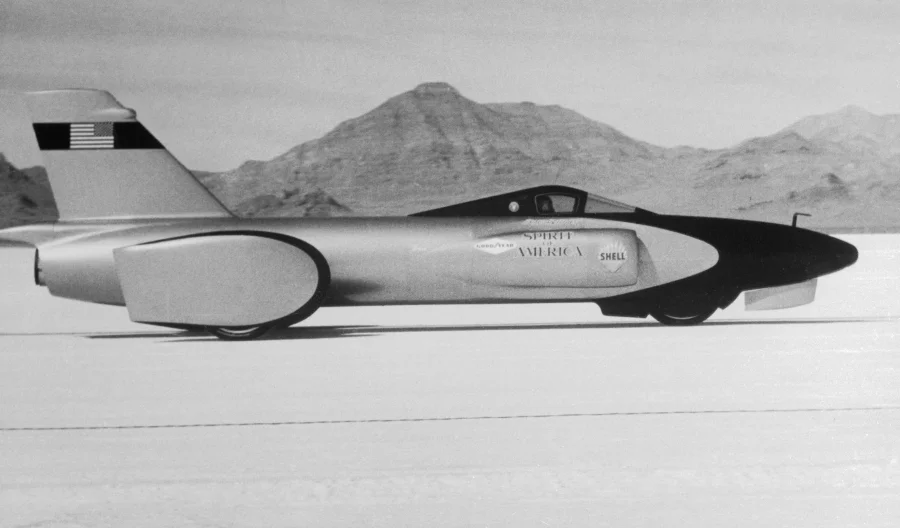
A world record of 283 m/s (633 mi/h) for the fastest jet-engined car was set in 1983 by Richard Noble in the car Thrust 2. Such a measurement is made by calculating the average velocity of the car over a measured course. The driver makes two runs through the course, one in each direction, to nullify any wind effects. The car first travels from left to right and covers a distance of 604 m in 2.12 s Then it drives the same course in the reverse direction, covering the same distance in 2.15 s. From these data, determine the average velocity for each run.
Solution
To determine the average velocity for each run, we use the formula for average velocity:
vavg = Δx / Δt
where Δx is the displacement (distance in a specific direction) and Δt is the time interval.
Run 1: Left to Right
- Distance (d): 604 m
- Time (t1): 2.12 s
v1 = 604 m / 2.12 s ≈ 284.91 m/s
Run 2: Right to Left (Reverse)
- Distance (d): 604 m
- Time (t2): 2.15 s
v2 = 604 m / 2.15 s ≈ 280.93 m/s
(Note: If velocity is treated as a vector where left-to-right is positive, the second run would be represented as $-280.93 m/s.)
Summary:
- Average velocity for the first run: 284.91 m/s
- Average velocity for the second run: 280.93 m/s
What is acceleration?
Acceleration is the rate at which an object’s velocity changes over time.1
In everyday language, we often use “acceleration” only when something speeds up.2 However, in physics, acceleration occurs whenever there is a change in speed, direction, or both.3 This means that slowing down or turning a corner are both forms of acceleration.4
1. The Formula
Acceleration is calculated by taking the change in velocity and dividing it by the time it took for that change to happen:5
a = Δv/t = (vf – v0)/t
- a: Acceleration
- vf: Final velocity6
- v0: Initial velocity7
- t: Time interval8
The Units: The standard unit for acceleration is meters per second squared (9m/s2).10 This literally means “meters per second, per second”—it tells you by how many meters per second your speed is changing every single second.11
2. Three Ways to Accelerate
Because velocity is a vector (it has speed and direction), there are three distinct ways an object can accelerate:12
- Speeding Up: Velocity and acceleration are in the same direction.13
- Slowing Down: Often called “deceleration,” this happens when acceleration is in the opposite direction of the motion.14
- Changing Direction: Even if you stay at a constant 15$20\text{ mph}$, turning a steering wheel causes acceleration because your velocity vector is changing.16
3. Positive vs. Negative Acceleration
The sign of acceleration depends on your chosen coordinate system:
- Positive (+): Acceleration is in the positive direction (usually right or up).17
- Negative (-): Acceleration is in the negative direction (usually left or down).18
Important Note: A negative acceleration does not always mean “slowing down.”19 If an object is already moving in the negative direction and has negative acceleration, it is actually speeding up in that negative direction!
4. Average vs. Instantaneous
- Average Acceleration: The total change in velocity over a measurable period of time.20
- Instantaneous Acceleration: How fast your velocity is changing at one specific “frozen” moment in time.21 On a velocity-time graph, this is the slope of the line at that exact point.22
Physics – Acceleration & Velocity – One Dimensional Motion
This video explains the relationship between velocity and acceleration and walks through how to solve one-dimensional motion problems using these concepts.
Are there equations that describe kinematics for constant acceleration?
Yes, there are four primary equations used to solve problems where acceleration is constant.1 These are often called the SUVAT equations (named after the variables they use: 2s for displacement, 3u for initial velocity, 4v for final velocity, 5a for acceleration, and 6t for time).7
Each equation is missing one of the five variables, which is why we have several—you simply choose the one that includes the information you have and the variable you need to find.8
The Big Four Kinematic Equations
| Equation | Missing Variable | Best Used When… |
| v = v0 + at | Displacement (Δx) | You don’t know the distance/displacement. |
| Δx = v0 + 1/2at2 | Final Velocity (v) | You don’t know the final speed. |
| v2 = v02 + 2aΔx | Time (t) | You don’t know how long the motion took. |
| Δx = ((v + v0)/2)t | Acceleration (a) | You don’t know the acceleration. |
How to Pick the Right Equation
When solving a physics problem, follow these steps to avoid getting stuck:
- List your “Knowns”: Write down the values given in the problem (e.g., v0 = 0, a = 9.8 m/s2).
- Identify your “Target”: What is the question asking for? (e.g., find Δx).
- Find the “Missing Variable”: Look for the variable that is neither given nor asked for.
- Match with the Table: Pick the equation that does not contain that missing variable.
Example: If you know how fast a car was going (v0), its final speed (v), and its acceleration (a), but you don’t know the time (t), you would use the “Velocity-Squared” equation (v2 = v02 + 2aΔx) to find the distance.
Why “Constant” Acceleration Matters
These specific formulas only work if the acceleration stays the same throughout the motion. If the acceleration changes (like a rocket engine sputtering or a person pulsing their brakes), you would typically need calculus (integration) to find the position and velocity.
Kinematic Equations – Resources – PASCO scientific
This resource provides a clear breakdown of each equation, including their derivations and how to break motion into horizontal and vertical components.
How are the kinematics equations applied?
Applying the kinematic equations effectively is about more than just “plugging in numbers.”1 It requires a structured strategy to ensure you’re using the right formula for the right situation.2
1. The Five-Step Problem-Solving Strategy
Professional physicists and students alike use this systematic approach to avoid confusion:
- Draw a Diagram: Sketch the scenario.3 This helps you visualize the motion and decide which direction is positive (+) (usually right or up) and which is negative (-).4
- List Your “Givens”: Scour the problem for the five kinematic variables (Δx, v0, v, a, t).
- Tip: Look for “hidden” values.5 Words like “at rest” mean 6v0 = 0.7 “Stops” means v = 0. “Dropped” means a = -9.8 m/s2 (gravity).
- Identify the Target: Clearly mark what you are trying to find.8
- Pick the Equation: Select the kinematic equation that contains your three known variables and your one unknown target.9
- Solve and Check: Rearrange the equation for your target variable, plug in the numbers, and check if the answer makes sense.10 (e.g., If a car takes 3 hours to stop from 20 mph, you likely made a unit error).
2. Common Challenges and “Hidden” Information
Applying these equations often requires reading between the lines of a word problem:
- Free Fall: In vertical motion problems, acceleration is almost always a = -9.8 m/s2 (or -10 for quick estimates). At the very peak of a throw, the instantaneous velocity 11v is always 0.12
- Deceleration: If an object is slowing down, its acceleration must have the opposite sign of its velocity.13 If it’s moving right (14+) and slowing down, 15a must be negative (16-).17
- Units: Always convert to standard SI units (meters, seconds, m/s2) before calculating. Mixing kilometers per hour with seconds will result in a wrong answer.
3. Example Application
Scenario: A car traveling at 15 m/s slams on its brakes and stops in 3 seconds. How far did it slide?
- Knowns: v0 = 15 m/s, v = 0 (stopped), t = 3 s.
- Target: Displacement (18Δx).19
- Missing Variable: Acceleration (a) is neither given nor asked for.
- Selection: Use the equation that doesn’t need a: Δx = ((v + v0)/2)t
- Calculation: Δx = ((0 + 15)/2) * 3 = 7.5 * 3 = 22.5 meters
AP Physics 1 – Applying Kinematic Equations
This video is an excellent guide for mastering these steps, featuring specific examples like a stopping car and a hockey puck to show exactly how to identify variables and choose the right formula.
What is free fall?
Free fall is a specific type of motion where the only force acting on an object is gravity.1
In a true free fall, there is no air resistance, friction, or any other force pushing or pulling the object.2 Because only gravity is at work, all objects in free fall—regardless of their mass—accelerate at exactly the same rate.3
1. The Key Value: g
On Earth, the acceleration due to gravity is represented by the symbol 4g.5
- Value: 6g ≈ 9.8 m/s2 (downward).7
- What it means: For every second an object falls, its velocity increases by 89.8 m/s.9
2. Characteristics of Free Fall
- Independent of Mass: A bowling ball and a feather will hit the ground at the same time if dropped in a vacuum.10
- Direction: The acceleration is always directed toward the center of the Earth (downward).11
- Upward Motion: Technically, an object thrown upward is also in “free fall” the moment it leaves your hand, because gravity is the only force acting on it, even as it rises and slows down.12
- At the Peak: When you throw a ball up, its velocity is 130 m/s at the very highest point, but its acceleration is still 149.8 m/s2 downward.15 If the acceleration were zero, the ball would just hover there!
3. Real-World vs. Ideal Free Fall
In physics problems, we usually assume a “vacuum” to make the math simpler. In the real world, air resistance eventually pushes back against gravity.16
- Terminal Velocity: As an object falls faster, air resistance increases. Eventually, the upward force of air resistance equals the downward force of gravity. At this point, the object stops accelerating and falls at a constant speed called terminal velocity.
4. Applying Kinematic Equations to Free Fall
You can use the standard kinematic equations for free fall by making two simple substitutions:17
- Replace horizontal displacement (Δx) with vertical displacement (Δy).
- Replace acceleration (a) with -9.8 m/s2 (assuming up is positive).
| Standard Equation | Free Fall Version |
| v = v0 + at | v = v0 – 9.8t |
| Δx = v0t + 1/2at2 | Δy = v0t – 4.9t2 |
| v^2 = v02 + 2aΔx | v2 = v02 – 19.6Δy |
This video demonstrates a classical ball drop experiment to show that the time it takes for an object to fall is completely independent of its mass.
How is graphical analysis of velocity and acceleration for linear motion performed?
Graphical analysis is a powerful way to visualize motion and extract values without using complex algebra. In physics, we primarily use three types of graphs: Position vs.1 Time ($x-t), Velocity vs. Time (v-t), and Acceleration vs. Time (a-t).
The “secrets” to these graphs lie in two mathematical properties: the slope (gradient) and the area under the curve.2
1. Position vs. Time Graph (x-t)
This graph shows where an object is at any given moment.3
- The Slope = Velocity:4
- A straight, diagonal line means constant velocity.5
- A steeper slope means a higher velocity (the object is moving faster).6
- A horizontal line (zero slope) means the object is at rest.7
- A curved line means the velocity is changing, which implies acceleration.8
- The y-intercept: This represents the object’s starting position (x0).
2. Velocity vs. Time Graph (v-t)
This is the most “information-rich” graph in kinematics.
- The Slope = Acceleration:9
- A straight, diagonal line indicates constant acceleration.10
- A horizontal line means constant velocity (zero acceleration).11
- The Area Under the Curve = Displacement (12Δx):13
- The geometric area between the line and the time axis tells you how far the object moved.
- Above the axis: Positive displacement (moving forward).14
- Below the axis: Negative displacement (moving backward).
- The y-intercept: This represents the initial velocity (v0).
3. Acceleration vs. Time Graph (a-t)
In introductory kinematics, this graph usually consists of horizontal segments because we mostly study constant acceleration.
- The Slope = Jerk: (Rarely used in intro physics).15
- The Area Under the Curve = Change in Velocity (16Δv):17
- Calculating the area tells you how much the object’s speed increased or decreased during that time interval.
- A horizontal line at zero: The object is moving at a constant velocity.
Summary Table: Moving Between Graphs
You can “move” between these graphs by either finding the slope or calculating the area:
| From → To | Method |
| Position → Velocity | Find the Slope of x-t |
| Velocity 18→ Acceleration19 | Find the Slope of 20v-t |
| Acceleration → Velocity | Find the Area under a-t |
| Velocity → Position | Find the Area under v-t |
Pro Tip: The Tangent Line
If a graph is curved (non-constant motion), the slope is different at every point. To find the instantaneous velocity or acceleration at a specific second, you draw a “tangent line” (a straight line that just touches the curve at that point) and find the slope of that straight line.21